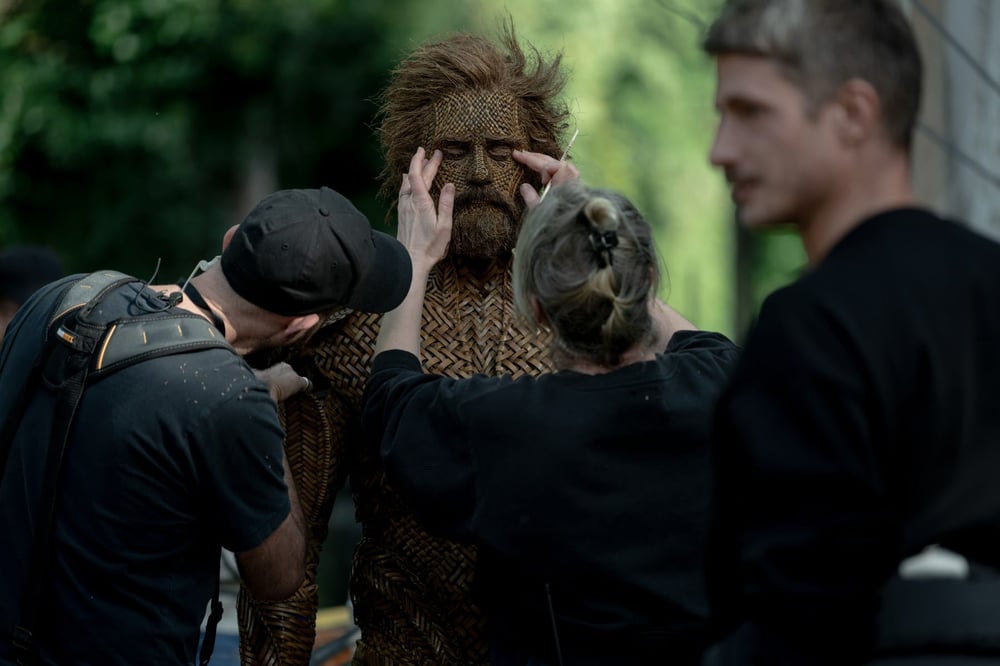
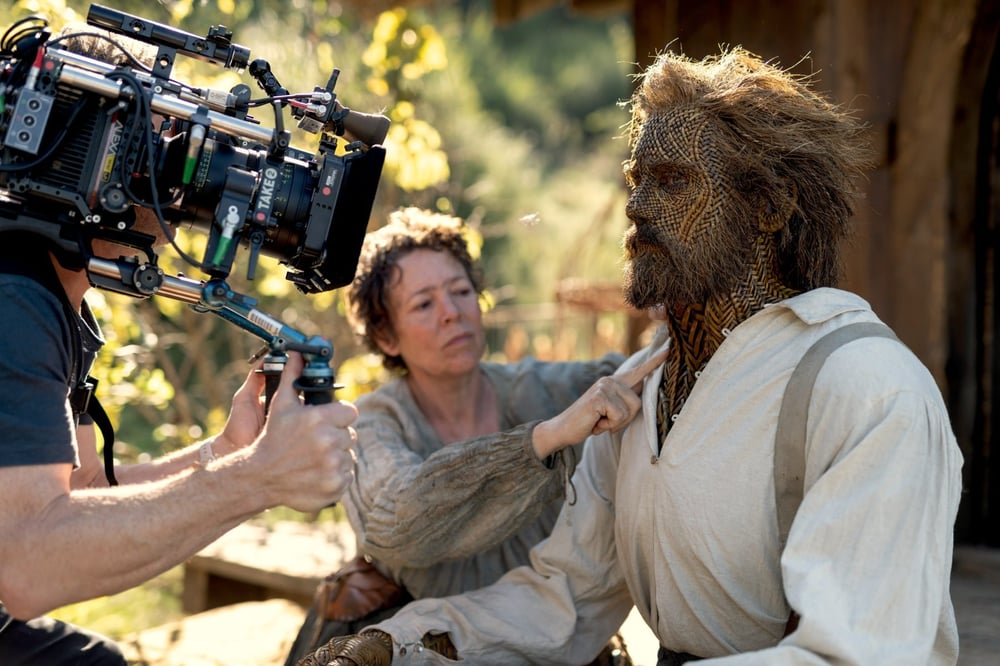
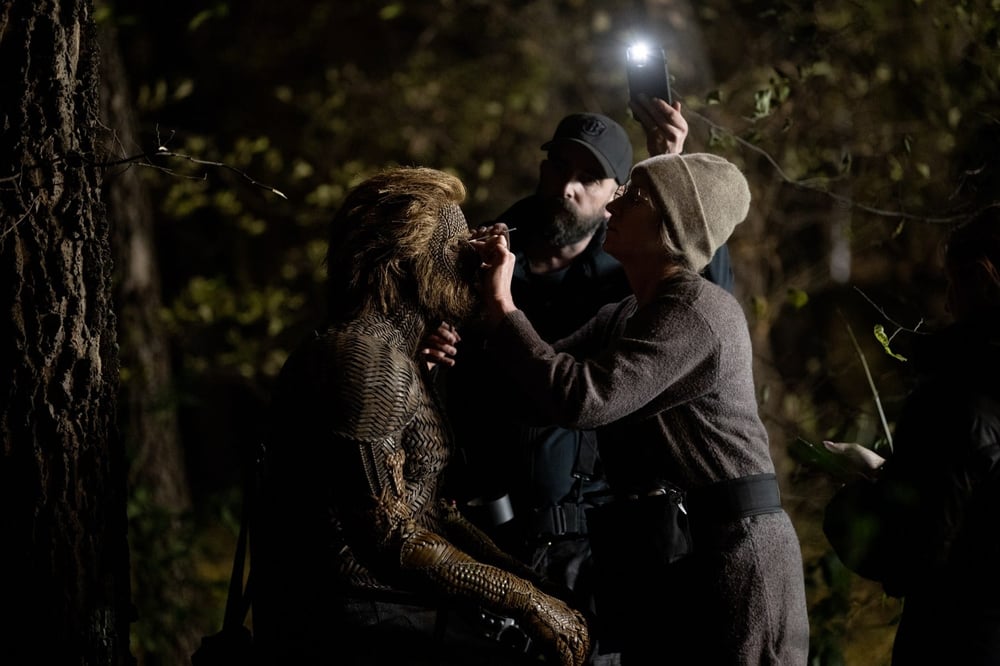
Alexander Skarsgård receiving makeup adjustments on Wicker. Courtesy of Black Bear Pictures, via IndieWire.
Wicker turns a woman’s request for a woven husband into a practical filmmaking challenge. Eleanor Wilson and Alex Huston Fischer adapted the fable, Wētā Workshop developed an expressive suit, and the cast, camera, editing and sound teams made the impossible character feel present.
The central question behind Wicker was wonderfully concrete. What would happen if the romantic lead really looked like a basket, and Olivia Colman had to fall in love with him?
Colman plays a fisherwoman who asks a basketmaker, played by Peter Dinklage, to make her a husband. Alexander Skarsgård becomes the extraordinary result. The film’s fantasy depended on something the actors could touch, the camera could approach and the audience could read emotionally.
That meant far more than designing a striking costume. The production had to find a shared language for a whole village, then carry its strange romance through the shoot and the edit.
A short story with room to grow
Wicker began with Ursula Wills’ short story The Wicker Husband. In Deadline’s Sundance conversation, Wilson and Fischer explain the immediate attraction: they wanted to see that woven face in close view. The premise already offered a visual reason to become a film.
Their AwardsWatch interview describes envy as the starting point. Writing about marriage brought questions of power and freedom into the story. The Fisherwoman’s ability to accept love became an increasingly important thread.
They retained the fable’s habit of identifying people through their roles rather than personal names. That choice helped the dialogue belong to a world slightly removed from ours, while leaving the relationships recognisable.
At a cast and filmmaker Q&A, the directors recalled writing the first draft in about two weeks during quarantine. Revisions took at least another year. The quick arrival of the premise was the beginning of the writing process.
Colman was the first actor to agree to the film. By the time Skarsgård was approached, her involvement and Wētā’s participation gave him both an acting partner and a team capable of realising the character.
Eighteen months to make a face move
The Wicker Husband needed a woven surface that could bend without hiding the performer underneath. In their CBR interview, Wilson and Fischer describe 18 months between the first Wētā conversations and filming. Tiny changes mattered: one version of the weave made the character look unexpectedly old and gaunt.
Prosthetic designer Joe Dunckley explains the development loop in IndieWire’s crew interviews. Concept drawings led to physical samples by head weaver Jasmin Van Lith. Those samples informed revised artwork, digital models, printed tests and makeup trials.
The result used 50 printed body pieces attached to fine spandex or mesh. Makeup effects artist Sarah Rubano describes a hood that moved with Skarsgård’s neck, followed by separate facial pieces. The hair, beard and eyelashes used muka, a New Zealand flax fibre.
In The Set Set’s account, Rubano recalls turning the forehead piece on the bias. Suddenly it allowed a much greater range of movement. The detail captures the problem neatly: a convincing texture was useless if it stopped the actor expressing anything.
Skarsgård performed inside the suit and facial appliances. Digital work helped light appear through the weave of his forearms and removed small traces of exposed skin around the eyes. The character was a physical performance with selective visual effects, not an entirely digital replacement.
The costume changed the performance
Skarsgård told Deadline that he had to exaggerate facial movements beneath the appliances. A quiet exchange with Colman could feel unusually large from inside the mask, even when the finished expression remained restrained.
Dunckley and Rubano were there every day to apply, remove and adjust the makeup. Dinklage learned basket weaving with a tutor, while Colman learned to gut fish and handle a coracle. The village’s occupations became things the performers could actually do.
The suit also suggested the rhythm of the character’s voice. In the longer cast Q&A, Skarsgård describes finding the physicality first and letting that inform the cadence. The filmmakers recall testing the character through a short William Carlos Williams poem shortly before shooting.
A village specific to itself
The directors wanted a comedy with the visual richness of a seventeenth century Dutch painting. They told AwardsWatch that production designer Renátó Cseh built the Fisherwoman’s hut and transformed an existing Hungarian backlot village, adding painted folk details to walls and furniture.
The costume design duo András + Attila drew on Hungarian folk clothing and several historical periods. The village did not need to match one real place or date.
The Set Set describes how the Husband’s borrowed wedding clothes were deliberately too small: abbreviated sleeves and trousers made the enormous new arrival look as though he had outgrown somebody else’s suit. Under clothing, padding could preserve his silhouette without applying every body appliance.
His surface also changed as the story progressed. Rubano and Dunckley prepared weathering, including bleaching and mould, for the appropriate scenes. Because the film was not shot in story order, that ageing had to be organised rather than left to happen.
Making room for the dance
The cast Q&A gives a useful glimpse of the shoot’s energy. Three cameras covered the dance, while the villagers performed an invented folk routine. Cinematographer Lol Crawley moved close to Colman and Skarsgård as they danced, making the camera part of the encounter.
Another scene found material in an irritation on location. Resetting fruit for the berry picking sequence attracted wasps. The filmmakers remembered the actors swatting them away, then building that unease into the scene’s sound.
The sound and the edit completed the illusion
Sound designer Andy Neal began work before the picture was locked. Wilson told Hammer to Nail that he experimented with baskets and crushed seaweed. His sounds let early viewers experience the Husband’s body as something with weight and texture.
They also changed with the character. Early rigidity softened as his relationship developed. This was part of the performance, not simply a collection of creaks added at the end.
Anna Meredith’s wedding dance music arrived during preparation, in time for choreography. Her wider score used recorders around the central couple and strings for the village. The directors wanted music that could stand forward and have its own personality.
Editor Sofi Marshall had previously worked with Wilson and Fischer on Save Yourselves! In her Post interview, she describes an entirely remote edit: filming in Budapest, herself in New York, the assistant editor and visual effects team in Australia, and the directors eventually back in Los Angeles.
Marshall says she cut during production and worked for about eight months, reaching picture lock in late spring 2025. One scene involving a poorly skilled doctor required months of experiments to balance comedy, tenderness and physical discomfort.
A quieter exchange between the couple presented a different challenge. Its basic shape came together quickly, but Marshall spent considerable time testing alternative performances. Having strong takes did not remove the need to decide which emotional turn belonged at each moment.
From the workshop to an audience
Wicker reached Sundance in January 2026, with the cast discussing the work together in Deadline’s festival studio. Its later Sitges presentation brought the fable to another festival audience before the autumn release.
By 19 November, Deadline reported that Black Bear’s release was approaching $40 million worldwide. That is box office revenue, not a statement of profit or money returned to the filmmakers.
The production’s most revealing achievement remains the connection between departments. A change in the weave affected an expression; an expression influenced a voice; sound suggested the same body becoming less rigid. Each part helped the next one feel believable.
For another approach to practical creatures, read how Pan’s Labyrinth was made. Our account of Superbad’s writing and casting follows a different route from a comic script to performances that work together.
When you are ready to present your own film on your website, Vidreno Hosting lets you host and embed your work. Start with a free account.