Ken Russell’s 1971 film grew from a book and a play into an extraordinary collaboration between performers, designers, cinematographer David Watkin and editor Michael Bradsell. Its new restoration makes that work easier to see, while leaving some gaps in the film’s history.
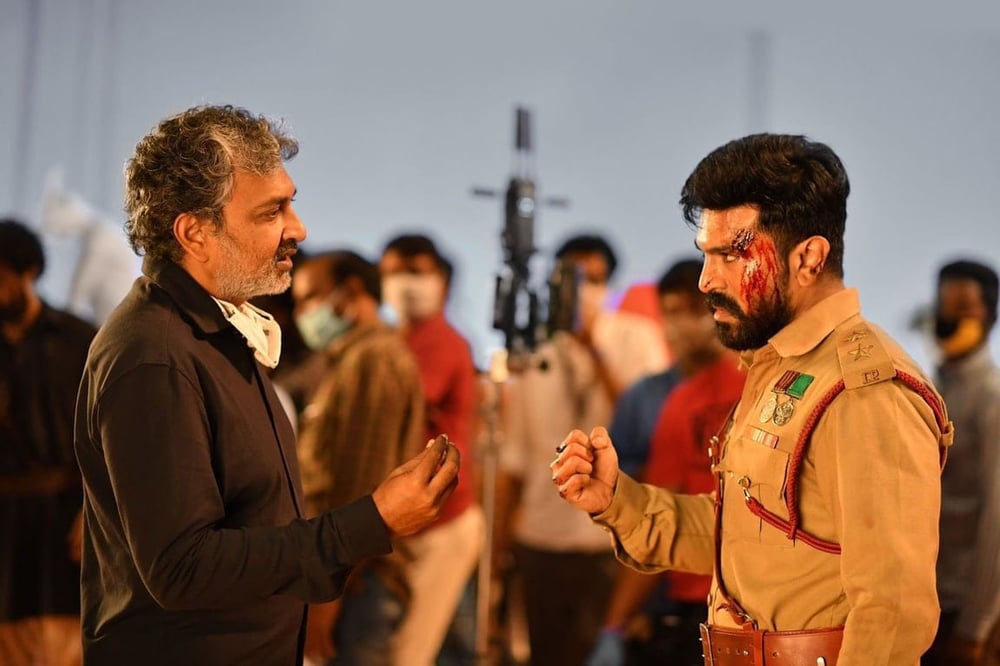
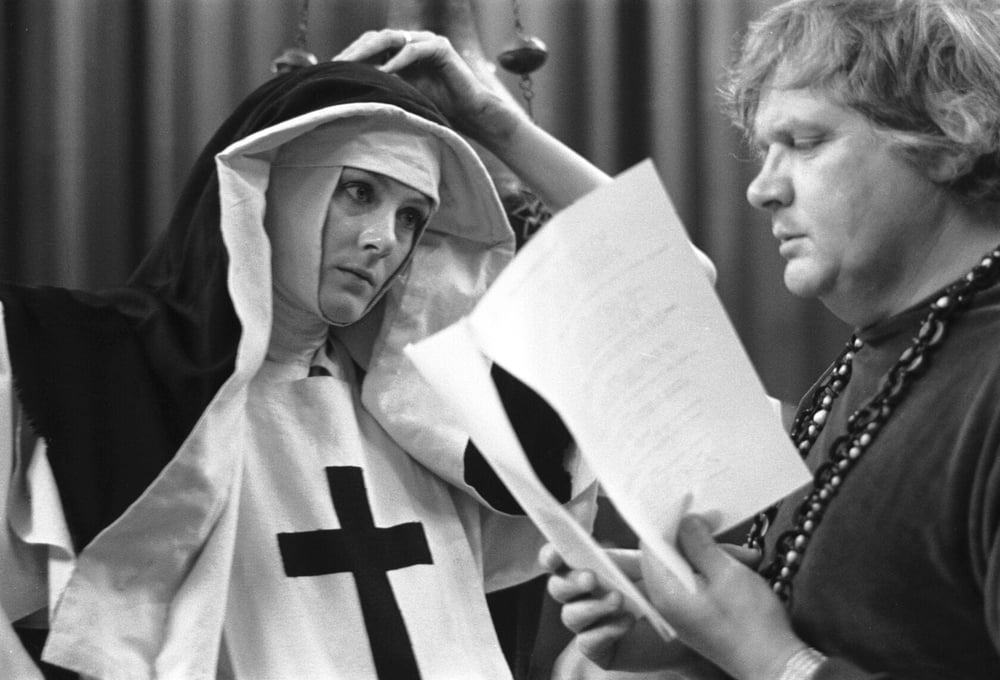
Cover image: Ken Russell working with a performer in costume on The Devils. Production photograph published by Dundee Contemporary Arts; photographer not identified.
The white walls of Loudun look almost too clean for the events unfolding inside them. That disquieting contrast was a deliberate choice. In The Devils, a historical city becomes a place where political power, religious spectacle and private desire press against one another.
Ken Russell’s film is often introduced through its censorship battles. Yet its production story also contains a rejected screenplay, a young designer’s first feature, costumes that explain authority and a cinematographer trying to make sunlight feel overwhelming.
The 2026 restoration offers a reason to return to those decisions. So does the BFI’s newly published study of Shirley Russell’s costume drawings, which brings the practical work behind the finished images back into view.
From Huxley and Whiting to a screenplay Warner would finance
Russell drew on Aldous Huxley’s The Devils of Loudun and John Whiting’s stage play. At the centre is Urbain Grandier, the priest played by Oliver Reed, whose position in Loudun becomes entangled with allegations of demonic possession. Vanessa Redgrave’s Sister Jeanne is central to those accusations.
In his 1995 interview with Mark Kermode, Russell described the story as political: the struggle over Loudun’s defensive walls concerned the state’s ability to impose its will.
Russell recalled that United Artists initially accepted his proposed next project, then refused it after reading the screenplay. Warner Bros. took it on.
An earlier interview reveals another adaptation problem. Speaking in 1973, Russell argued that disturbing events on a page pass through a reader’s imagination, while filmed images confront the audience more immediately. Translating Huxley into cinema meant negotiating that difference in intensity.
In the same conversation he names German Expressionism, Fritz Lang and Jean Vigo among his influences. His interest in fantasy was connected to expressing emotion. That helps explain why a plausible historical setting did not have to look like a conventional costume drama.
Derek Jarman built a city that felt new
Production designer Derek Jarman came to the film from theatre. In Dundee Contemporary Arts’ interview with Jarman scholar Brian Hoyle, the design emerges as a rejection of the familiar studio picture of a crumbling past.
At Pinewood, Jarman turned towards stark white surfaces. Hoyle connects the tiled appearance to an image in Huxley’s book and identifies Metropolis as another influence. The result makes the buildings feel organised, imposing and strangely contemporary.
Russell’s own explanation was straightforward: Loudun was a modern city to the people living there. The design asks us to enter their present, rather than admire the weathering that later centuries might leave behind.
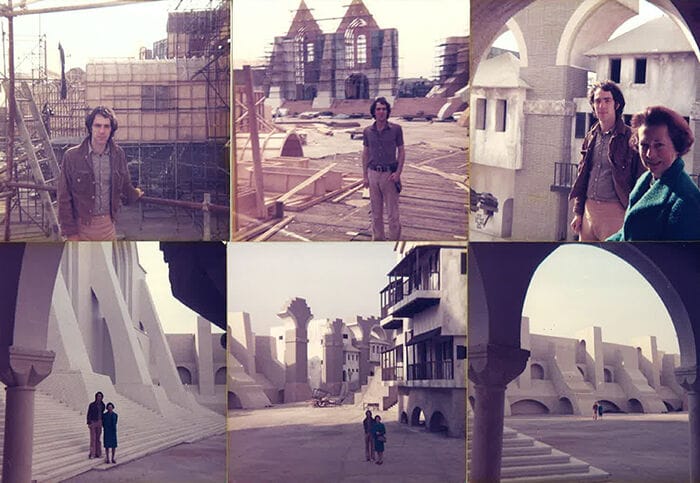
The construction photographs are especially useful beside the finished film: they show the monumental spaces as places a crew had to build and navigate. Jarman later directed his own features. Our story of how Sebastiane was made follows that next stage, with a very different production scale.
Shirley Russell made power wearable
The BFI’s archive study shows how Shirley Russell’s costumes differentiated forms of authority. Louis XIII’s elaborate black and gold clothing uses solar imagery, associating the ruler with a grand conception of his power.
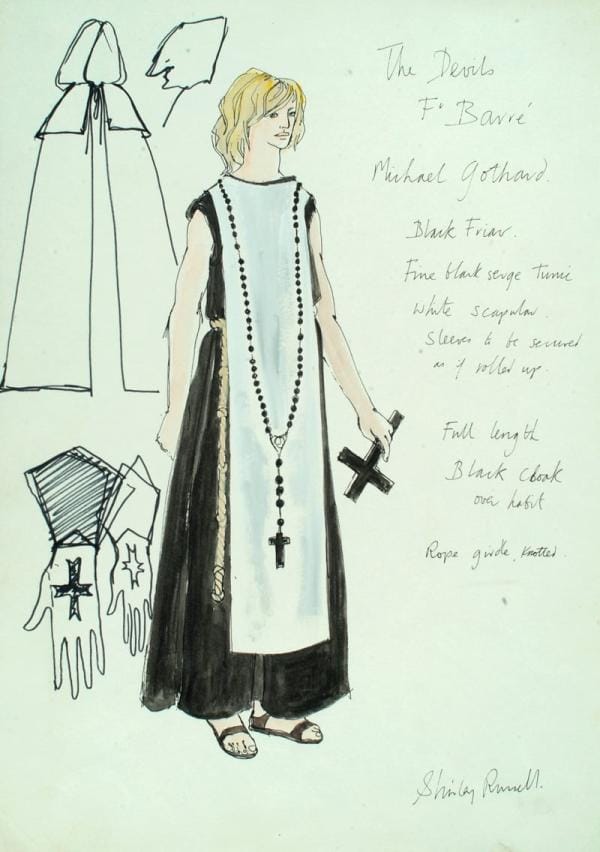
Father Barre, played by Michael Gothard, has a different kind of presence. His rolled sleeves, rosary, glasses and conspicuous gloves suggest someone prepared to put on a performance of religious certainty.
The surviving drawings were working documents. Notes specify materials and colours; small additional views explain accessories. Look at the separate glove sketches below. They turn an expressive character idea into something another craftsperson can actually make.
Lighting the space and trusting the performers
David Watkin’s 1994 oral history interview contains a wonderful account of the cathedral set. Ordinary lamps were failing to give him the force he wanted. Remembering an earlier production, he proposed using a searchlight to create a much more concentrated shaft of light.
He tested the idea before committing to it. The dramatic purpose was simple: Redgrave could move from the surrounding space into a beam with an exceptional intensity. The lighting made a change of position feel like an event.
At the 2026 New York Film Festival, Kermode recalled Russell’s admiration for Reed’s understanding of the camera. He also described the director’s confidence in Redgrave’s extraordinary range. Those recollections offer a useful counterweight to the film’s reputation for excess: the central performances depended on actors who understood how small decisions would register.
Notice how the white architecture contains the crowds, how costume accessories announce authority, and how performers move into sharply different light. These departments are telling the story together.
Music, editing and the struggle over the finished film
The production credits name Peter Maxwell Davies as composer and Michael Bradsell as editor. Davies’ contribution is another part of the film’s unsettled world. Alexander Kolassa’s research into the music examines its meeting of modernist composition and ideas of the medieval past, including the involvement of David Munrow’s Early Music Consort and the Fires of London.
Editing became a battle over meaning as well as duration. In the Lincoln Center conversation, Kermode explains that a notorious sequence originally alternated collective sacrilege with Grandier receiving a sacrament. Removing one side of that construction changed the relationship between the images.
The BBFC’s case history records a rough cut screening in January 1971 and successive changes before an X certificate in May. Warner also required cuts. Further alterations produced the American R version, which later complicated the film’s video history.
The film did reach British cinemas in 1971, but local bans and differing versions meant that its release was never a single, stable event. Following the cuts is part of following the production.
What the 2026 restoration brings back
The BFI’s restoration announcement traces the director’s cut to work supervised by Russell and Bradsell in 2004, with Kermode and Paul Joyce. The new 4K restoration uses the original camera negative, with picture work at Warner Bros.’ Water Tower Color and audio restoration from original magnetic material.
Colourist Andrea Leigh Chlebak describes a less tidy task than simply copying an approved reference. In her Films in Review interview, she explains that no single ideal colour reference survived. An older video master, a faded print and original lobby cards each offered incomplete clues.
She also distinguishes publicity photographs from the film’s actual photography. A lobby card can suggest intent without proving precisely how a shot should look. Her aim was to preserve Watkin’s work through careful decisions about skin tones, contrast and shadow detail, keeping the restoration’s intervention unobtrusive.
The BBFC classified the 2026 director’s cut 18 without new cuts. It reinstates two sequences, but the BBFC says other material removed in 1971 is presumed lost. This is a major restoration, not proof that every original frame has been recovered.
The restored film returned to UK and Irish cinemas on 30 October 2026. The BFI has also announced a home release for 20 April 2027, including a collector’s edition presenting three versions. Those dates describe different stages of this renewed release, rather than a newly made film.
The collaborators behind the images
| Department | Key collaborator |
|---|---|
| Writing and direction | Ken Russell, adapting Huxley and Whiting |
| Production design | Derek Jarman |
| Costume design | Shirley Russell |
| Cinematography | David Watkin |
| Editing | Michael Bradsell |
| Music | Peter Maxwell Davies |
What survives across the versions is the strength of that collaboration. A city’s surfaces, a glove, an actor’s position in a shaft of light and the cut between two actions all carry ideas. Looking closely at those choices gives The Devils a richer production history than its reputation alone suggests.
For another film whose imagined world depended on close collaboration between departments, explore the making of Pan’s Labyrinth.
Making work of your own? Vidreno Hosting lets you present video on your website. Create a free account to start building your own showcase.