Before RRR’s animals could burst into a party, the people filming them needed to know where to look. The animals were digital. Their speed, the actors’ reactions and the camera movement still had to agree.
Visual effects supervisor V. Srinivas Mohan’s solution included LED strips that marked animal movement on the set. The practical aid captures something essential about this enormous film: the illusion depended on giving different departments a shared plan.
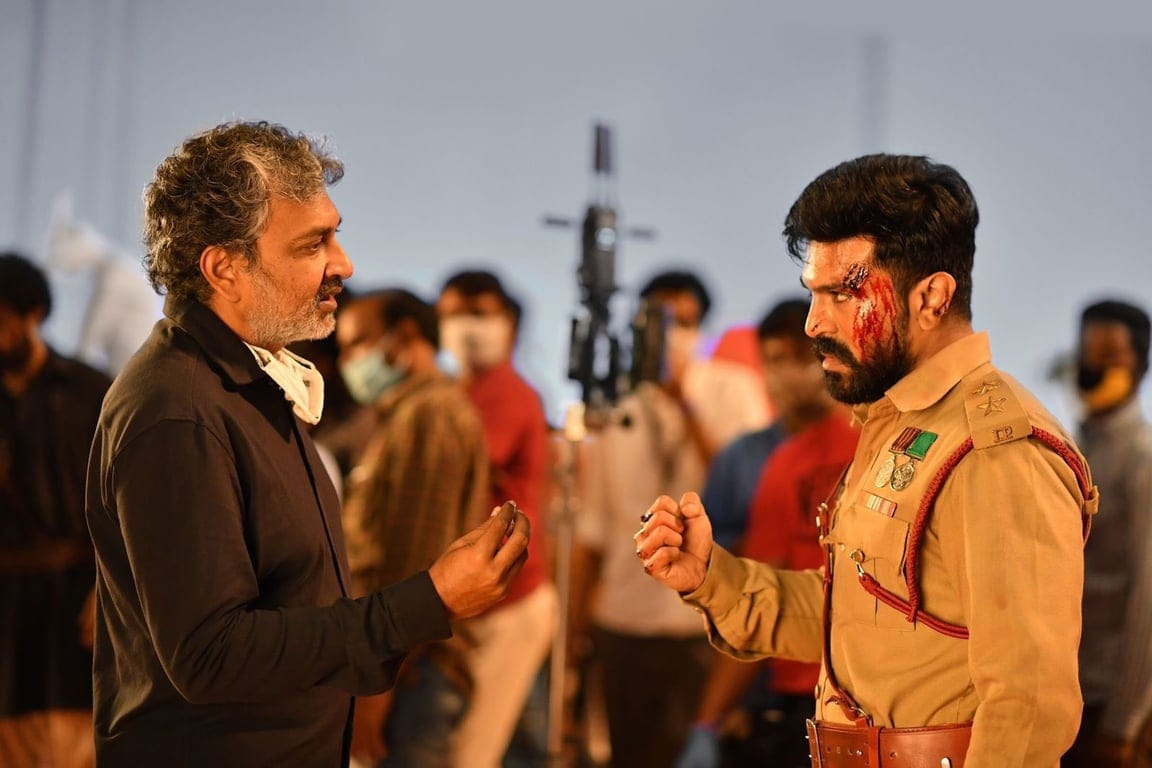
Cover: S. S. Rajamouli directing Ram Charan on the RRR set. Image: DVV Entertainment, published by Silverscreen India. Photographer not identified by the source.
A fictional meeting became the story
The starting point was a question about two real revolutionaries, Alluri Sitarama Raju and Komaram Bheem. What might have happened if their lives had crossed?
In a 2020 interview with story writer V. Vijayendra Prasad, he distinguished the historical figures from the invented encounter. As far as he knew, they had never met or fought together. Their imagined partnership gave the film its dramatic freedom.
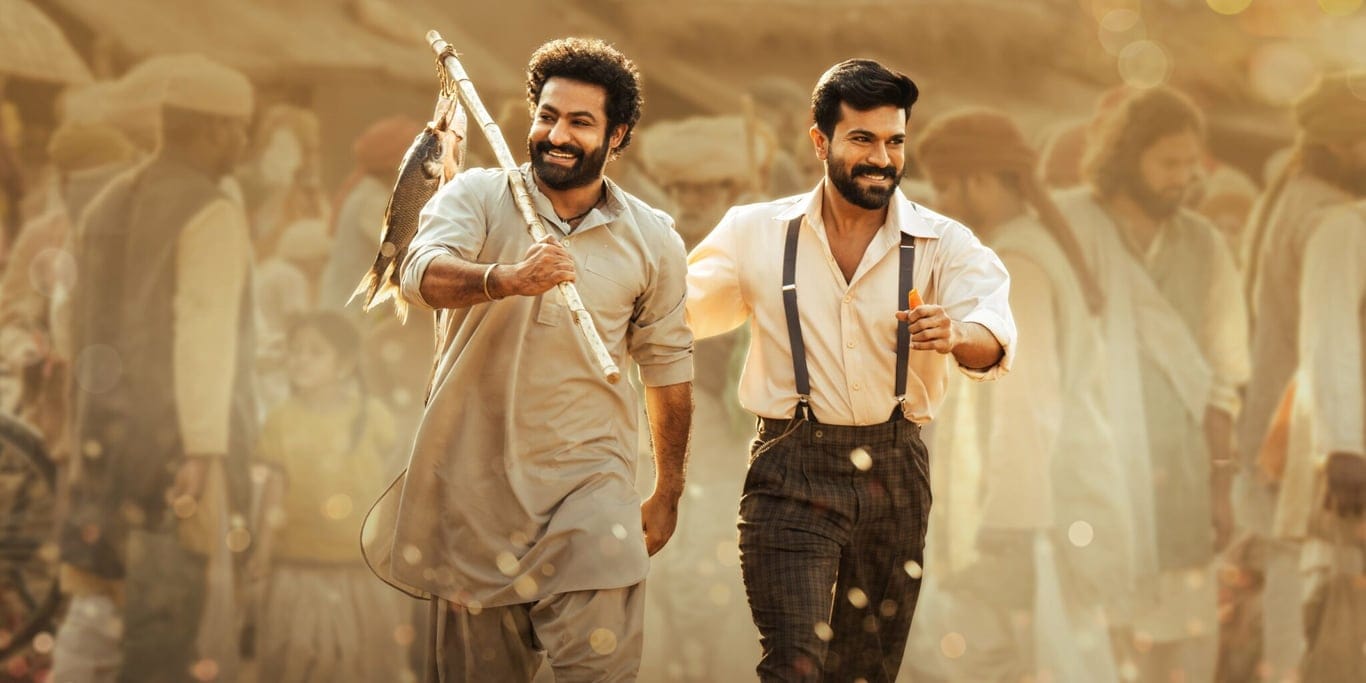
That distinction matters when watching RRR. The friendship is a fictional construction, rather than a record of the men’s lives. N. T. Rama Rao Jr. plays Bheem and Ram Charan plays Raju, with the audience drawn into their bond before understanding everything that separates them.
The film’s credits distinguish Vijayendra Prasad’s story, S. S. Rajamouli’s screenplay and Sai Madhav Burra’s Telugu dialogue. For the director’s wider path to this project, our Rajamouli career story follows the earlier films and partnerships.
Preparing a film with two leading men
Producer D. V. V. Danayya made RRR under DVV Entertainment. Distributor Lyca’s credits also identify cinematographer K. K. Senthil Kumar, composer M. M. Keeravani and editor A. Sreekar Prasad, whose jobs had to connect across a complex production.
Prasad told Silverscreen India that Rajamouli approached him in 2018. The story’s scale initially made him nervous, but the narration drew him in. Shooting began that November.
The editor’s account explains the balance between the stars. Bheem occupies more of the foreground early on, while the later revelation of Raju’s past changes the emphasis. Equal importance did not require identical treatment in every scene.
Building the action before the cameras rolled
Mohan described the preparation to Animation Xpress. For the bridge rescue, the team developed the action in three dimensions before filming, including the child’s fall and the train explosion. Camera positions could then be agreed in advance.
The finished rescue joins real material with an extensively constructed environment. In his New Indian Express interview, Mohan explained that there was no complete bridge on location. Partial pillars and a slab provided physical elements and shadows; the surrounding city, water and bridge were built digitally.
The animal sequence presented a different problem. A camera operator guessing the speed of an absent tiger could make the eventual creature feel sluggish. The team therefore worked out the animals’ movement before photography. An Ncam setup combined the live camera view with animation so the cinematographer could see the intended action on a monitor.
LED strips provided another way to communicate movement. Mohan also described using radio controlled cars as stand ins. These were tools for timing and interaction, not the creatures the audience would eventually see.
Naatu Naatu made conflict into choreography
In his Vanity Fair scene breakdown, Rajamouli describes the dance as a confrontation the characters cannot resolve with punches without exposing themselves. Choreographer Prem Rakshith needed movement that suited both actors and could also be copied by audiences.
Monsoon conditions prompted the search beyond India that led to Kyiv’s presidential palace. Costume designer Rama Rajamouli supplied clothes for the scene; Rakshith saw the braces and worked them into the choreography. A costume detail became part of the performance.
Editing while the film was still being made
Prasad received footage in Chennai and cut it away from the location. He told Silverscreen that this distance helped him judge what the audience would see without being influenced by the effort a shot had cost. Between schedules, he worked with Rajamouli in Hyderabad.
Agreed sequences went to the effects team. The animal action required editing and animation to develop together, using the planned timing of creatures that were not yet in the photographed material.
The pandemic extended the process. Mohan told Animation Xpress that remote reviews became part of the work, with important decisions still requiring the editing team. Photography, effects and post production were interdependent stages rather than separate boxes to finish in order.
From delayed release to an international audience
After pandemic delays, RRR reached cinemas on 25 March 2022. Prasad’s contemporary interview describes the relief of finally releasing a film designed for a large screen when audiences could return.
The actors later told The Associated Press about discovering the Western response through screenings and audience reactions. Ram Charan described that recognition as gradual. Their account preserves the human scale of a success that can otherwise look inevitable in hindsight.
In 2023, Naatu Naatu won the Academy Award for Original Song, recognising Keeravani’s music and Chandrabose’s lyrics. The song’s journey also offers a companion to our story of how Golden was made for KPop Demon Hunters.
RRR’s production is useful to filmmakers because its problems are recognisable even when its resources are not. The story has to hold the spectacle together. Performers need something concrete to react to. Editors need room to judge the result, and effects artists need decisions early enough to build on them.
If you are preparing your own film for an audience, explore Vidreno and start with a free account.