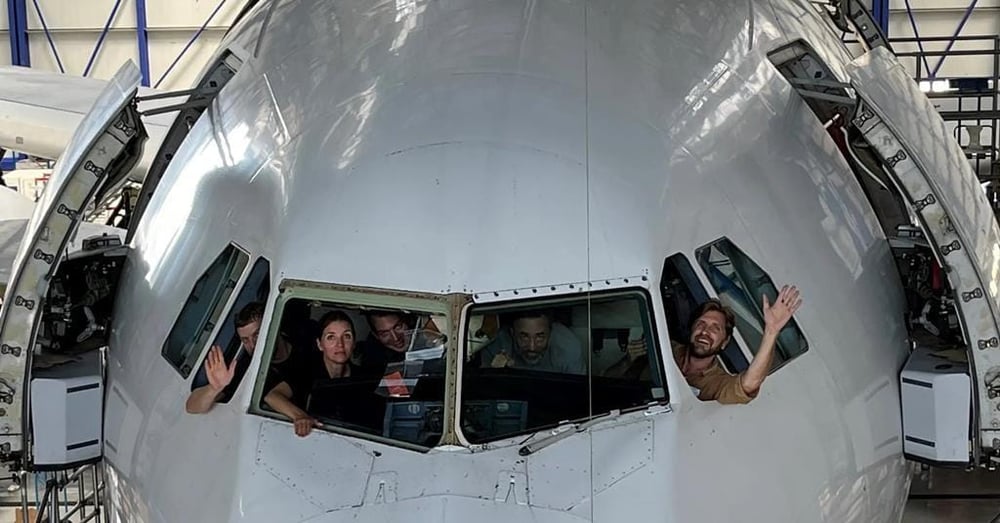
Ruben Östlund and collaborators with an aircraft in a production publicity photograph. Photo: Toni Pons, published by SF Studios; image supplied through Film i Väst and Screen.
The Entertainment System Is Down turns a failed aircraft entertainment system into a social experiment. A real airliner, a crowded cabin and patient performances make that simple premise a demanding film to produce. Here is how the project has taken shape so far.
A contained story does not necessarily mean a small production. Ruben Östlund’s The Entertainment System Is Down confines its passengers to an aircraft, then takes away the screens that help them ignore one another. Making that confinement convincing has required much more than a few rows of seats.
The project brings together the director’s established creative team, an international cast and a financing structure designed to keep an ambitious film independent. Its most revealing production choice is physical: the filmmakers bought a retired airliner and rebuilt it in a studio.
Writing boredom into a dramatic situation
Östlund, credited as both screenwriter and director in the Swedish Film Institute’s production catalogue, starts with a rule that can generate many scenes. In his Film i Väst interview, he describes a flight from London to Sydney where the entertainment system fails. As other devices lose power, the passengers must confront their own restlessness and the people beside them.
He approaches the premise as a study of behaviour, moving between the individual, a couple and the larger group. The distance of the observer allows ordinary embarrassment to become comedy.
One proposed sequence makes the audience share the discomfort. Two daughters have one working iPad. Their father tells them to take turns, and the film stays with the waiting child in real time. In that interview, Östlund describes a ten minute wait and the possibility of restarting the clock whenever she complains.
The writing question is also an editing question: how long can a viewer tolerate a shot after expecting it to end? He is describing an intention for the film, rather than confirming the running time of a finished scene.
Casting the scene before shooting it
At the press conference recorded by MovieZine, Östlund explains a marital crisis triggered when a wife unlocks her sleeping husband’s phone. Kirsten Dunst says she filmed an improvisation of that situation herself after a Zoom conversation with him.
That is a useful glimpse of development becoming performance. A premise on the page becomes a sequence of choices: noticing the phone, attempting access, responding to what appears. The audition tests how an actor can carry the situation before a studio full of people is involved.
Östlund says the confined setting places particular weight on faces and presence. The film cannot continually refresh itself by cutting to a new environment. Dunst and Daniel Brühl’s performances must give the audience a reason to remain inside it.
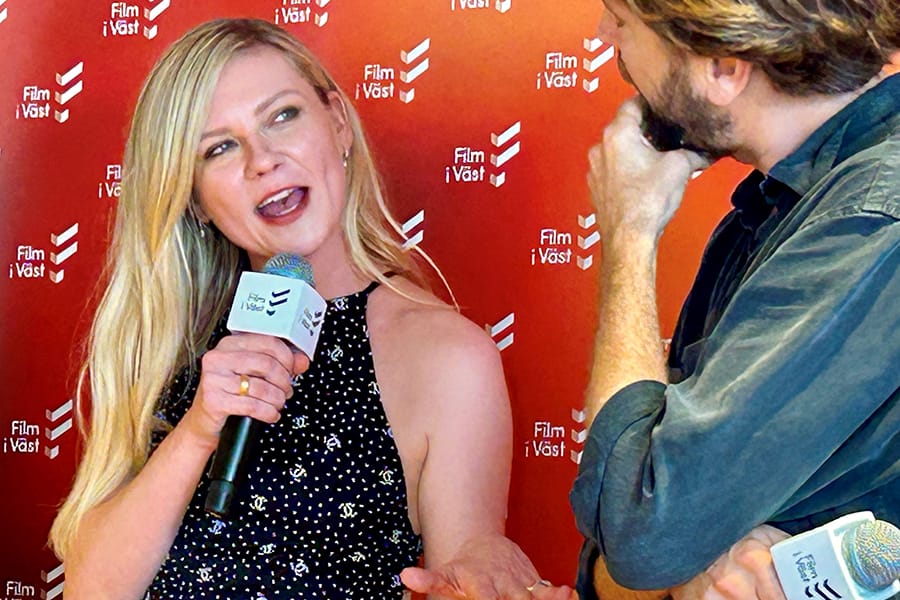
Why buy and rebuild an aircraft?
In the same press conference, Östlund explains that the complete cabin would put the couple among other passengers and permit extended movement through the space. A private argument becomes more awkward when strangers are close enough to overhear.
The set therefore serves the story’s social pressure as well as the camera. The audience needs to feel the surrounding crowd, rather than imagine it beyond a carefully framed corner.
The production also retained established collaborators. Film i Väst’s production record identifies cinematographer Fredrik Wenzel, production designer Josefin Åsberg and first assistant director Rikard Waxin, alongside producers Erik Hemmendorff and Philippe Bober.
These roles meet inside the same problem. Design makes the cabin usable; photography finds a position for the camera; the assistant directing team coordinates the people who make the aircraft feel occupied. A single location can concentrate those demands rather than remove them.
In the press conference from 8:22, listen to why Östlund wants the whole cabin. The aim is to place intimate conversations inside a crowd and give the camera room to travel through it.
The crowded cabin became a continuity problem
SF Studios announced the start of filming on 28 January 2025, with a planned 70 shooting days in Budapest through May. Its announcement describes a Swedish, German and French coproduction, with Nordic distribution through SF Studios.
By June, Östlund was discussing the completed shoot with Screen at Slano Film Days. He described roughly 70 shooting days and 150 extras whose seating positions had to remain consistent. Background performers could be visible for substantial stretches even without dialogue.
He also described a programmable mechanical camera arm, operated through a PlayStation controller, which could reach into spaces too narrow for an operator and camera together. Wenzel worked with him on programming it.
This is equipment solving a specific staging problem. The cabin’s restrictions shaped how the crew could reach a performance without abandoning the space around it.
At that point, Östlund was editing on a laptop while staying on the Croatian island of Lopud. The large physical production had become a quieter task of deciding what the audience would see and how long it would stay with it.
Financing time as well as a set
In Geoffrey Macnab’s Screen interview of 17 November 2026, Bober says a production loan from Cofiloisirs, supported by an IFCIC guarantee, helped make the film possible while preserving Östlund’s creative freedom. The company still has to repay the loan.
Screen reports a budget close to $30 million from Swedish press coverage; Bober does not confirm that figure. The reported credit line above €10 million is also an estimate, not a published loan agreement. A24 holds US distribution rights.
Bober says the financing flexibility allowed an additional year after the anticipated Cannes 2026 launch moved to a Cannes 2027 target. That remains an aim, not a confirmed festival selection.
A financing arrangement affects how much time a director can spend shooting and editing. In this case, retaining creative control also means carrying responsibility for the money borrowed to finish the film.
A film still taking its final shape
The British Council’s current project record lists The Entertainment System Is Down in post production, with 2027 as its year. It is too early to judge how all these choices work in the finished film.
What is already clear is the relationship between the premise and the labour behind it. The story removes distractions from its passengers. The production must then make their faces, neighbouring seats, pauses and small movements compelling enough to sustain attention.
For another example of a set shaping an entire production, read how Derek Jarman’s designs helped build The Devils. For a different stage of collaboration, our Wildwood score story follows musical sketches through to orchestral recording.
When you are ready to present your own filmmaking, Vidreno Hosting lets you put videos on your website. Start with a free account.