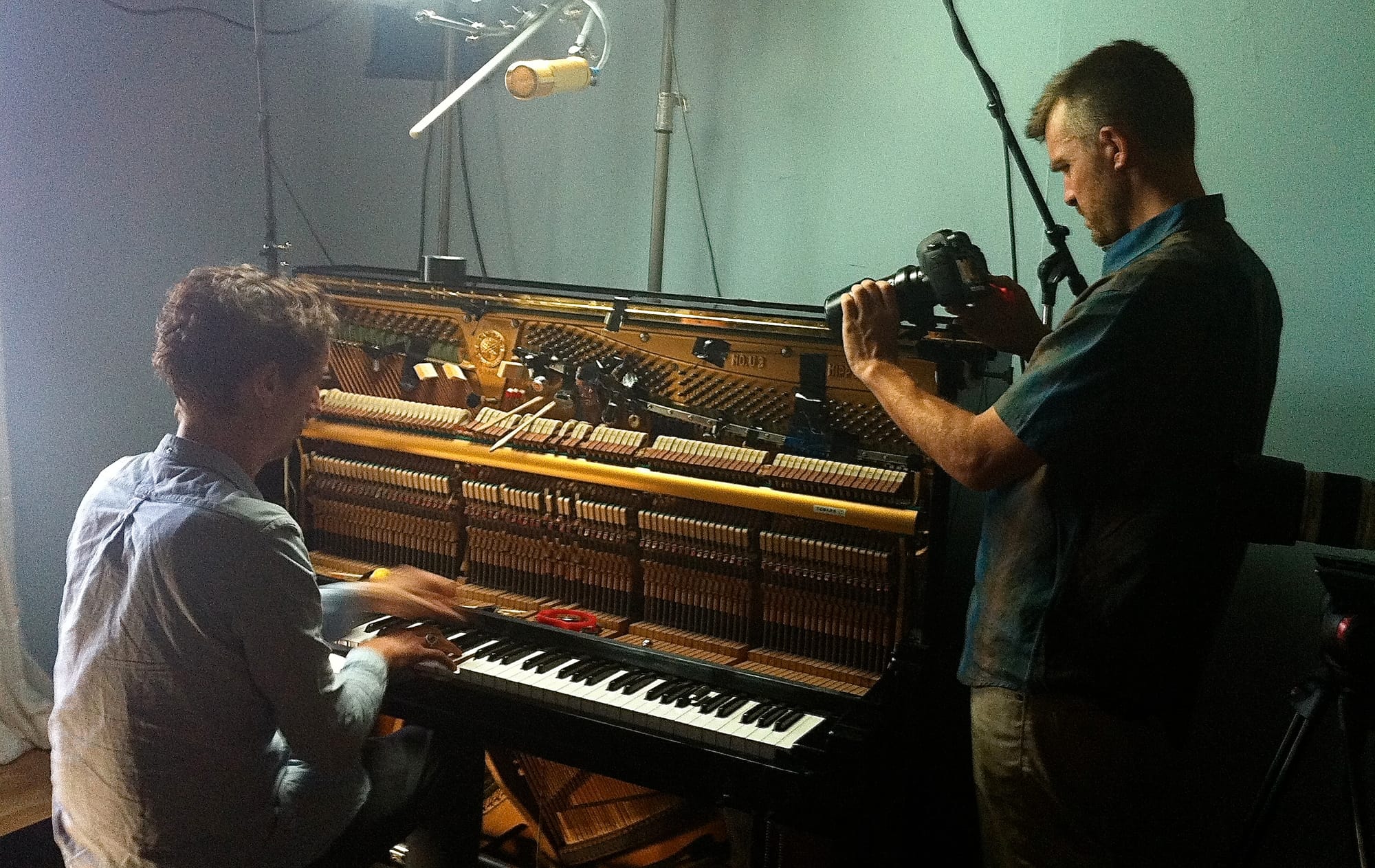
Cover: Hauschka at the piano with director Greg Hunt during the Room 205 production in 2012. Photo: Incase, via Wikimedia Commons, CC BY 2.0. Unmodified.
Garth Davis had to wait while Volker Bertelmann finished selling records. The director had come to a Hauschka concert in Melbourne, but there was still a queue at the merchandise table.
When they finally met in a pub, Davis showed him an image of India and explained the film he was making. Bertelmann recalls realising that this was something rather larger than the student projects he was sometimes approached about.
The film was Lion. The encounter was a major break, but the musician standing behind that table had already spent decades finding his sound.
Church music, bands and an uncertain route
Born in Kreuztal in 1966 and raised in Ferndorf, Bertelmann encountered music early. In his Score: The Podcast interview, he remembers hearing Chopin played in church and asking for lessons. A relative lent the family a piano.
Classical lessons did not lead neatly to a classical career. He played in bands, moved to Cologne and tried studying medicine, then business administration. Music kept drawing him away.
Filmportal’s biography traces his next attempt through God’s Favourite Dog, a hip hop group formed with his cousin. They toured and supported Die Fantastischen Vier, but the record deal ended and the group broke up.
It is an important part of his story because the first version of success did not last. The work that eventually made him recognisable grew out of another approach.
Becoming Hauschka
In Düsseldorf, Bertelmann returned to the piano and began releasing music as Hauschka. Substantial arrived in 2004, followed by The Prepared Piano in 2005.
A prepared piano is a piano whose sound has been altered with objects placed on or among its working parts. Bertelmann’s materials have included felt, foil, rubber and other ordinary things. The familiar instrument becomes a source of rattles, pulses and unexpected textures.
His publisher’s account of his work describes that search expanding into orchestral writing. He was developing a way of listening, not simply a trick to repeat.
Collaborators helped widen that world
Violinist Hilary Hahn became an important musical partner. For Silfra, they recorded at Greenhouse Studios in Iceland, creating space to explore together. Bertelmann’s official site describes the collaboration alongside his work with ensembles and dance.
The Room 205 photograph above belongs to this period: a musician, a filmmaker, a microphone and an exposed piano mechanism. It shows the practical work behind sounds that can seem mysterious on a recording.
Lion was the breakthrough, and it was shared
Davis wanted Bertelmann to compose with Dustin O’Halloran. That could have complicated the invitation. Instead, it helped: they were already friends and knew each other’s work.
Their score for Lion brought an Academy Award nomination. It also helped turn Bertelmann’s concert career into a much larger screen career. His IMDb record confirms the joint credit and later collaborations including The Old Guard and Ammonite.
Other projects included Adrift and Patrick Melrose. Different films demanded different responses, but the willingness to explore an instrument’s character remained useful.
Edward Berger and the sound of All Quiet
Working with Edward Berger became another defining relationship. For All Quiet on the Western Front, the instrument at the centre of the score was a harmonium that had belonged to Bertelmann’s great grandmother.
In his interview with TheWrap, he explains how amplification, distortion and boosted bass transformed it. He also kept the mechanical sounds of the instrument, using microphones to bring its workings into the recording.
The result could feel enormous without depending on a continuously enormous orchestra. An old domestic instrument became something alarming.
Bertelmann won the 2023 Oscar for Original Score for the film. The award marked an arrival, but the underlying method connected directly to his years as Hauschka: listen closely to an object, then discover what else it can do.
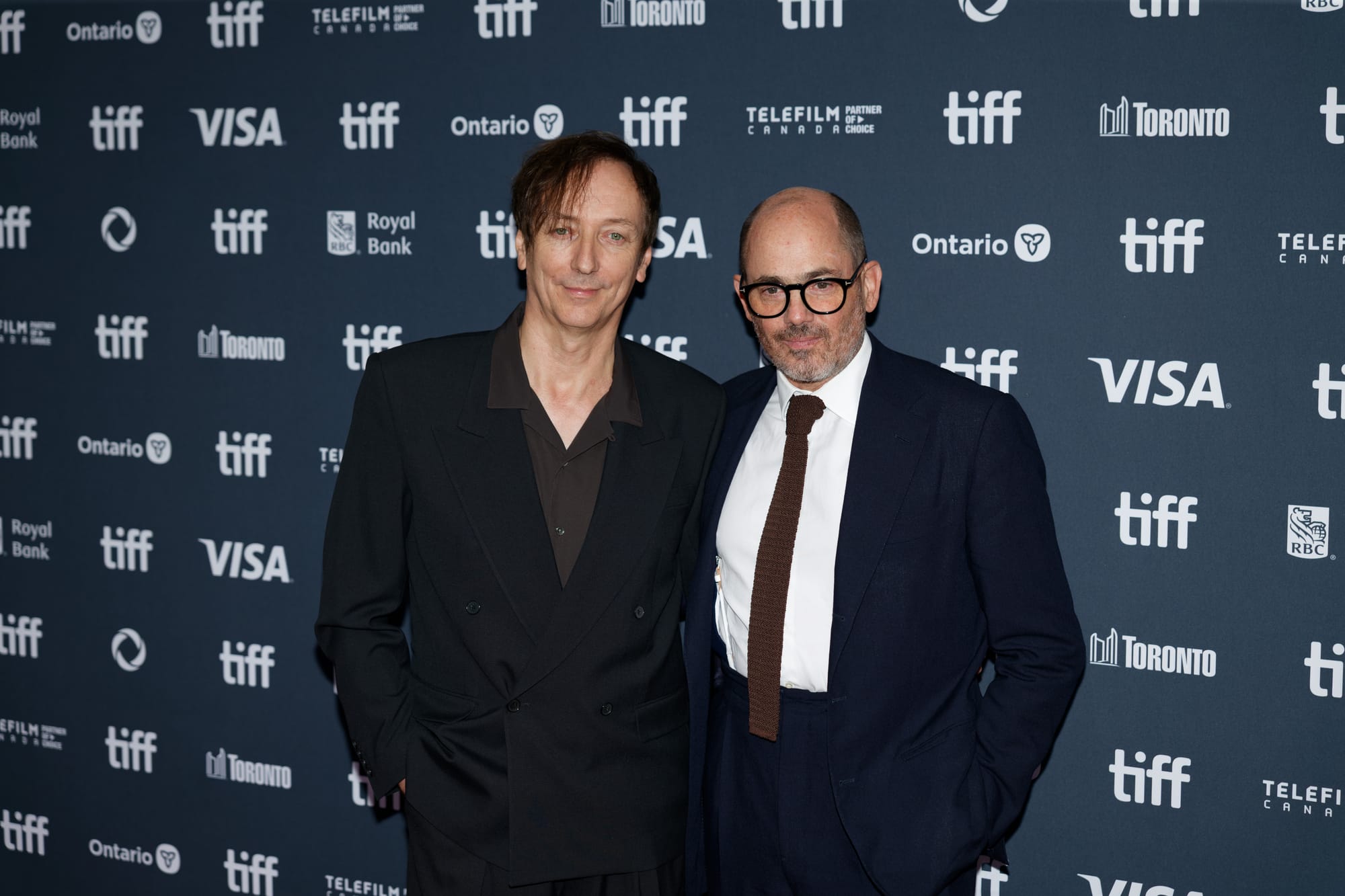
Conclave asked for another sound
For Conclave, the setting might have suggested an organ or a choir. Bertelmann wanted an ethereal quality without immediately placing the listener inside familiar church music.
In Dolby’s conversation, he describes finding the Cristal Baschet, an instrument played by rubbing glass rods with wet fingers. Its sound could move from delicate to strange, giving him something he could develop with Berger.
He sent music before it belonged to a specific edited scene. The early sketch became central to the finished score. That is a valuable detail in a long collaboration: a director and composer can recognise a useful direction before knowing exactly where every piece will sit.
Listen to the instrument choice: In Dolby’s Conclave conversation at 5:11, Bertelmann explains why he searched beyond familiar church sounds.
The story continues with Clayface
Bertelmann’s more recent work includes Clayface. WaterTower Music released its soundtrack on 16 October 2026, with his theme opening the album.
The film brings him together with James Watkins, another director interested in tension and unease. Read Watkins’s own route from writing to directing for the other side of that collaboration.
Bertelmann’s career makes more sense as a series of discoveries than as a sudden transformation at the Oscars. The bands, solo records, concerts and partnerships all gave him something to carry into the next film.
A few things worth taking from his journey
- Your own work can become the introduction. The Hauschka concert gave Davis something specific to respond to.
- A breakthrough can be collaborative. Lion grew through a partnership with O’Halloran.
- Explore the sound before settling into habit. The harmonium and Cristal Baschet each changed what a score could express.
- Keep a creative life outside the commission. The solo work helped form the musician the films needed.
Explore more through Bertelmann’s official website, IMDb credits, official Instagram and Hauschka YouTube channel.