When Rian Johnson told Steve Yedlin about Star Wars, the cinematographer was hearing more than news of a possible job. Johnson had already secured agreement to bring him and his editor. A friendship that began on a student film was heading into one of cinema’s largest productions.
He recalled that call in his Go Creative Show interview.
Short films, shared rooms and paid work
Born in Los Angeles County in 1975, Yedlin met Johnson when they were about 17 and 18. They were volunteering on a student production. They later became college roommates and made weekend shorts together.
After college, gaffer work paid the bills. Yedlin shot shorts and small features when opportunities arose. While Johnson spent years getting Brick financed, Yedlin accumulated experience that made hiring his friend easier for the producer to accept.
Brick made the partnership visible
Brick brought their work to Sundance in 2005, where it won a Special Grand Jury Prize. The teenage detective story became a defining early milestone for the pair. Its recognition matters alongside the less visible preparation: Yedlin arrived with experience beyond their homemade films.
His Maine Media biography records a range that grew well beyond Johnson’s projects. Tobe Hooper’s The Toolbox Murders, American Violet, Carrie, Danny Collins and San Andreas put his cinematography into horror, drama, comedy and large scale spectacle.
With Johnson, The Brothers Bloom and Looper widened the partnership before The Last Jedi. Their career together is not one visual formula applied to progressively larger budgets. A crime story, a con artist adventure and a science fiction film ask different things of the person behind the camera.
The science became part of his authorship
By the time the American Society of Cinematographers welcomed Yedlin in 2015, he had spent a decade developing methods for modelling photographic processes. He was also teaching at the American Film Institute.
His On Color Science essay explains the central idea: with sufficiently capable professional capture formats, much of the final look can be shaped by the mathematical preparation of an image for display. Choosing a camera and choosing an appearance are not the same decision.
That is a practical extension of cinematography, rather than a detour away from it. It gives Yedlin another set of decisions to make alongside framing, light and movement. The tools serve a chosen dramatic result.
Knives Out opened another long chapter
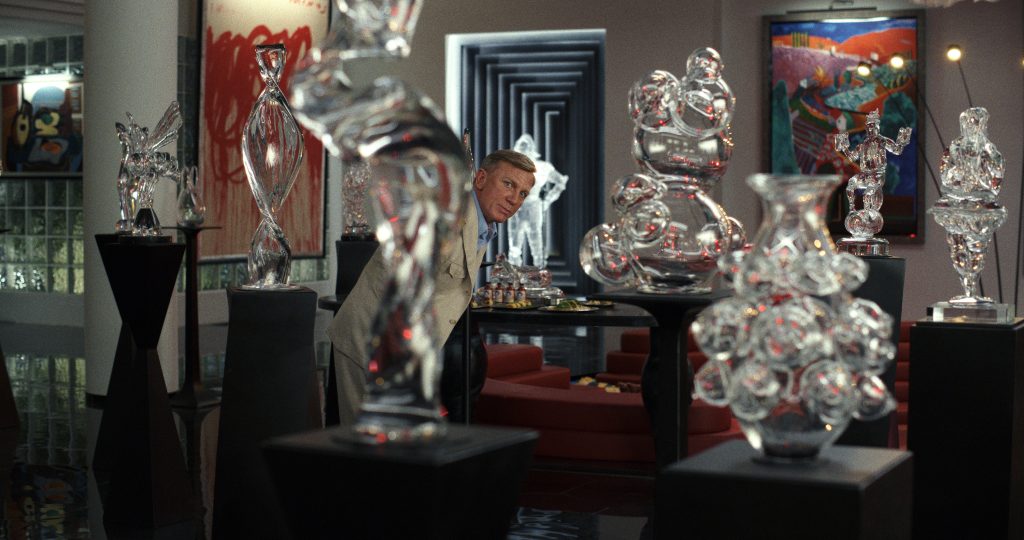
Knives Out brought Johnson and Yedlin into Benoit Blanc’s world in 2019. Glass Onion took that detective to bright Greek locations, followed by the darker church setting of Wake Up Dead Man. Yedlin’s credits also include Johnson’s television series Poker Face.
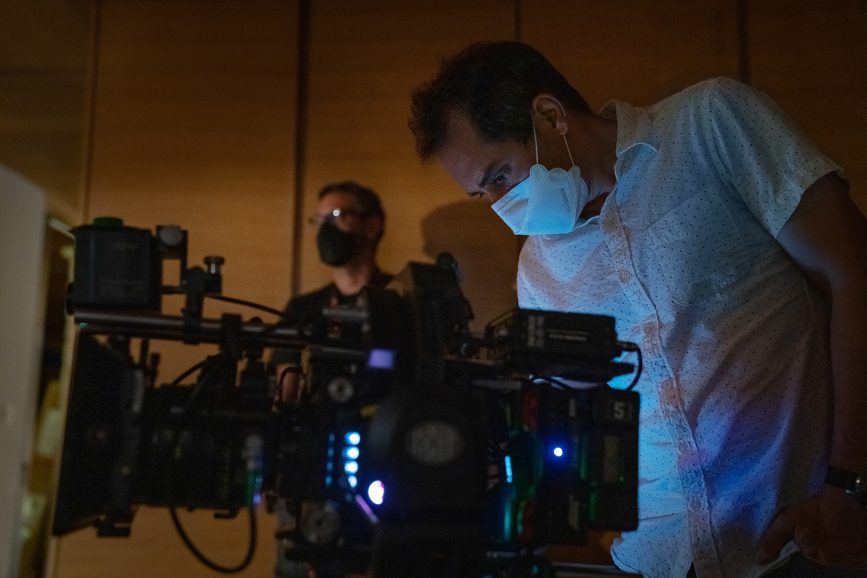
For Glass Onion, familiarity let the collaborators begin preparation with specific shots and practical problems. Yedlin described working with gaffer Carlos Baker and key grip Pat Daily on the sweeping lighthouse effects. He and Eric Cameron wrote control software, while Daily designed the physical mechanisms.
These are substantial collaborations in their own right. Colourist Philip Beckner helped refine the film’s balance and skin tones; second unit cinematographer Jaron Presant contributed to the production too. The finished image is the work of departments, even when a longstanding director and cinematographer partnership gives it continuity.
For Wake Up Dead Man, Yedlin told Filmmaker that the throughline was solving dramatic problems, not imposing artificial rules across the series. Large ensemble scenes needed to express relationships between people, rather than simply cutting from one face to another.
A new outlet for the same curiosity
Yedlin’s image research now also underpins Chromagraph, an iPhone photography app. Its official description says it starts with raw sensor data and uses his customised colour and texture processing. That carries part of his film practice into still photography; it does not make a phone photograph equivalent to a film production.
His current professional résumé also lists Beach Read with director Yulin Kuang and You Deserve Each Other with Abby Kohn and Marc Silverstein. The list establishes credits, not release dates.
The career’s strongest thread remains the combination of a durable creative partnership and work beyond it. The experiments, lighting jobs and films with other directors all belong to the story alongside the famous titles.
Explore the work
- Browse Yedlin’s official site for his films and image science demonstrations.
- Find his Instagram account, identified in The Cinematography Podcast’s interview notes.
- Read another route into cinematography in our Adolpho Veloso career story.
Working on your own films? You can create a free Vidreno account to start sharing your work.