Before Vin Diesel was driving impossible cars, he was trying to make a film he could afford. He had a feature script, a desire to act and no simple way to bring the two together.
The solution was smaller: a short about an actor struggling to fit the parts available to him. Multi-Facial became a calling card, but the career that followed was built through several different doors, and several very different collaborators.
A theatre door opened first
Diesel’s own account of his beginning is wonderfully specific. At seven, he went into a New York theatre with a group of children intending to cause trouble. A woman called Crystal caught them and offered something unexpected: return each afternoon, learn the lines and earn a small weekly wage.
In his 2016 conversation with Carol Moreira, he names the play as The Dinosaur Door. The encounter gave him a first job and a place to perform.
Acting also belonged to his family life. In a 2013 interview with Maria Menounos, he recalls his father coming home from plays in costume. The attraction was to an actor’s life long before there was a film star’s life to imagine.
He kept performing, but earning a living was another matter. By his account, he spent about a decade working as a bouncer in New York. Experience on stage did not automatically persuade casting directors to give him screen work.
Why he made Multi-Facial himself
The familiar version of the story begins with a short film. Diesel’s 2004 Blackfilm interview adds an important detail: he had already written the feature Strays.
He could not raise the money for that longer project. So he wrote something smaller that could show his acting, rather than leaving all his hopes inside an unmade screenplay.
Multi-Facial follows a performer whose background does not fit neatly into the categories being used to cast him. Diesel wrote, directed and acted in it. In Moreira’s interview, his list of jobs extends to cooking pasta for the production.
That last detail brings the scale into focus. Before he was negotiating large productions, he was helping feed the people making a short with him. The film reached Cannes in 1995 and put his work in front of people who had not been offering him roles.
Strays, Spielberg and the first Hollywood break
Strays eventually became a feature. Sundance’s account records its place at the 1997 festival, with Diesel writing, directing and starring in a story rooted in multicultural New York.
Then came the opportunity that changed the scale of his working life. Spielberg had seen Multi-Facial, and Diesel joined the cast of Saving Private Ryan as Private Caparzo. The 1998 film put him alongside Tom Hanks, Giovanni Ribisi, Barry Pepper and an ensemble working on a major war production.
Diesel later described Hanks as a mentor during that experience. The move was substantial: from trying to get his own material made to learning inside a Spielberg film.
The interview below catches him much closer to that moment. Bobbie Wygant spoke with Diesel, Ribisi and Pepper in July 1998, before the later franchises came to define his public image.
The voice, the outsider and the leading man
The next few years revealed different uses for the same performer. In The Iron Giant (1999), audiences heard Diesel as an enormous animated character capable of tenderness. In Pitch Black (2000), they saw him as Riddick, a dangerous outsider whose presence could carry a science fiction film.
Then The Fast and the Furious (2001) gave him Dominic Toretto. His pairing with Paul Walker, alongside Michelle Rodriguez and Jordana Brewster, became the foundation of a much longer screen story. xXx followed in 2002 with another action lead, Xander Cage.
These were different kinds of breakthrough. Spielberg had given Diesel a major Hollywood opportunity. Riddick, Dom and Xander showed that films could be built around him. His IMDb credits trace how quickly those roles arrived after the independent work.
Why Riddick mattered to him
Diesel’s partnership with filmmaker David Twohy became a recurring part of his career. Discussing The Chronicles of Riddick in 2004, he described their interests as complementary: Twohy’s science fiction instincts and his own enthusiasm for fantasy.
He wanted to expand a character into a world. Choosing that project over a second xXx film shows an actor already thinking beyond the next available action role. Riddick was something he wanted to keep developing with its creator.
The parts outside the action image
The muscular screen persona also gave other filmmakers something to play against. The Pacifier put Diesel into family comedy. Find Me Guilty, directed by Sidney Lumet and released in 2006, asked for a different sort of attention.
As Jackie DiNorscio, he worked alongside performers including Peter Dinklage, Ron Silver and Annabella Sciorra. In his RadioFree interview, Diesel described studying footage of DiNorscio before meeting him.
That meeting changed the task. Matching the man’s gestures was no longer enough; Diesel wanted to understand the feeling behind his decisions. It is a revealing account of preparation from an actor more often asked about physical spectacle.
The performance belongs in his story because a filmography of cars and franchises leaves out the work between them. Lumet’s courtroom film gave him space to be talkative, vulnerable and comic within a very different ensemble.
Returning to Fast as a producer
Diesel’s later relationship with Fast involved more than playing Dom again. In the Moreira interview, he recalls initially resisting a sequel and later returning with an interest in producing and shaping the material.
Justin Lin became a key collaborator during that expansion. Fast & Furious (2009) brought Diesel and Walker back together, while Fast Five (2011) pushed the series into a Rio heist with a larger ensemble.
That change gave the films room to bring characters together and build bigger jobs around them. Dom’s circle could grow, and the series could move beyond the original street racing premise without losing its returning relationships.
From a cast member to a continuing collaborator
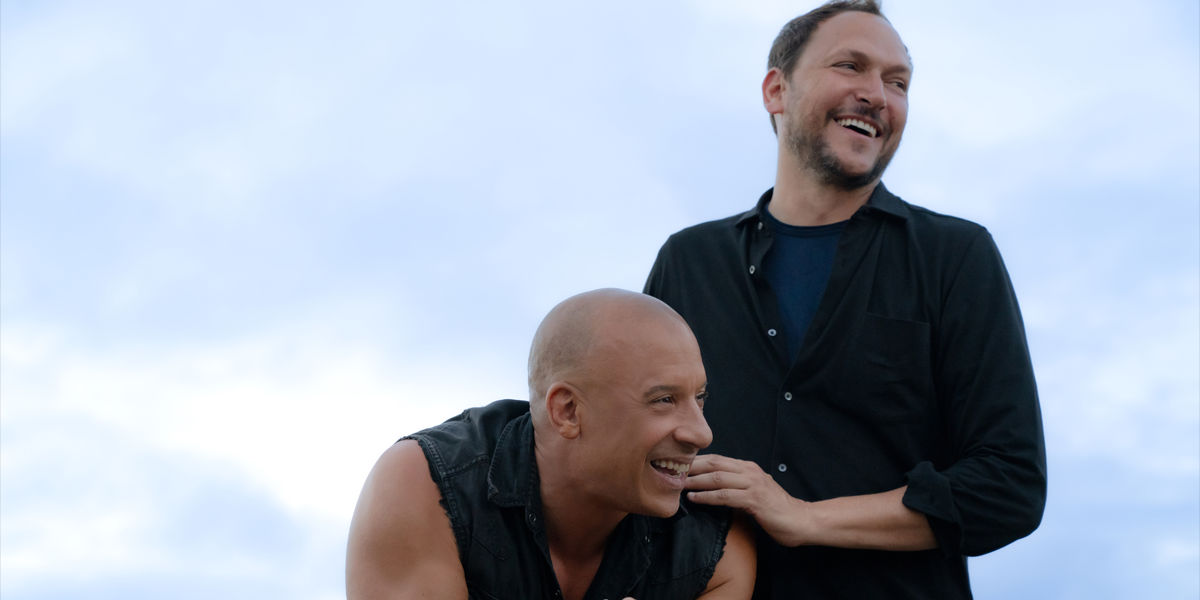
By Fast X in 2023, Diesel’s producer credit sat alongside Neal H. Moritz, Justin Lin, Jeff Kirschenbaum and Samantha Vincent. Universal’s film site credits Louis Leterrier as director, with returning performers including Rodriguez, Brewster, Tyrese Gibson, Ludacris and Sung Kang.
It is a striking distance from the short he could just about get made. He was now one of the people sustaining a large continuing production, working with an ensemble whose history had become part of the appeal.
The scale changed, but making and performing remained connected. The early writer and director had become a star with an ongoing producing role.
Groot and another life behind the microphone
The Iron Giant had already shown what Diesel’s voice could do. Guardians of the Galaxy gave it another home in 2014, this time as Groot.
Disney’s record of his work follows that character through the Guardians films and the Avengers stories, including Baby Groot. The performance had to communicate feeling through a very small vocabulary.
Marvel’s recording material makes the craft visible. In the official video below, Diesel records the character’s familiar introduction in Spanish. It is a useful glimpse of the actor working at a microphone, with tone and delivery carrying meaning that the words alone cannot supply.
The next chapter is still being made
In May 2026, Diesel appeared at NBCUniversal’s presentation to announce a move into scripted television. The company’s account says Peacock and Universal Television were developing a series based on Fast & Furious.
That is a development announcement, rather than a completed show. It points to another stage of the same long relationship: the performer who first played Dom in 2001 helping carry the world beyond feature films.
Where to follow his work
For credits, use IMDb. For public updates, the social accounts below are linked from Diesel’s official website:
- IMDb for his acting, directing and producing credits.
- Instagram for his public posts.
- Facebook for his official page.
A few useful distinctions
Was Multi-Facial his first feature?
No. It is a short film. Strays is the feature he wrote, directed and starred in, which reached Sundance in 1997.
Did he only act in his early films?
No. Writing and directing were part of his route into screen work. Those early credits help explain why producing later became an important part of his career.
Are Riddick, Dom Toretto and Xander Cage the same character?
No. They belong to separate film series: Pitch Black and the Riddick films, Fast, and xXx, respectively.
Is Diesel’s voice work limited to Groot?
No. He voiced the title character in The Iron Giant years before joining the Marvel films.
Another story that began with a smaller film
Our Christopher Nolan career story follows a different journey from an independently made film into larger productions. The paths are distinct, but both begin with finished work that someone else could actually watch.
If you have a short of your own ready for an audience, our guide to selling a short film directly to fans explores the release decisions. Vidreno On Demand supports public film purchases and rentals.