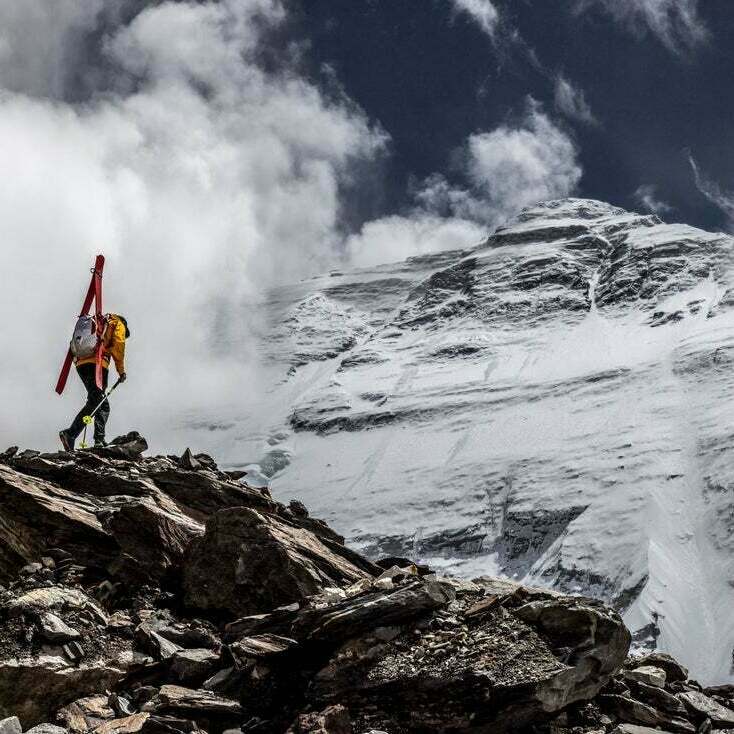
Cover: A mountaineer carrying skis beneath Everest in a publicity still from Everest: The Other Side. Image supplied by Disney UK Press / National Geographic Documentary Films.
Three cameras reached the top. That sounds like a modest amount of coverage until you remember where the operators were standing.
For Everest: The Other Side, Jimmy Chin needed people who could make pictures at the height of Everest’s summit while still doing everything necessary to get themselves down. The challenge was to carry a film production into an environment where spare equipment, physical effort and every extra ounce mattered.
Chin and fellow director Elizabeth Chai Vasarhelyi describe the result as their hardest film. Their original interviews reveal two productions happening together: the painstaking organisation of an expedition, and the less predictable work of finding a documentary’s story.
A shared dream became a film
The project began when ski mountaineers Jim Morrison and Hilaree Nelson approached the directors about climbing and skiing Everest’s direct North Face. At Deadline’s Contenders London conversation, Chin recalls understanding immediately what that meant. He had attempted the line himself in 2003.
The physical objective was extraordinary, but the filmmakers were drawn to the people pursuing it. Morrison and Nelson’s relationship gave the proposed film its emotional centre. It was a love story built around a shared ambition, rather than an expedition looking for a plot afterwards.
Documentary development could not guarantee an ending. Chin’s account makes that uncertainty plain: committing to the project came before knowing whether the material would become the film they imagined.
National Geographic Documentary Films and Little Monster Films are behind the production. Disney’s official release announcement credits Shannon Dill, Anna Barnes, Bob Eisenhardt and Janet Yang as producers alongside the directors. It names Clair Popkin, Chin and Christopher Murphy as directors of photography.
The mountain set the production calendar
Chin says the film took six years. The final ascent followed repeated attempts, so the production’s calendar depended on far more than assembling a crew for a shoot.
National Geographic’s report from the expedition records a permitting delay in 2023 that left the team too late for a summit attempt. In 2024, rope fixer Yukta Gurung was injured in an avalanche. The rescue ended that season’s attempt; he later recovered and returned.
The successful summit came on 15 October 2025. Morrison’s descent took four hours and five minutes, including a rappel past exposed rock. That detail matters: the achievement was not an uninterrupted ski run down a uniformly snowy face.
For a production, those seasons were also a reminder that the intended climax could remain unavailable. The film needed the patience to follow a process whose outcome its directors could not control.
Climbers first, camera operators as well
Vasarhelyi stresses the amount of production planning behind the expedition. Chin’s experience organising climbs was central to making the filming possible, but experience alone was not enough. The team also trained for years.
At Deadline’s panel, Chin explains the unusual hiring requirement. These had to be exceptional mountaineers who were also cinematographers, capable of operating at 28,000 or 29,000 feet. A good camera operator who could not function there would not solve the problem.
He also describes building redundancy into the system. That meant planning around the possibility that things would fail, rather than assuming a single operator or piece of equipment would always deliver the essential shot.
The pictures had another use before the descent. Morrison says views of the couloir from different angles helped him understand and visualise the line. The crew’s work supported his knowledge of the terrain as well as the audience’s eventual view of it.
Three cameras and a ruthless weight limit
Chin carried one camera on summit day. Two further operators, whom he names as Pemba and Eric in the panel, carried the others. Having three cameras gave the production more than one perspective at the moment it had spent years trying to reach.
He credits lighter equipment with making that coverage possible while meeting the production’s IMAX requirements. His example of how carefully the expedition treated weight is wonderfully concrete: even the labels inside jackets were cut away.
That is the useful filmmaking point here. The camera decision was part of the expedition plan. Carrying more coverage had to remain compatible with carrying people safely through the climb.
Chin does not present technology as removing the risk. His account returns to preparation, physical capability and backups. The equipment made certain images possible; the people still had to make them.
Finding a different film in the edit
Nelson died in September 2022. The documentary could no longer be the same account of two people pursuing their shared dream. In IndieWire’s Art of the Doc conversation, Vasarhelyi describes having to respond to what the material was becoming, rather than force it back into the original plan.
For her, the emphasis moved towards the cost of ambition. The earlier films had brought their crews home safely; this project made the consequences of risk harder to keep at a distance.
One decision was to include Vasarhelyi herself in a conversation with Chin at their kitchen table. She normally avoids appearing in their films. Here, she felt that examining the risks required acknowledging how personally the filmmakers were involved.
She also discusses difficult choices about including Nelson’s children and the period surrounding her death. Those choices belong to the film’s construction just as much as the summit coverage. What to include, where to place it and whose experience it represents are how an observational documentary finds its shape.
Bob Eisenhardt and Simona Ferrari are the credited editors. The directors’ account does not supply a neat recipe for the edit. It describes a willingness to let events challenge the story they had set out to tell.
From the expedition to the cinema
The film premiered at Venice on 3 September 2026. Disney has announced a cinema and IMAX release for 30 October, making this a useful moment to hear the filmmakers explain what sits behind the finished images.
The production’s strongest lesson is the connection between preparation and flexibility. The expedition required detailed planning. The documentary required the freedom to change when reality changed.
For a different example of filmmakers leaving room for events and performance, read how The Trip is made. Its setting and risks are entirely different, but the relationship between a plan and what happens in front of the camera remains a useful question.
If you are preparing a film of your own, create a free Vidreno account to explore sharing your work with an audience.