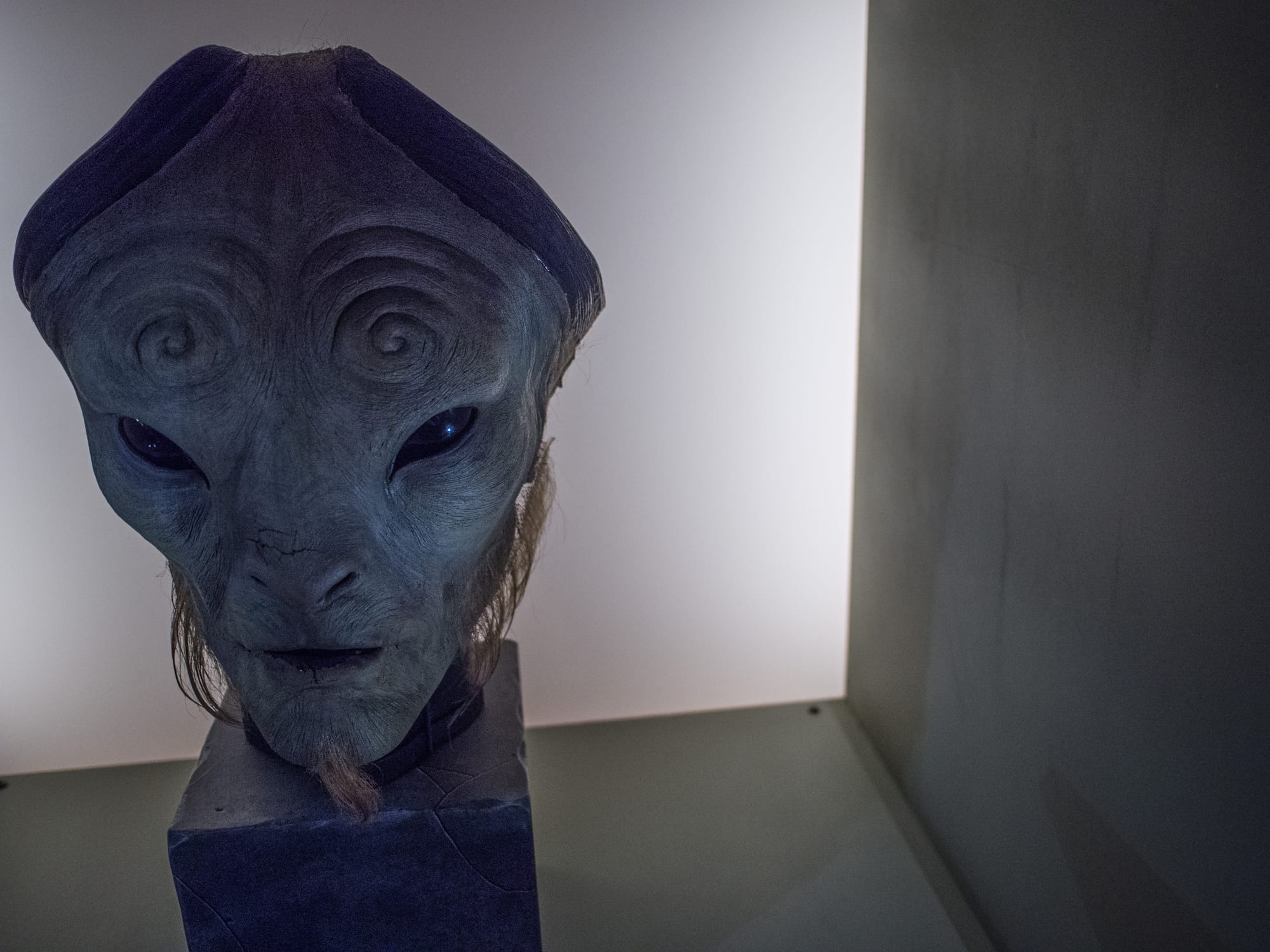
Cover: The Faun’s face displayed at Seattle’s Experience Music Project in 2014. This is a museum photograph, not a production still. Photo: Roland Tanglao, via Wikimedia Commons, CC BY 2.0. Unmodified.
The corridor looks long enough for a nightmare. Ofelia runs from the Pale Man towards an escape that seems impossibly far away. On the set of Pan’s Labyrinth, there was only a short stretch of passage to work with.
Del Toro explained to the Directors Guild of America that repeating its architectural elements let him film the run from different angles. A sloping floor, wide lenses and carefully chosen camera heights helped distort the distance. The frightening space existed partly in the construction and partly in the way it was filmed.
That collaboration between design and camera runs through the making of the 2006 film. Its twentieth anniversary restoration gives us a good reason to look beyond the monsters and notice the people who made them convincing.
Writing a fairy tale about choices
Del Toro wrote the screenplay himself. The story places Ofelia, played by Ivana Baquero, in Spain in 1944, where her new stepfather, Captain Vidal, hunts the remaining resistance. A mysterious faun offers her another world, but entering it brings demands of its own.
In his conversation with Mark Kermode, del Toro identified Edwin Sidney Hartland’s The Science of Fairy Tales as an important source. He drew on recurring traditions: forbidden food, tests and creatures that force a traveller to choose.
He connected those choices to the denial of choice under fascism. The historical and fantastic stories therefore belonged together from the writing stage. This was a companion to The Devil’s Backbone, rather than an unrelated adventure pasted over a war drama.
Drawing was part of that development. His notebooks joined character sketches to story ideas. The Pale Man evolved from a figure with loose skin into a creature without a face, whose eyes could move to his hands. An argument about power became an image you could understand without an explanation.
Putting a Spanish and Mexican production together
The project was a collaboration between Spain and Mexico. Del Toro told ComingSoon in December 2006 that assembling its finance had been faster than for The Devil’s Backbone, but maintaining the balance of contributors from both countries complicated the production.
Alfonso Cuarón joined him on this film. Pedro Almodóvar’s company was occupied with Volver, and del Toro did not want to burden it with another production at the same time.
The money was substantial for an intimate story and limited for the world it needed to build. Del Toro put the budget at $19.3 million in the Academy Museum discussion below. Sets, creature work, period detail and digital effects all had to serve the same film.
A camera that could move between worlds
Cinematographer Guillermo Navarro and his team began shooting in July 2005. He told American Cinematographer that a proposed northern location became too expensive. The production instead found a site near Segovia, about an hour from Madrid, where the building, labyrinth and surrounding landscape could relate to one another.
The camera searches rather than simply watches. That movement made lighting difficult: sources had to stay hidden while the frame explored the space. The forest nights were often photographed during daylight, with exposure and the later colour work helping transform them.
A drought also ruled out ordinary fire effects for the climactic attack. Navarro’s team used powerful lights on dimmers, with dirt and cork supplying debris. The illusion depended on timing the light with the physical action.
Doug Jones gave the creatures a performance
Jones played both the Faun and the Pale Man. His body supplied the movement, but the characters also depended on the makeup team and its mechanisms. In the Academy Museum conversation, he describes the Faun’s motorised facial features and batteries hidden in the horns.
For the Pale Man, his view was restricted to the mask’s nostrils. Even a simple move had to work with the camera’s movement. Navarro praises Baquero’s ability to understand the frame and participate in that choreography.
Language added another layer. Del Toro confirmed in the ComingSoon interview that Jones learned his Spanish dialogue phonetically and was subsequently dubbed. The performance on set still needed its timing and intention; replacing the voice did not replace the actor.
The effects company’s own footage below makes the daily physical labour visible. Watch the separate pieces become a character, and how much of Jones remains responsible for bringing it to life.
Inside the makeup room: Watch DDT SFX’s original footage of Doug Jones becoming the Faun. The team demonstrates the layers of work behind the finished creature.
Solid objects and digital work shared the frame
The opening magical kingdom offers a compact example of the film’s approach. Del Toro told the DGA that the crew built a large miniature, then placed a digitally animated girl inside its photographed image. The camera movement could be recorded and repeated without an elaborate motion control system.
Production designer Eugenio Caballero’s spaces gave the fantasy its physical boundaries. Those boundaries were also expressive: del Toro insisted on crimson tones for the Pale Man’s corridor, even when naturalistic stone colours might have seemed the obvious choice.
Post production helped join the pieces. Bernat Vilaplana edited the film and Javier Navarrete wrote its music, as the Cannes credits record. Navarro’s colour work with Chris Wallace at Deluxe/EFilm in Toronto improved continuity and refined the forest night effect. The visual decisions had already begun on set.
For another account of music meeting del Toro’s imagination, read our story about Alexandre Desplat’s Frankenstein score.
From Cannes to a twentieth anniversary return
Pan’s Labyrinth screened in competition at Cannes in 2006. Its reception led to an awards season that recognised several of the crafts responsible for its world.
At the 2007 Academy Awards, it won cinematography for Navarro, art direction for Eugenio Caballero and set decorator Pilar Revuelta, and makeup for David Martí and Montse Ribé. Del Toro’s original screenplay and Navarrete’s score were also nominated.
The restored film returned to Cannes Classics in 2026. Cineverse and Fathom’s anniversary release brought versions in 4K, 3D and HDR to US cinemas from 9 October, overseen by del Toro. The official anniversary site confirms that this is not a new story cut.
Three production choices worth looking at again
- The corridor: repeating a small piece of architecture can create a much larger journey when blocking, lenses and editing agree.
- The creatures: makeup and mechanisms need a performance inside them. Jones’s timing remains part of the effect.
- The night attack: when the planned method becomes impossible, identify what the audience must see and rebuild the illusion from that.
The film’s craft is worth studying because each solution belongs to its story. The spaces feel threatening, the creatures feel present and the camera keeps drawing us towards the next choice.
If you are preparing your own film for an audience, create a free Vidreno account.