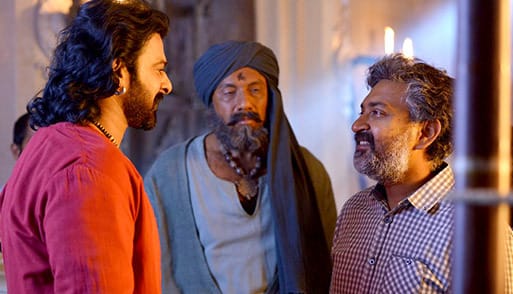
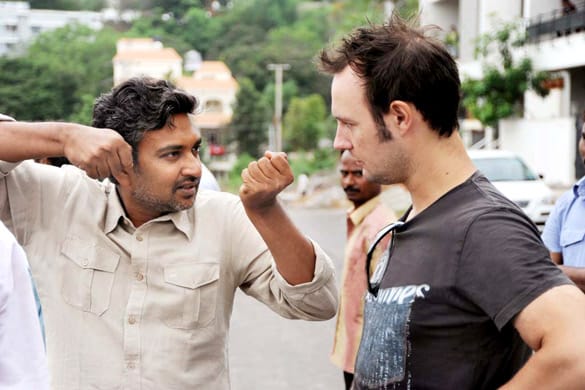
Cover: Rajamouli with Prabhas and Sathyaraj while filming Baahubali 2: The Conclusion. Photo: Bollywood Hungama, via Wikimedia Commons, CC BY 3.0. Existing cropped version.
Before S. S. Rajamouli could command an epic, he had to persuade people that the success of his first film belonged to him.
Student No. 1 had been a hit in 2001, but its established supervisor, K. Raghavendra Rao, received much of the industry’s credit. Rajamouli’s next film, Simhadri, changed that. In a 2005 interview with Idlebrain, he recalled how its success made people reassess his debut too.
It is a revealing beginning for a director now associated with enormous confidence. His career grew through opportunities, trusted collaborators and increasingly difficult experiments, long before the world discovered RRR.
A childhood full of stories, followed by uncertainty
Born in Karnataka in 1973, Rajamouli grew up in a Telugu family and studied in Andhra Pradesh. His father, V. Vijayendra Prasad, became a screenwriter; his cousin M. M. Keeravani became a composer. Both would remain central to his films.
In a 2012 interview, Rajamouli remembered a family whose unsuccessful productions had consumed its resources. Relatives shared a small flat in Chennai. He described those years with affection as well as anxiety: the family could still laugh together, even when money was scarce.
Storytelling was already his pleasure. He remembered mixing characters from Amar Chitra Katha comics into new tales for classmates. Later, he told Sight and Sound that the Ramayana and Mahabharata shaped his heightened characters, while Hollywood epics supplied powerful images. He did not attend film school.
Learning through work, then finding his own name
His apprenticeship included editing and recording work, followed by years assisting his father. Narrating stories to directors taught him how a scene could live in somebody’s imagination.
Television gave him sustained directing experience. Under Raghavendra Rao, he made Santhi Nivasam, a demanding period he recalled as roughly eighteen months of extremely long working days.
Student No. 1, starring N. T. Rama Rao Jr., opened the feature film door. Simhadri in 2003 made the breakthrough unmistakable. Rather than immediately repeat its formula, he followed it with the rugby drama Sye in 2004.
The distinction matters. Commercial success gave him room to choose a different kind of challenge.
From leading men to a housefly
Rajamouli’s credits trace the widening range: Chatrapathi with Prabhas in 2005, Vikramarkudu in 2006 and Yamadonga in 2007. Magadheera, starring Ram Charan, followed in 2009, then Maryada Ramanna in 2010.
In 2012, Eega gave that ambition an unlikely body. Its protagonist returns as a fly and pursues revenge. The audience has to believe that a tiny insect can carry a human emotional story.
It was not an effortless technical triumph. In his Rediff interview after release, Rajamouli described rejecting an early effects version after months of work because it did not look convincing. The team had to start again.
He also explained the difficulty of asking actors and technicians to imagine the same moving creature before it existed in the finished image. The film’s apparent madness depended on patient, shared understanding.
Baahubali expanded the audience
Baahubali: The Beginning arrived in 2015, followed by Baahubali 2: The Conclusion in 2017. Prabhas returned at the centre of a much larger fictional world.
In his TIFF conversation, Rajamouli describes this expansion as a process. He had wanted Magadheera to travel further, but the investment was not available. Eega then found audiences beyond Telugu speaking states, helping build confidence for Baahubali.
That is more useful than treating international success as a single leap. Each film changed what the next project could attempt.
The people who made the scale possible
His father remained a writing partner, while Keeravani supplied music and Rama Rajamouli, his wife, worked on costume and styling. Rajamouli told Rediff that his family collaborators offered encouragement, warnings and confidence.
Cinematographer K. K. Senthil Kumar became another important partner. In a conversation with the RRR crew, Senthil and production designer Sabu Cyril described building a heightened but believable world around the director’s intentions. Their work gave the spectacle a place to happen.
Rajamouli and his father did not agree on every detail. In the Sight and Sound interview, he recalled defending the ambiguity of Ram Charan’s character early in RRR. The uncertainty was meant to make viewers curious about the person behind the behaviour.
RRR reached viewers he had not expected
RRR in 2022 reunited him with N. T. Rama Rao Jr. and Ram Charan. Its fictional friendship between two historical revolutionaries reached audiences far beyond the established Indian diaspora.
At TIFF, Rajamouli admitted that the Western response had surprised him. He had initially doubted the American rerelease plan, then watched enthusiasm spread among audiences and filmmakers. Streaming widened that discovery further.
The awards brought another kind of visibility. Naatu Naatu won the 2023 Oscar for Original Song, awarded to composer M. M. Keeravaani and lyricist Chandrabose. The achievement belonged to the song’s creators within a film built by a much larger team.
For another perspective on music travelling beyond its film, read how Golden was created for KPop Demon Hunters.
Varanasi is the next chapter
Speaking in São Paulo in October 2026, Rajamouli described wanting the audience that found him through streaming to experience his next film in cinemas.
Screen’s report of the masterclass identifies Varanasi as an adventure starring Mahesh Babu, Priyanka Chopra and Prithviraj Sukumaran, with an April 2027 release planned. Rajamouli wrote it with Vijayendra Prasad and S. S. Kanchi.
He said better preparation had reduced the shoot from RRR’s 315 days to 275 days for the larger new project. Those are his reported figures, but the lesson connects neatly to his beginnings: imagination becomes a film through detailed work.
What his career offers another filmmaker
- Use each success to learn something new. Sye and Eega show a career taking different shapes.
- Give spectacle an emotional reason. The audience needs somebody to care about before the scale matters.
- Build collaborators into the story. Writing, music, costume, design and photography make the director’s intentions visible.
Explore his IMDb filmography and his accounts on X and Instagram. If you are preparing your own film for an audience, you can create a free Vidreno account.