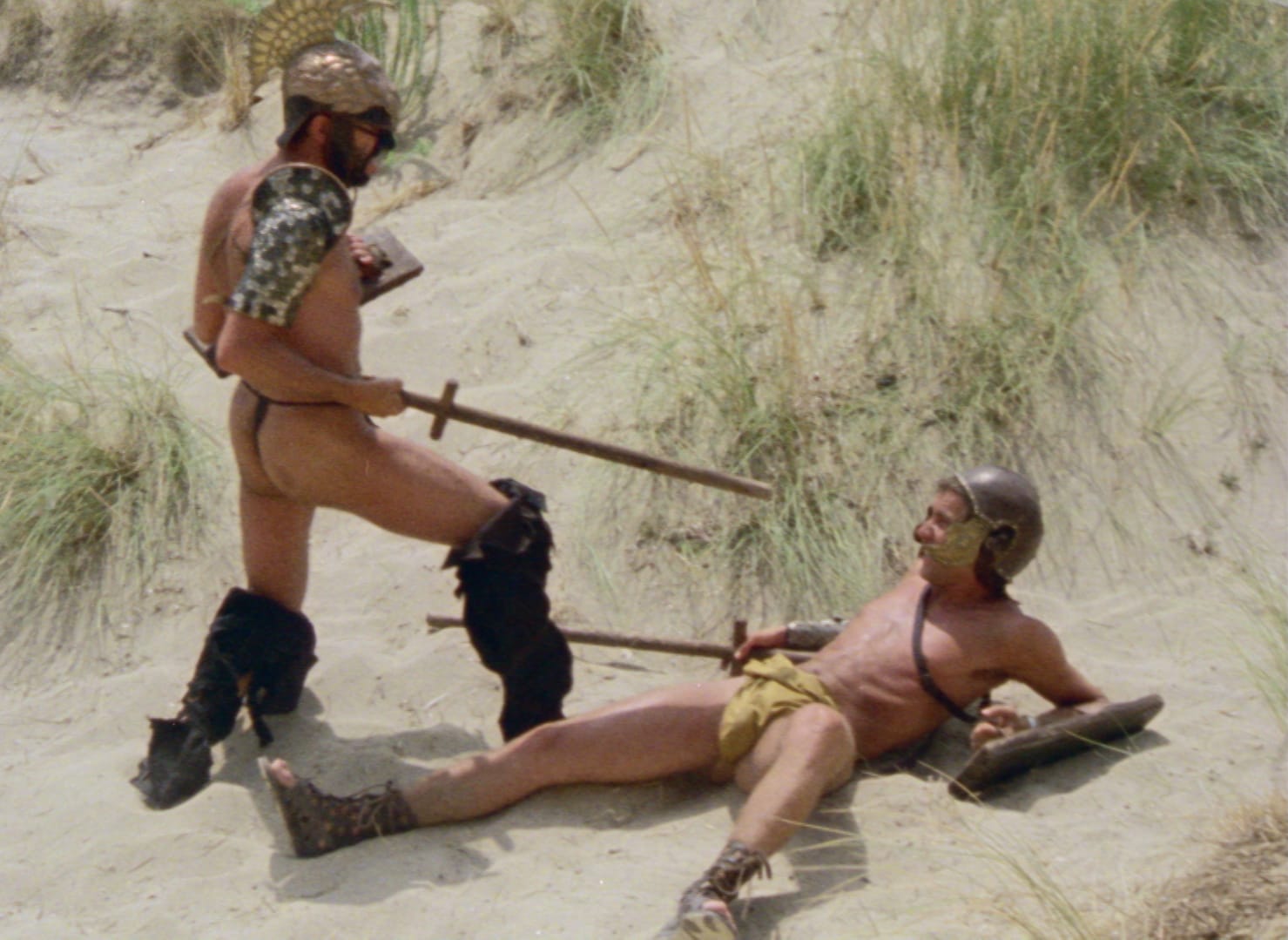
Cover: soldiers on the sand in Sebastiane. Film still © Malavida, supplied in the distributor’s publicity materials.
A Roman garrison, a Sardinian beach and dialogue in Latin: Sebastiane did not offer an obvious route into feature filmmaking. Yet Derek Jarman and Paul Humfress turned that combination into a film whose fiftieth anniversary falls in 2026.
Its production story is unusually revealing because the practical decisions are so closely connected to the result. The landscape influenced the writing. The small amount of footage affected the pace. A painter’s interest in bodies and composition had to become a film that could survive the cutting room and find a cinema audience.
Jarman and Humfress directed the 1976 film, produced by James Whaley and Howard Malin. Its Latin dialogue and Sardinian setting helped create a distinctive historical world. The project grew through revision, location work and editing, rather than following an entirely fixed blueprint.
A conversation became a treatment
In his journal Dancing Ledge, Jarman recalls discussing feature ideas with James Whaley at a Sunday lunch in January 1975. Saint Sebastian was among them. Whaley returned with a synopsis, giving a long contemplated subject a practical start.
Jarman describes competing ambitions during development: Whaley favoured a muscular spectacle, Humfress a serious art film, while he wanted poetry and mystery. That disagreement helps explain why the finished film resists a single familiar category.
The BFI’s film record names Jarman and Whaley as writers. Distributor Malavida instead lists Jarman and Humfress for the screenplay. The records differ, but Whaley’s contribution to the writing is also documented in his own account of the production.
A script that could respond to the beach
BAMPFA’s programme note preserves a particularly useful recollection from Whaley’s Time Out interview. He described repeated revisions before filming and during the shoot. Keeping the script flexible allowed it to use the location and incorporate abilities the performers brought with them, including dancing, flute playing and shadow boxing.
That gives the apparent looseness of the soldiers’ days a practical explanation. Activities could come from the people available to perform them. A script was still being written, but some of its material emerged from what the cast could do in that place.
The choice of Latin also had practical consequences. ACMI’s collection account connects it both to the international cast and to escaping the familiar speech of screen costume dramas. It describes a partly improvised shoot lasting just over three weeks.
The film uses the Sebastian legend to explore desire, belief and power within an isolated group of soldiers. Latin does not make that interpretation an objective reconstruction of Roman life. It gives an invented dramatic world its own sound.
Private money and a location that did several jobs
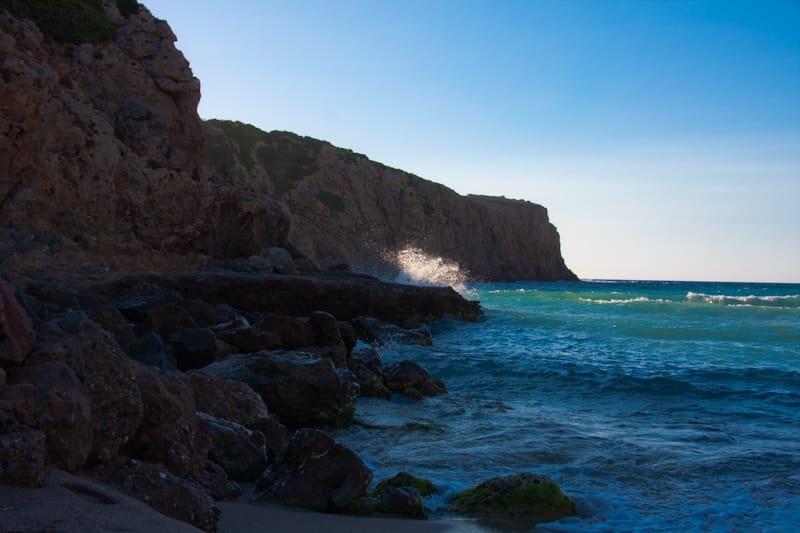
The BFI Southbank notes put the privately financed 16mm production at £30,000. They identify Cala Domestica as the filming location and a ruined fisherman’s house as both a set and accommodation for the company.
The notes identify Jack Welch as the Latin translator. They also record Jarman declining to cast Joe Dallesandro, concerned that a star would unbalance the little known cast.
The landscape was therefore more than scenery hired for a few shots. It was part of the production’s everyday life. This makes Whaley’s description of writing around the location especially significant: the place could influence the action while also serving the company’s practical needs.
The collaborators behind the images
Malavida’s credits identify Leonardo Treviglio as Sebastian and Barney James as Severus, with Peter Middleton responsible for the photography and Brian Eno for the music. Jarman’s name may dominate later discussion, but the film has two directors and a wider group of makers.
The BFI’s fuller credits also record several distinct contributions:
- Paul Humfress: editing as well as shared direction.
- John Hayes: location sound recording.
- Christopher Hobbs and Daniel Egan: illustrations and props respectively.
- Lindsay Kemp and his troupe: the opening dance sequence, with music credited separately to Andrew Wilson.
The division matters when looking at the film’s different textures. The staged court spectacle and the soldiers’ life on the coast are parts of the same film, but they call on different kinds of performance and design.
The film was made again in the cutting room
Jarman’s Dancing Ledge account places the start of Humfress’s edit in autumn 1975, with finance arriving gradually. He remembers having barely enough footage, so the cutting had to preserve duration. He also recalls working with monochrome rushes before seeing the colour answer print.
These are revealing constraints: the pace was partly a response to the material available. Jarman credits Humfress with making it work and recalls Eno completing the music during the finishing period.
There is material evidence of that editorial journey. For its 2018 releases, the BFI documented archival comparison work on two versions of Sebastiane. Its photographs show film leader, inspection and comparison, offering a useful route beyond the finished feature into the work of identifying and preserving earlier material.
The BFI’s archive photographs are worth examining alongside the production accounts. A film’s earlier version can reveal choices that a list of credits cannot: what was retained, what moved and what the final shape conceals.
Finding an audience did not mean fitting in
Michael O’Pray’s account in the BFI notes records rejection by Cannes, a contentious Locarno reception and strong attendance at the Gate in Notting Hill. These were different tests of the same film. Festival resistance did not settle whether an audience would want to see it.
In his 1991 conversation with ITN’s Fiona Murch, from 16:14, Jarman says he had thought of himself as mainstream, even though filmmaking offered him little obvious place to join. Making Sebastiane, he adds, would hardly have made a move to Hollywood straightforward.
He then turns from institutional acceptance to individual responses: letters from people whose lives had been changed by the work. He is cautious about measuring large social effects. That distinction is useful when considering this debut. Its significance cannot be reduced either to a hostile screening or to ticket sales.
For another chapter in the working relationships around Jarman, read Sandy Powell’s account of finding her way into his films. Her later experience belongs to a different production, but continues the story of a filmmaker whose collaborators were central to what reached the screen.
If you are preparing your own film for an audience, explore releasing it through Vidreno On Demand with a free account.