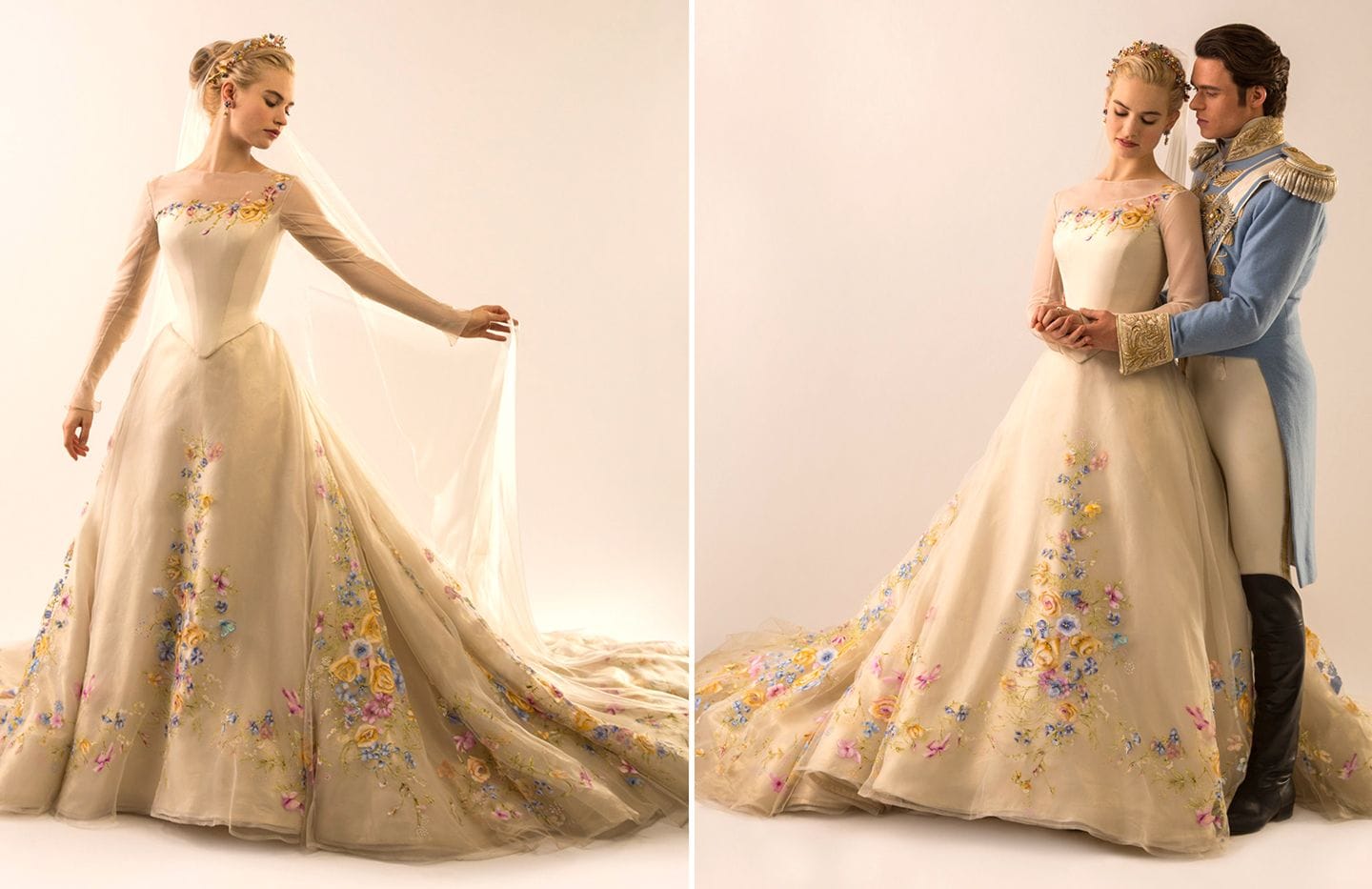
Cover: Lily James and Richard Madden in Sandy Powell’s wedding costumes for Cinderella. Photo: Jonathan Olley/Disney, via Vanity Fair.
Sandy Powell’s route into film began with a phone call to someone whose work she admired. She invited Derek Jarman to a theatre show she had designed. He came, and suggested she learn through music videos.
It was the beginning of a relationship that led to Caravaggio, and eventually a career spanning royal courts, gangsters, fairy tales and glam rock. The connection still matters: on 20 October 2026, Film London named Powell guest of honour at its forthcoming Jarman Award.
A sewing machine, a cinema obsession and Lindsay Kemp
Growing up in London, Powell learned to make things around her mother’s sewing machine. In her BAFTA interview, she remembers choosing fabrics, studying patterns and making clothes for dolls. She even produced her own fashion magazines.
Cinema gave that fascination somewhere to go. At 14, she repeatedly watched Death in Venice, captivated by its faces, makeup and costumes. Then Lindsay Kemp’s stage production Flowers showed her a world she wanted to join.
At 21, she went to Kemp’s dance classes in Covent Garden and asked to work with him. He agreed. She arranged a year away from art school and never returned, beginning her professional life in theatre and dance.
Jarman opened the door. Orlando brought the breakthrough
Powell’s account of Caravaggio is wonderfully unpolished. In her Life Journeys conversation, she remembers people moving between jobs, scenic artists helping with costumes, and her sister joining the making. It felt closer to fringe theatre than a neatly divided production machine.
Jarman gave her a first feature in 1986 and a place to learn. They worked together again on Edward II. But the film that brought wider recognition was Sally Potter’s Orlando, starring Tilda Swinton.
Its journey through centuries made clothes part of the storytelling itself. Powell received her first Oscar nomination for the film at the 1994 Academy Awards. That distinction matters: Jarman provided her opening; Orlando established her on a much larger stage.
Learning how to handle a bigger film
Work with Neil Jordan included The Crying Game, Interview with the Vampire and Michael Collins. The change in scale brought new pressures.
For Interview with the Vampire, Powell hired an assistant who had experience of larger productions. In the longer interview, she credits that colleague with helping her manage the scale and budget. Getting further in the industry meant knowing when somebody else knew more.
Glam rock, Shakespeare and the call from Scorsese
Powell actively pursued Todd Haynes’ Velvet Goldmine after hearing about a glam rock project. Much of its wardrobe came from renting and shopping, including London’s Portobello market, where she could still find original 1970s clothes.
Her two 1998 films brought different rewards: Velvet Goldmine won her a BAFTA, while John Madden’s Shakespeare in Love brought her first Oscar. Soon afterwards, she remembers receiving a call about meeting Martin Scorsese.
That became Gangs of New York, followed by The Aviator, The Departed, Shutter Island, Hugo, The Wolf of Wall Street and The Irishman. The last film’s costume design was shared with Christopher Peterson.
On The Aviator, Powell studied photographs of Howard Hughes and reproduced particular looks for Leonardo DiCaprio. The aim, she explains to BAFTA, was to let the audience see the character rather than the star. It brought her second Oscar; The Young Victoria brought the third.
From Cinderella’s spectacle to Carol’s restraint
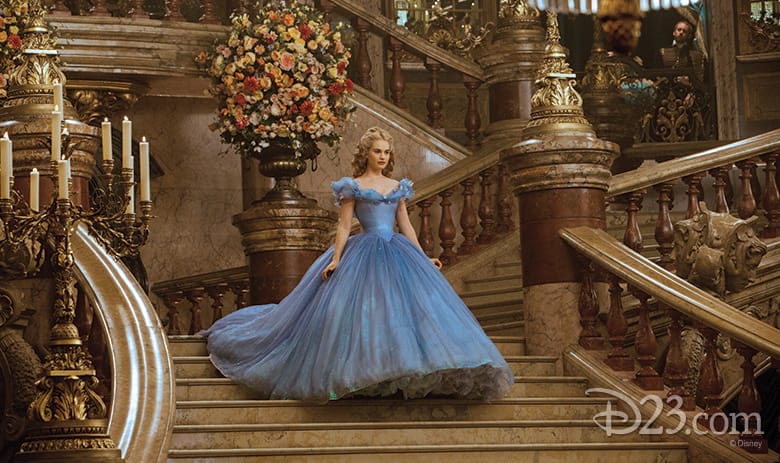
Cinderella and Carol arrived in 2015, showing how differently Powell could use clothes. One offered a fairy tale transformation. The other placed Cate Blanchett and Rooney Mara within the social world of 1950s New York.
Speaking to Disney’s D23, Powell described showing Kenneth Branagh her fabric, colour and silhouette ideas. She remembers Lily James becoming emotional when she first tried on the completed ball gown in the fitting room.
The wedding dress needed a different answer. Powell told Vanity Fair that she wanted simplicity rather than another attempt to outdo the ball gown. Its pale fabric and painted flowers offered a quieter ending to the transformation.
For Carol, the useful detail is less spectacular. In Life Journeys, Powell points out that people do not replace their entire wardrobes when a decade changes. Older clothes remain in circulation. A believable period film needs that overlap.
The later career: a fellowship and an orange dress
The Favourite and Mary Poppins Returns brought another pair of Oscar nominations. Later work included Living and Snow White. In 2023, Powell became the first costume designer to receive the BAFTA Fellowship.
Her work on Maggie Gyllenhaal’s The Bride! provides a recent example of the judgement behind the colour. Gyllenhaal initially wanted Jessie Buckley’s orange dress to be more muted. As she recalled in the production notes, reported by SYFY, seeing it under the film’s night lighting changed her mind.
It is a useful reminder that a costume must work inside the photographed scene. A fabric swatch viewed on its own cannot tell the whole story.

What her career reveals about the job
Powell’s interviews keep returning to the work around the design. A sketch starts a conversation; a crew and an actor make it usable.
- Build trust in the fitting room. An actor’s discomfort or suggestion may lead to a better choice.
- Keep the departments talking. Costume has to work with production design, hair, makeup and cinematography.
- Respect the makers. Cutters, stitchers, painters, embroiderers and supervisors turn the design into something a production can use.
- Expect practical limits at every scale. Small films may lack money; larger ones can demand far more work within too little time.
That emphasis on the people behind the image also runs through our story of cinematographer Adolpho Veloso. A distinctive screen career depends on craft and collaboration together.
Powell has also used her career to support the person who helped start it. Her signed calico awards suit raised money for the campaign to save Jarman’s Prospect Cottage. Her appearance at the Jarman Award on 24 November continues that connection.
The sewing machine, the theatre show and the first phone call have not become irrelevant footnotes. They explain a working life built by following an interest, approaching people and learning with them.
Explore her work
Find her credits on Sandy Powell’s IMDb page and her work on Instagram, the account linked by her agency, Storm Management.
Making a film of your own? Create a free Vidreno account to explore a home for your work.