Mahershala Ali’s career is easy to misread backwards. Start with the two Oscars and the early jobs can look like an inevitable route to them. Start with the basketball player at Saint Mary’s College, trying a play without knowing where it might lead, and the story becomes much more interesting.
There was no single discovery that settled everything. Training opened one door. Television kept him working. Moonlight changed his public standing. Leading roles still required another argument about what he could do.
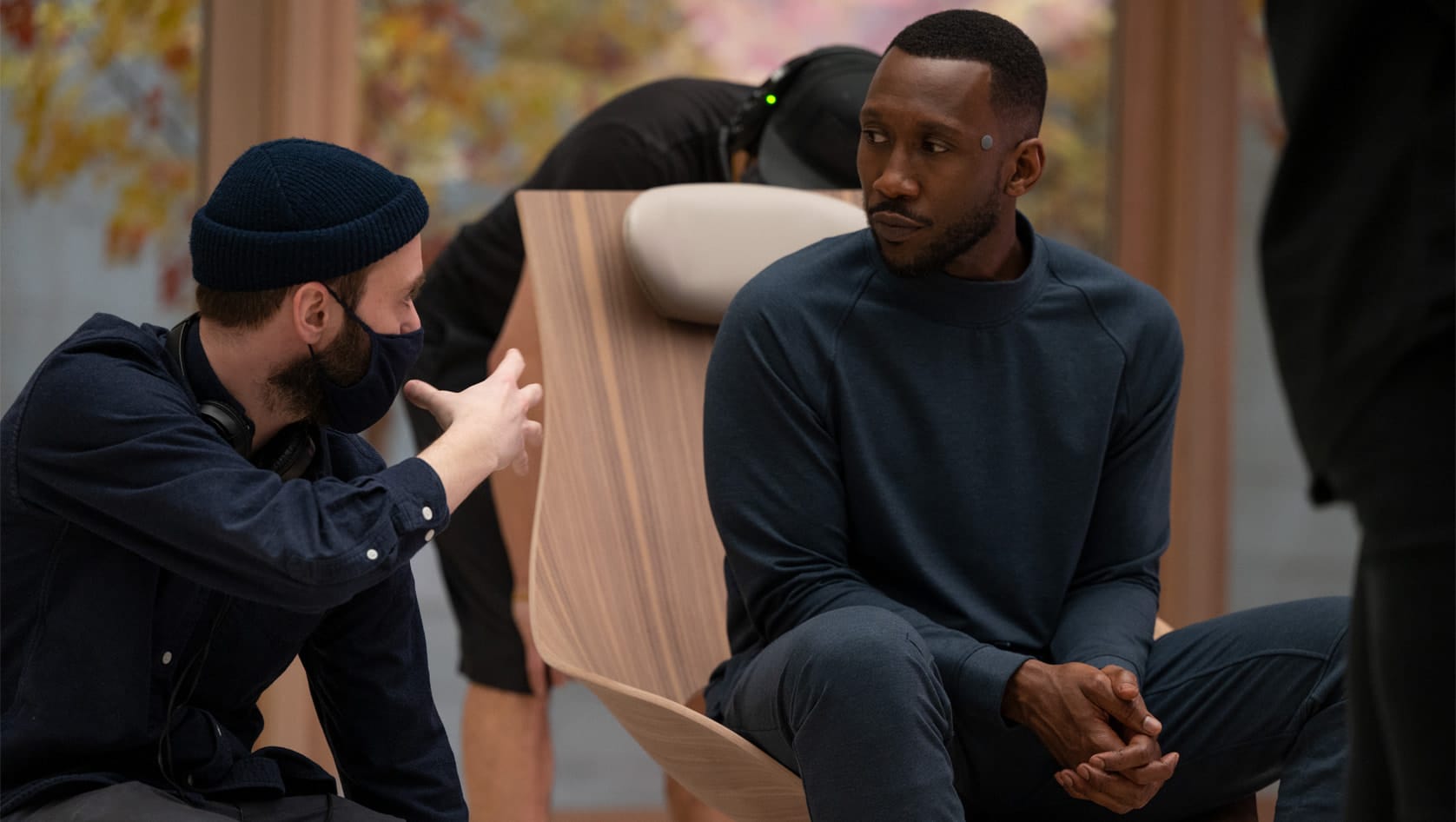
Cover: Mahershala Ali with director Benjamin Cleary during Swan Song. Courtesy of Apple TV.
Before the camera, a different kind of stage
Born in Oakland and raised in Hayward, Ali was the first in his family to earn a college degree. Saint Mary’s account of his return to campus places that achievement alongside the community that helped him get there.
He entered college as a basketball player. Acting became a possibility through Rebecca Engle, a teacher who noticed him speaking on a diversity panel. In his career retrospective, he remembers joining The House of Blue Leaves, then finding a much stronger sense of direction in Spunk.
His father had worked in performance and introduced him to films beyond the blockbusters his friends were watching. That influence mattered before acting became a profession: it gave him a wider picture of what a screen performance could be.
The change of direction was practical as well as emotional. An apprenticeship with California Shakespeare led towards graduate auditions. Yale would not audition him after his application arrived late. NYU accepted him.
Learning the job while building a career
NYU records his acting MFA in 2000. The next chapter was television, including Crossing Jordan, Threat Matrix and The 4400. These were substantial working years, not an empty stretch before the famous films.
The Curious Case of Benjamin Button brought him into David Fincher’s film world. Later, Remy Danton in House of Cards, Boggs in the Mockingjay films and Cottonmouth in Luke Cage placed him in very different kinds of storytelling.
Those parts asked for different forms of authority: political control, military reliability, menace. The variety matters because it is easy for a recognisable supporting actor to become associated with a single useful quality.
For the individual credits and his earlier billing as Mahershalalhashbaz Ali, see Ali’s IMDb filmography.
Moonlight made the wider world pay attention
Barry Jenkins’s Moonlight gave Ali the role of Juan, an adult whose tenderness towards a child exists alongside the harm of the world he inhabits. It is a supporting performance with an influence that extends beyond the scenes in which he appears.
The Academy awarded Ali Best Supporting Actor in 2017. Two years later came the same award for Green Book, in which he played pianist Don Shirley opposite Viggo Mortensen.
The two roles are useful to consider together. One depends on the intimacy of a relationship with a child; the other on the changing balance between two adults sharing a journey. Neither is simply a display of charisma detached from a scene partner.
Three different kinds of breakthrough
- Training: the tools and confidence to make acting a profession.
- Regular work: the opportunity to develop across television and film.
- Recognition: an Oscar that brought a much wider audience to work already years in the making.
Asking for the lead in True Detective
In GQ’s career interview, Ali recalls pitching himself for the lead in True Detective rather than the supporting part first discussed. He sent creator Nic Pizzolatto photographs of his grandfather in uniform to support the conversation about a Black police officer in that period.
It is a revealing piece of career initiative. He did more than express interest. He brought something concrete that helped another person imagine the casting.
Swan Song and a greater say in the work
Saint Mary’s describes Swan Song as his first leading film role. Released in 2021, Benjamin Cleary’s drama places him at the centre of a family story shaped by a speculative question: what would a dying man sacrifice to spare the people he loves?
Ali plays Cameron, with Naomie Harris as his wife Poppy. Apple’s production page credits Cleary as writer and director. The collaboration reunited Ali and Harris after Moonlight, in a very different dramatic relationship.

The later work has kept that range open. He appeared with Julia Roberts, Ethan Hawke and Myha’la in Sam Esmail’s Leave the World Behind. In Jurassic World Rebirth, he played Duncan Kincaid for director Gareth Edwards.
When preparation finds a different film
His latest collaboration with Bassam Tariq, Your Mother Your Mother Your Mother, gives him another central role. The BFI describes Latif as an assassin and father trying to protect his children after his wife dies.
At Deadline’s TIFF conversation, Ali explains that extensive sword training undertaken for Blade became useful on Tariq’s film. The new production could benefit from preparation it would not otherwise have had the time and money to provide.
That is a more useful industry story than treating a stalled project only as wasted time. Skills can survive the project for which they were acquired, then change what is possible on a smaller production.
Returning to the place that opened a door
In January 2026, Ali returned to Saint Mary’s to meet students in its High Potential programme and Moonlight Scholars. The college’s account describes a day of conversations about belonging, education and the uncertainty of finding a path.
It is a fitting place to leave his story for now. The person who arrived through basketball has become someone who can help other students imagine a different future. The awards are part of that journey, but so are the teachers, collaborators and ordinary working decisions that preceded them.
For another career shaped by finding a personal route into filmmaking, read Carol Morley’s story. For the collaboration behind a recent score, explore Max Richter and Chloé Zhao’s work on Hamnet.
Making a film of your own? Create a free Vidreno account to start sharing your work.