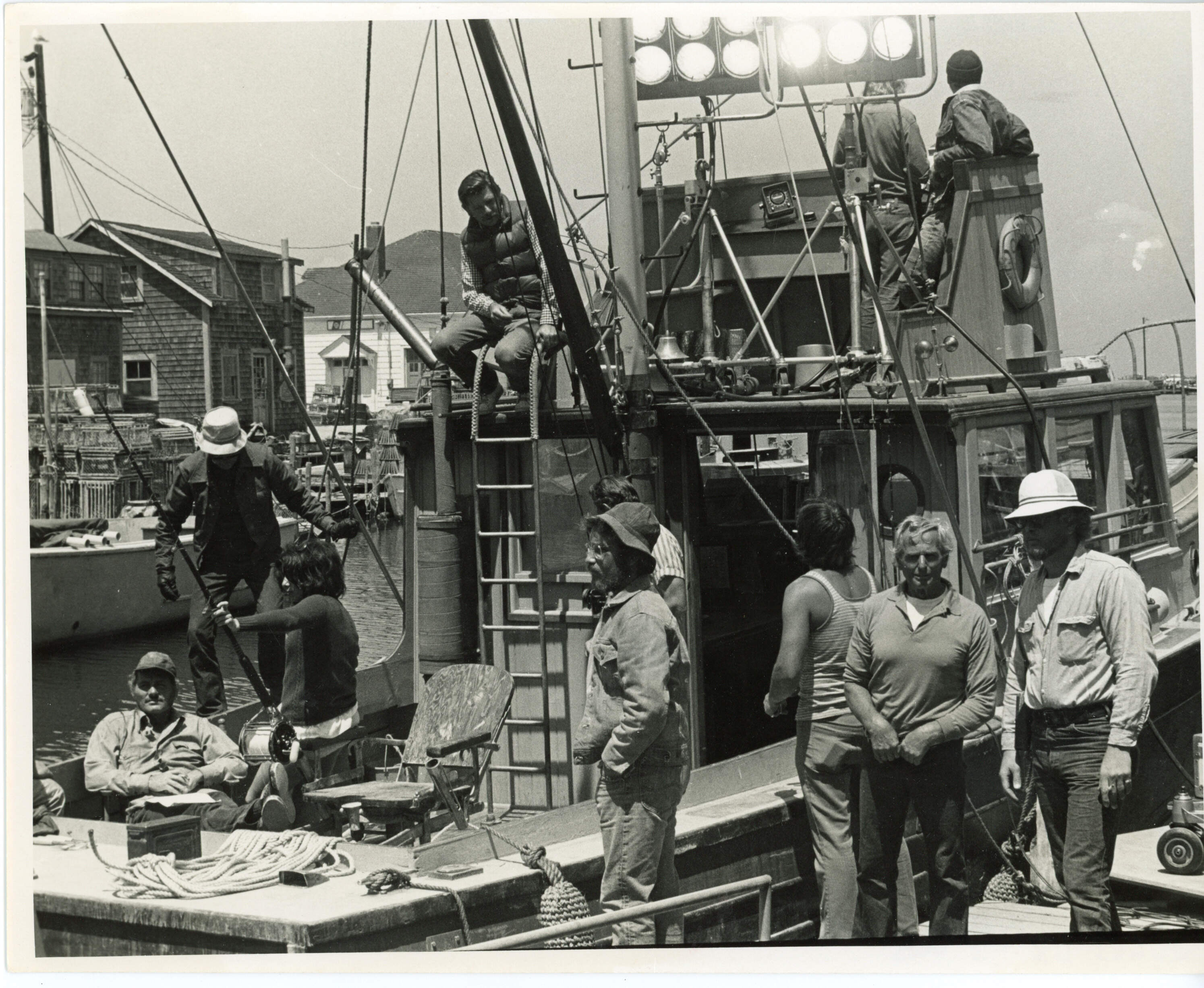
A crew member kneels beside the great white shark, scrubbing its face. Away from the cinema, the creature that frightened a generation needed people to clean it, repair it and persuade it to move.
That gap between the finished illusion and the work underneath is the story of Jaws. Spielberg’s 1975 film was made through rewrites, practical effects, a difficult location shoot and a precise collaboration in the cutting room.
Cover photograph: cast and crew aboard the Orca during production. Photo: Edith Blake / Martha’s Vineyard Museum, via WBUR.
Before the shark, there was a book
Producers Richard D. Zanuck and David Brown bought the screen rights to Peter Benchley’s novel before its publication. Universal backed the film. The American Film Institute’s production history records the deal in 1973 and Spielberg’s attachment that June.
The director had already worked with the producers on The Sugarland Express. He was still near the beginning of his feature career, and this next project would put him in charge of a much less predictable leading attraction.
In National Geographic’s Jaws @ 50, Spielberg recalls being gripped by the novel’s final shark hunt. The prospect was wonderfully direct: make an audience feel the fear he had felt while reading it.
The script kept changing around the actors
Benchley and Carl Gottlieb received the screenplay credit. Adapting the novel meant deciding which relationships the film needed and which could go. The affair between Hooper and Brody’s wife was dropped, leaving more room for the town’s crisis and the three men who eventually go to sea.
Roy Scheider played police chief Martin Brody, Richard Dreyfuss the shark expert Matt Hooper, and Robert Shaw the hunter Quint. Lorraine Gary played Ellen Brody, while Murray Hamilton gave Amity its mayor.
The writing did not stop when those actors arrived. In the Academy interview below, Spielberg describes recording their improvisations, then sitting with Gottlieb in their shared cabin to pick out material that belonged in the story.
Quint needed a reason to fear the water
The Indianapolis speech gave Quint’s hostility a history. In Jaws @ 50, Spielberg credits Howard Sackler with suggesting that connection, and describes later contributions from John Milius and Shaw.
It changes the atmosphere of the cabin scene. The men begin by comparing scars; then a story turns their competition into something quieter. Quint’s experience makes the coming encounter personal, rather than simply another job for a fisherman.
Building Bruce and giving the Orca a working crew
Production designer Joe Alves and effects specialist Bob Mattey faced a practical problem: build a shark that could perform specific actions in seawater. There were three large mechanical versions, designed for different views and movements. Bruce was a collection of machines, rather than one prop that could do everything.
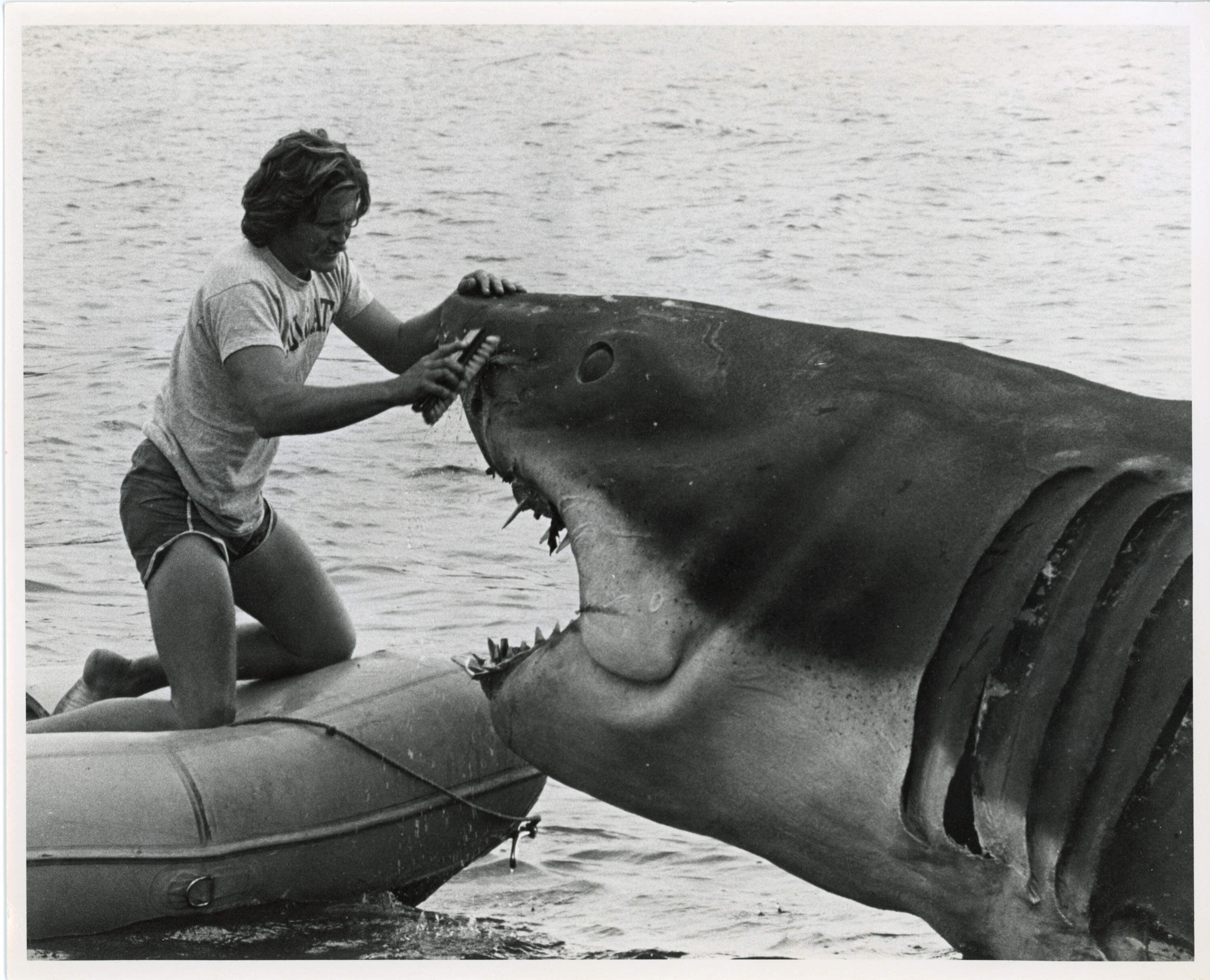
Edith Blake’s photographs make that work tangible. Her archive, held by Martha’s Vineyard Museum and published by WBUR, shows the shark being tended and the Orca crowded with people and lighting equipment.
Inside the finished film, the boat belongs to three men. Around the camera, it was a workplace. Ropes, lamps and crew had to share the same confined space as a performance that was meant to feel spontaneous.
Spielberg’s Academy recollection adds a revealing limitation: water pressure could stop the shark’s head and tail moving as intended. A mechanism that existed was not necessarily a mechanism that could deliver the required take.
Martha’s Vineyard became Amity, but the sea stayed itself
The location gave the film a convincing coastal town and a real horizon. It also made continuity and control much harder. Boats drifted, conditions changed and other vessels could enter the background.
American Cinematographer’s report from the shoot records cinematographer Bill Butler’s intended contrast: a bright holiday atmosphere near the beginning, then a more ominous feeling during the hunt.
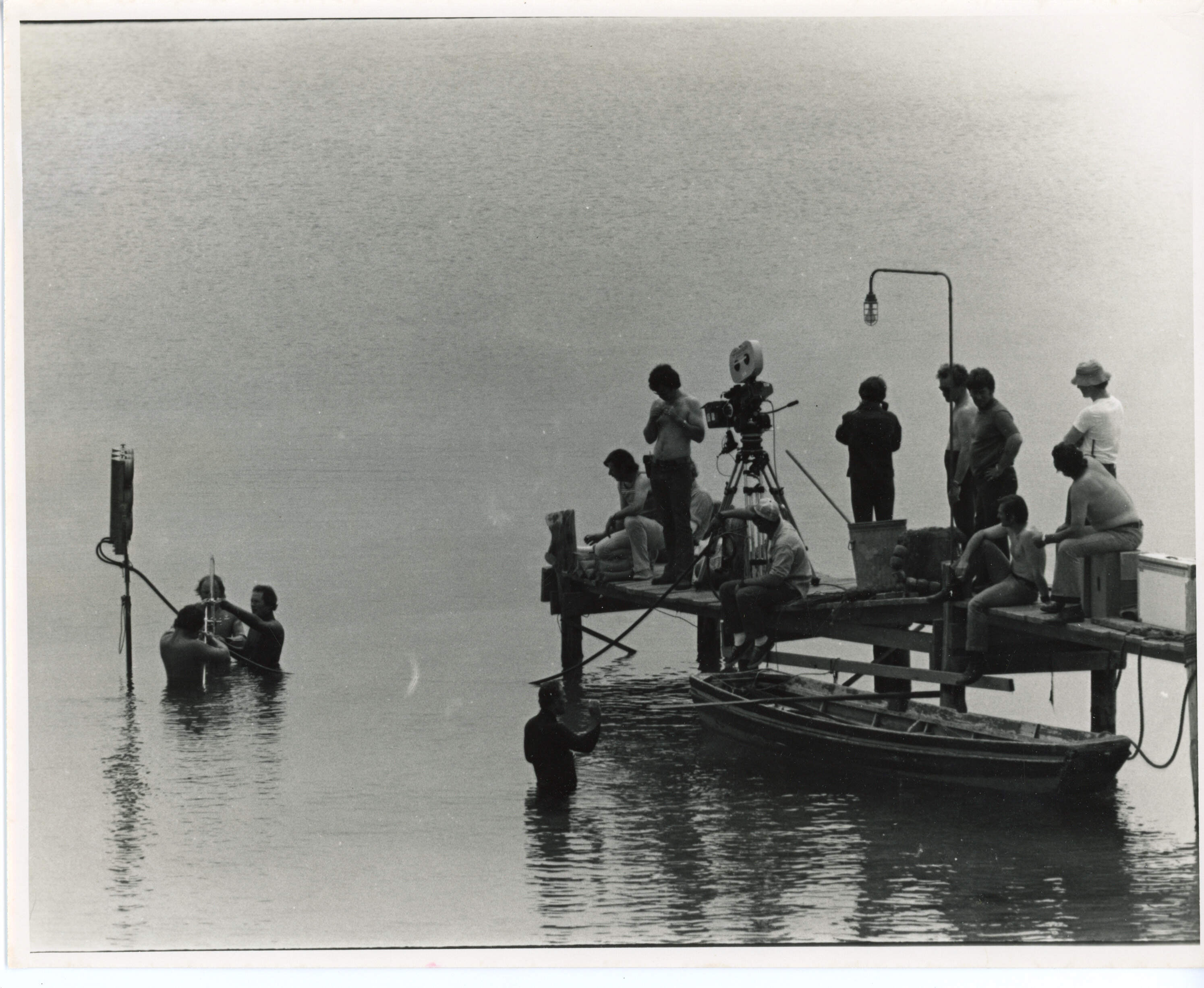
The camera had to work with the movement
Butler and camera operator Michael Chapman sometimes held the camera to obtain a steadier result on moving boats. Butler also developed an adjustable raft with space for a protective camera box, allowing filming close to the waterline.
The Orca had its own practical double. As the same contemporary report explains, a separate effects boat could be deliberately lowered and raised. The illusion of a vessel in danger depended on construction and operation as much as it did on the shark.
The photograph above is a useful reminder of the physical scale. A low viewpoint that lasts a moment on screen can require a platform, people in the water and a team waiting for the right conditions.
The delays changed the suspense
The production overran badly. CBS’s retrospective puts the shoot at 159 days against an initial 55 day schedule.
The delays were real trouble for the people making the film. The creative response was to give the audience other evidence of the shark: disturbed water, a moving barrel, a face registering alarm. The absence became something the viewer could watch.
It is easy to describe that afterwards as fortunate. Spielberg’s account is less comfortable. In the Academy interview, he remembers fearing that he would be fired.
Verna Fields and John Williams shaped the final experience
Editor Verna Fields worked on the film while production was still underway. The finished film’s rhythm depends on when it stays with a character, when it looks away and how long it makes us wait for the next piece of information.
Jaws @ 50 includes footage of Fields working, followed by Spielberg’s account of filming an additional underwater scare in her swimming pool. The production did use real sea locations extensively, but the final film also included later work in controlled water.
John Williams gave the shark a musical identity. In the documentary, he describes the repeated figure as an expression of its relentless drive. The score makes a threat felt before the image has to reveal its source.
For another collaboration in which music shapes a film’s identity, our Interstellar score story follows Hans Zimmer, Christopher Nolan and Roger Sayer from an initial idea to the Temple Church organ.
Three passages worth watching
- 13:23: the route from novel to producers, with Wendy Benchley and Spielberg’s account of wanting to direct it.
- 57:23: the origin of Quint’s Indianapolis speech and the writers who helped shape it.
- 1:05:41: Verna Fields at work, followed by the finishing process and Williams discussing the music.
The release turned a difficult shoot into a landmark
Jaws opened in the United States on 20 June 1975. AFI records an initial run far larger than a small platform release and a rapid rise to the top of the domestic box office.
At the 1976 Academy Awards, the film won for editing, original score and sound, and was nominated for Best Picture. Fields and Williams were among the people whose craft had turned difficult material into an unusually direct audience experience.
The production photographs are worth returning to after watching the film. The lights, platforms and hands working on Bruce disappear from the screen, but the decisions made around them remain in every scene.
Questions about making Jaws
Was Jaws filmed entirely in the ocean?
No. Much of the location work took place around Martha’s Vineyard, but later work included a studio tank and an additional underwater shot in Verna Fields’ pool.
Who wrote the Jaws screenplay?
Peter Benchley and Carl Gottlieb received the screenplay credit. Other writers contributed during development, including Howard Sackler and John Milius.
Was Bruce a real shark?
Bruce was the crew’s name for the mechanical shark. The production also used real shark footage filmed by Ron and Valerie Taylor.
Who edited Jaws and composed its music?
Verna Fields edited the film and John Williams composed the score. Both won Oscars for their work on it.
From making a film to finding its audience
Finishing a film brings a different set of decisions. Our guide to selling a short film directly to fans explores how to plan a release. Vidreno On Demand lets filmmakers offer public purchases and rentals.