Cleopatra had to be rebuilt before it could be finished. The 1963 epic passed from Rouben Mamoulian’s abandoned London production to Joseph L. Mankiewicz’s version in Rome, where filming continued without a finished screenplay. Its extraordinary scale made every change expensive: a new scene could mean another set, another crowd and another day of waiting.
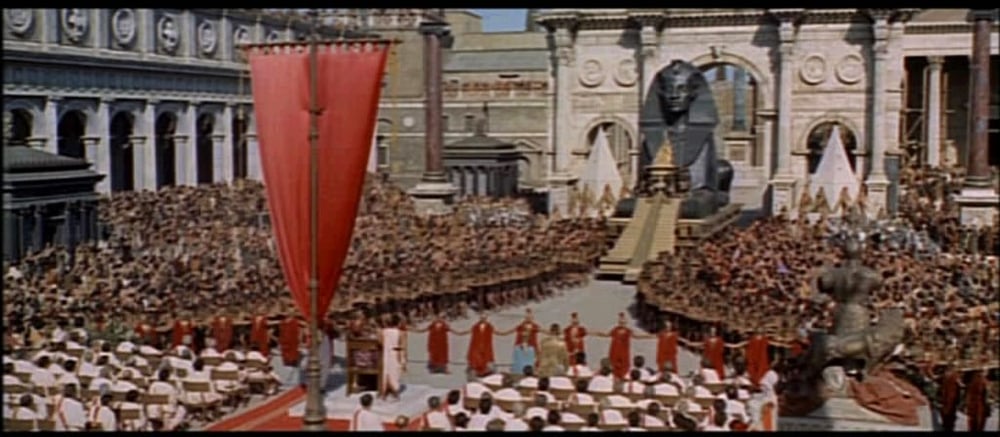
The most revealing image is not a palace at its grandest. It is a palace coming apart. In British Movietone’s footage from April 1961, workers dismantle the Alexandria built at Pinewood. The apparent stone city gives way to the practical business of taking a film set down.
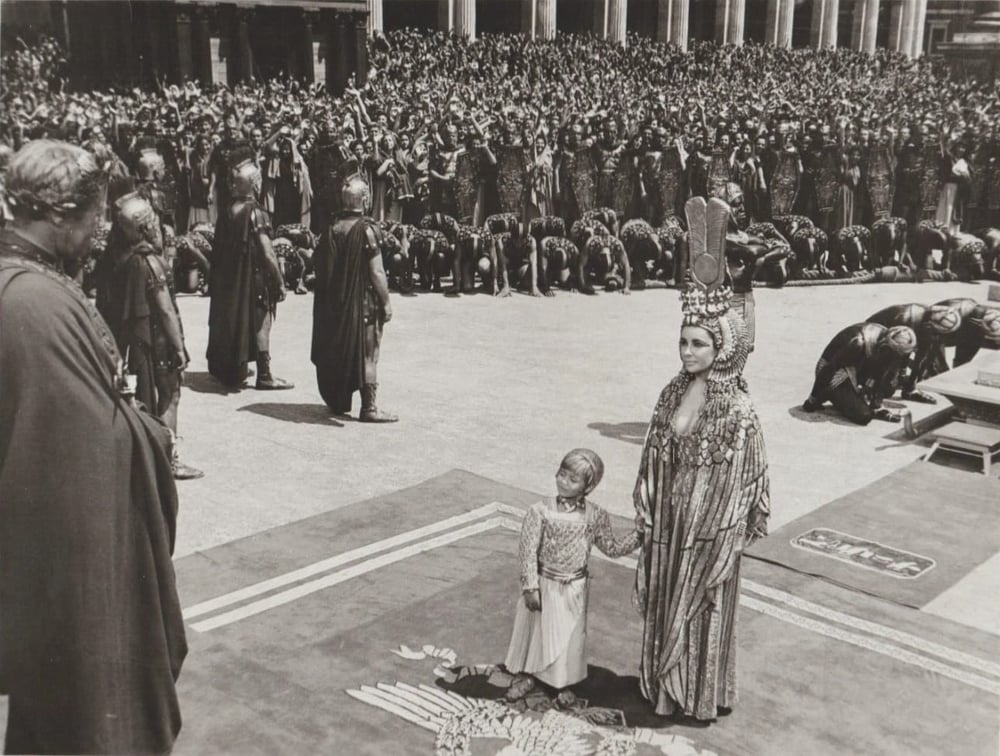
Elizabeth Taylor as Cleopatra, Loris Loddi as Caesarion and Rex Harrison as Caesar in a 1963 publicity still. Photographer uncredited; Ken Jones Collection. Original still and provenance; public domain in the United States.
From a book adaptation to an expanding epic
Producer Walter Wanger acquired the rights to Carlo Mario Franzero’s The Life and Times of Cleopatra in 1958. Nigel Balchin’s adaptation did not satisfy him; Dale Wasserman subsequently worked on another screenplay. By late 1959, Elizabeth Taylor was attached and a $5 million London production was planned with Mamoulian directing. These stages are documented in the AFI production history.
The ambition had a visual advocate. As TCM’s account explains, Wanger used John DeCuir’s designs and models to help persuade Fox executives of the project’s possibilities. The pictures could sell an epic before the screenplay could organise one.
That distinction matters. A design establishes what an audience might see. A shooting script allows departments to work out what must be built, who must be present and which scenes can share a day. Cleopatra’s development repeatedly moved those decisions out of step.
Why the London production was abandoned
Bad weather and Taylor’s serious illness interrupted the British shoot. Mamoulian resigned in January 1961. The replacement director, Mankiewicz, proposed a new conception, and the earlier footage was discarded. Wanger and Mankiewicz pressed for Italy; production restarted in Rome in September 1961. Richard Burton and Rex Harrison replaced Stephen Boyd and Peter Finch as Antony and Caesar. AFI records the restart and recasting.
In the Movietone newsreel at 00:53, the narration turns from Taylor’s recovery to the dismantling. Earlier, at 00:09, it identifies the impressive buildings as Alexandria at Pinewood. Together those moments show the difference between money already spent and material that will actually reach the screen.
Rome solved the location problem, not the screenplay
Mankiewicz wanted to reshape the drama rather than inherit the existing script. Ranald MacDougall joined the writing effort, but the new shoot still began before the screenplay was complete. TCM describes the director filming during the day and writing at night, with departments trying to plan around an evolving story. Finished sets could wait for scenes while other work required overtime. TCM’s production account makes the central difficulty clear: activity on a set is not the same as progress towards an agreed film.
Film historian M. Langley’s archival study, pages 131 and 132, gathers a particularly telling recollection from Martin Landau. A carefully made walking stick was discarded after an acting decision; Harold Berghof used it as an example of the production’s waste. The detail brings a colossal budget down to the level of a prop: craftsmanship could be excellent and still be spent on something the scene did not need.
Langley also argues that the restart denied Mankiewicz adequate development and preparation time. Moving to a more suitable location could not resolve the underlying uncertainty about the film being made.
The craftspeople who made the spectacle coherent
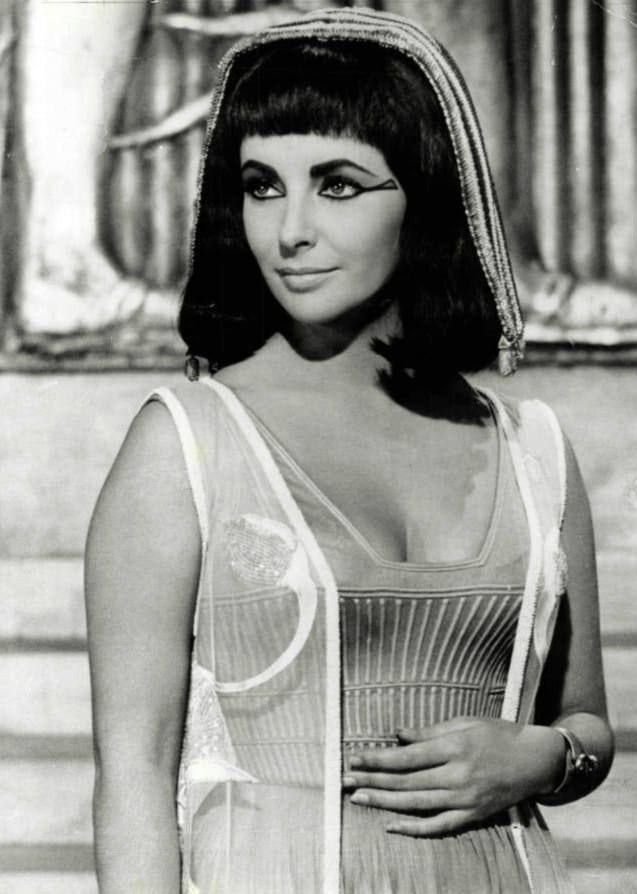
DeCuir’s production design gave Cleopatra a world that could carry the drama. Fashion historian Lourdes Font describes the contrast between Greek styled Alexandria exteriors and Egyptian styled interiors, reflecting the queen’s cultural inheritance. Costume design was divided between Irene Sharaff for Taylor, Vittorio Nino Novarese for the men and Renié for the other women.
Font’s analysis for the Fashion Institute of Technology is useful because it treats the clothes as storytelling. Sharaff adapted ancient forms with colour, jewellery and theatrical invention. These were costumes intended to communicate character on camera, rather than a claim that every garment reproduced ancient dress exactly.
A production can be badly organised and still contain exceptional work. Those two judgements belong together here. The visual departments had to turn shifting requirements into a convincing world that audiences could read in a moment.
The film still had to be decided in the cutting room
The credited writing team was Mankiewicz, MacDougall and Sidney Buchman. Leon Shamroy photographed the finished film, Dorothy Spencer edited it and Alex North composed its score. The film’s IMDb credits help distinguish this completed production from the earlier British attempt.
In David Kamp’s interview based production history, Mankiewicz’s widow Rosemary describes the strain of his simultaneous writing and directing. Kamp also recounts the director’s wish to divide the story into Caesar and Cleopatra and Antony and Cleopatra. Fox wanted one release. The argument was about narrative shape as well as running time.
Langley traces the Italian production through July 1962 and further shooting in early 1963. That final return to filming matters: the edit was still revealing work needed to complete the story. The camera schedule and the cutting room had become parts of an extended revision process. See Langley’s production chronology.
Darryl F. Zanuck dismissed Mankiewicz during post production, but the director returned to oversee remaining work, including scoring. The New York premiere on 12 June 1963 ran 243 minutes; later versions were shorter. Contemporary reports cited a $32 million cost. AFI distinguishes these release stages.
What survived the troubled production
At the 1964 Academy Awards, Cleopatra won for colour cinematography, colour art direction, colour costume design and visual effects. Shamroy’s photography and the work of the design, costume and effects teams received recognition even as the production became a cautionary tale.
For a filmmaker, the practical lesson is to connect creative decisions to the work they authorise:
- Before construction: know which scenes require the set and how it will be photographed.
- Before a restart: distinguish what can be reused from what a new approach makes obsolete.
- Before the shoot: agree the intended form of the finished work, including whether it is one film or several.
These are planning questions, not arguments against ambition. For another approach to organising spectacle, read how the crew made RRR. For the relationship between design and storytelling, explore the creatures and craft of Pan’s Labyrinth.
Cleopatra remains fascinating because the immense labour is visible. The palace that comes down in the newsreel and the city that fills the finished frame are parts of the same story: making an image is only one part of making a film.
Planning a release for your own work? Explore Vidreno and create a free account.