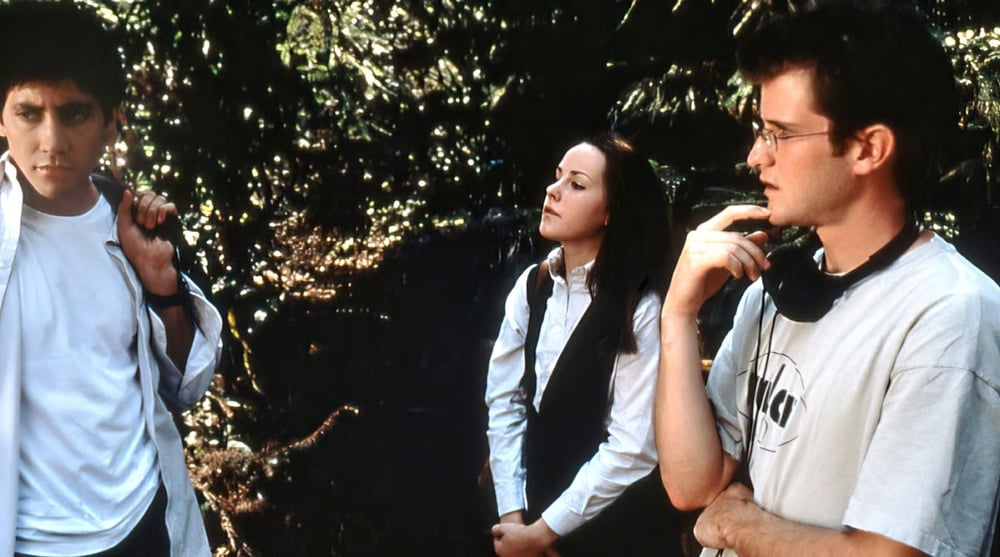
Cover: Jake Gyllenhaal, Jena Malone and Richard Kelly on the set of Donnie Darko. Photograph: Dale Robinette, published by the American Society of Cinematographers.
A jet engine lands in a teenager’s bedroom. The teenager is elsewhere, following a figure in a rabbit costume. Before Donnie Darko became a film people watched repeatedly to work out its rules, it was a screenplay that needed someone to trust its young writer with the camera.
Richard Kelly got that chance through a chain of collaborators, including producers Sean McKittrick, Nancy Juvonen and Drew Barrymore. Making the film was only the first test. Its festival reception, music costs and difficult initial release would all shape the version audiences eventually found.
Its 25th anniversary return to cinemas, including a Halloween screening at BFI IMAX, is a good moment to look at that practical story: how an unusual script became a film, and how the film survived a disappointing start.
Kelly wrote and directed his debut feature with a reported $4.5 million budget. Flower Films helped make it possible, an experienced crew translated its stranger ideas into physical scenes, and later audiences gave it a life beyond its original cinema release.
A childhood news story became a screenplay
In his Austin Film Festival On Story interview, Kelly recalls a local newspaper account of ice falling from an aircraft into a boy’s bedroom while the boy was away. He developed that remembered incident into a mystery involving an engine and an untraceable plane.
He then built a story about adolescence, authority and the end of the Reagan era around it. Kelly says the first draft took roughly five or six weeks. The screenplay brought him representation at CAA, but wanting to direct it himself made the project harder to finance.
That is an important distinction in the film’s development. A script can attract attention without securing the writer’s intended role. For Kelly, getting Donnie Darko made meant persuading people to back both the material and his ability to direct it.
The people who made the financing possible
Jason Schwartzman initially attached himself to the lead. Barrymore and Juvonen’s Flower Films then joined the project, with Barrymore also playing English teacher Karen Pomeroy. The budget was $4.5 million, an ambitious undertaking for a debut containing effects, period detail and elaborate musical sequences.
The cast still had to change. As Kelly and McKittrick explain in The Ringer’s oral history, Schwartzman became unavailable and the production needed to retain its summer 2000 start to keep Barrymore. Jake Gyllenhaal became Donnie. Jena Malone, Mary McDonnell, Patrick Swayze and other experienced performers helped surround the young lead.
It is easy to describe a debut as one person’s breakthrough. Here, the route to production depended on people lending their reputation, availability and practical knowledge to a project whose commercial prospects were far from obvious.
Planning the strange film with an experienced crew
Cinematographer Steven Poster asked for several days alone with Kelly to work through the screenplay before shooting. In his ASC interview, he describes that preparation as crucial: they could decide what the film needed before the pressure of the set took over.
Kelly wanted classical photography to hold the unusual material. Poster used anamorphic widescreen, finding ways to light practical interiors efficiently. The visual ambition had to work inside ordinary rooms as well as in the film’s more spectacular moments.
For the engine crash, production designer Alec Hammond obtained engine cowling, and physical effects supervisor Robbie Knott rigged it above a constructed bedroom set. Poster describes filming the drop with three cameras and a single opportunity to capture it. The apparently impossible event at the centre of the screenplay required a very concrete piece of staging.
Making Frank disturbing enough
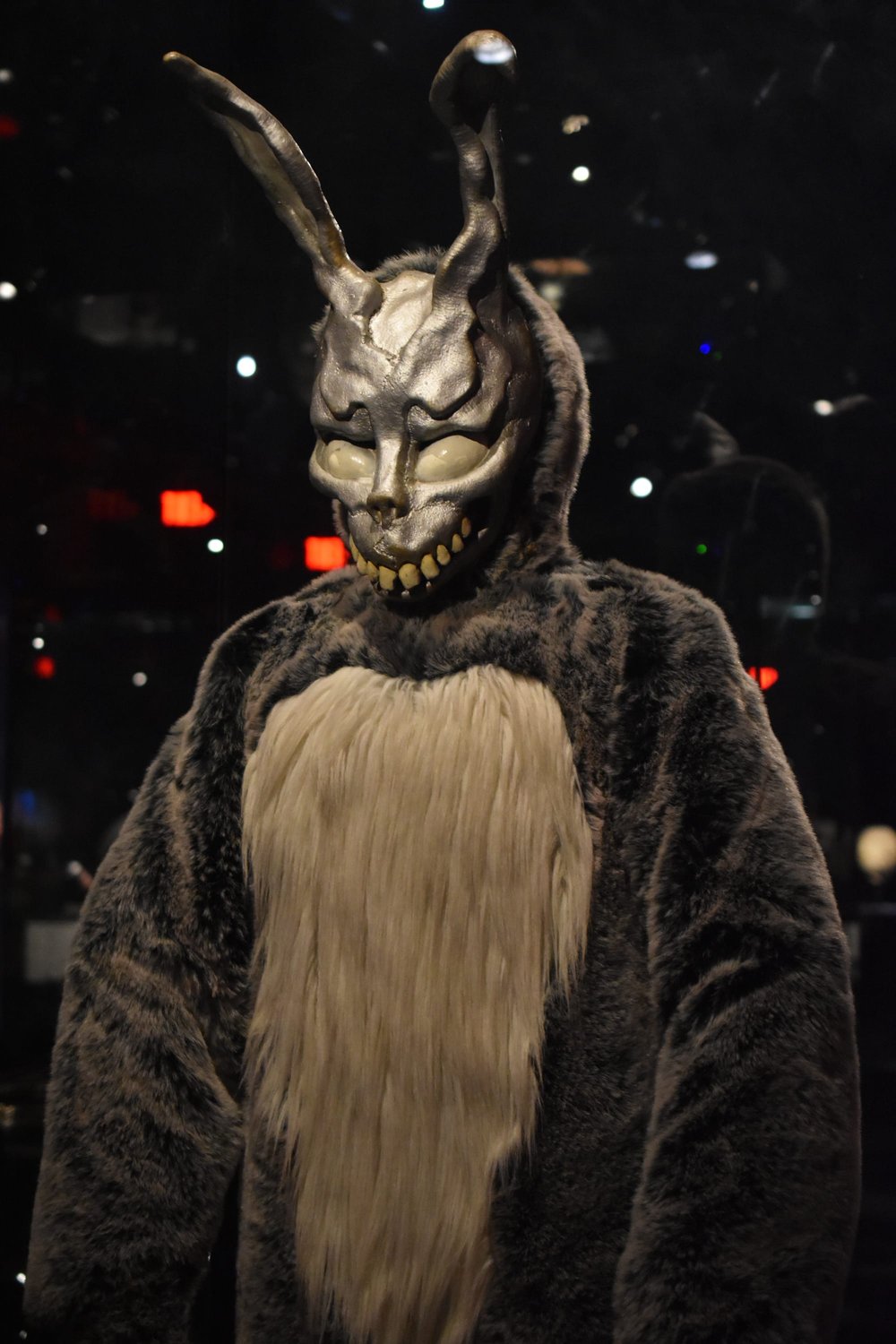
Frank needed to sit between a Halloween costume and something genuinely unsettling. Kelly began with a drawing. Hammond developed views of the mask, and costume designer April Ferry brought the suit into physical form.
In the oral history, Kelly remembers rejecting ideas that looked too much like an ordinary Easter bunny. The eventual costume gave James Duval an immediately unnerving presence. It is a useful example of design serving a precise dramatic requirement: recognisable enough to be a costume, strange enough to interrupt the everyday world around it.
See the production at work
The production diary with Kelly and Poster offers a different perspective from a retrospective interview: locations, crew and scenes being assembled before anyone knew the film’s eventual reputation. Watch it alongside the finished film to compare the practical work with the atmosphere it creates.
Music changed the film after shooting
Kelly’s On Story account contains a revealing post production detail. The Sundance version began with INXS. After the festival, pressure to reduce costs meant losing that song and moving Echo & the Bunnymen’s The Killing Moon to the opening. A choice now strongly associated with the film emerged from revising the original plan.
Composer Michael Andrews supplied another part of its identity. In Tape Op’s interview, he describes assembling an instrumental palette almost as though it were a band. For Donnie Darko, he recalls piano, vocoder and synthesiser as elements of that sound.
That approach makes a useful distinction between a score and a collection of songs. The soundtrack’s familiar recordings connect the film to a period; Andrews’s textures give its unexplained events their own emotional space. The music can keep the viewer close to Donnie even when the mechanics of the story remain uncertain.
Plan for the dramatic job of a cue as well as the preferred recording. Kelly’s account shows how a financial constraint can force a new arrangement of scenes and songs. A strong alternative still needs to serve the film.
A difficult release was not the end
At Sundance in 2001, the film did not find the reception Kelly had hoped for. In On Story, he describes pressure afterwards to shorten it and remove its period songs. Completing the shoot had left another difficult task: defending the film through the edit and towards an audience.
Its American cinema release in October 2001 proved disappointing. Yet Kelly told The Quietus that midnight screenings in New York during spring 2002 were an early sign of a different future. The enthusiasm he encountered in Britain then showed him how strongly the film could connect.
Later restoration work extended that life. Kelly and Poster returned to the image for Arrow, allowing audiences to encounter the film again in a presentation they had helped supervise. The 2026 anniversary screenings are another chapter in that continuing relationship with viewers.
None of this makes a slow release a dependable business plan. It does show why an opening weekend and a film’s lasting audience can tell different stories. The production’s carefully built world gave people something to return to, discuss and pass on.
Hear Kelly explain the choices
Austin Film Festival’s conversation follows the screenplay, financing and changes to the music in Kelly’s own words. It is especially useful after watching the film, when the decisions can be connected to scenes rather than treated as isolated anecdotes.
Three things worth taking into your own production
- Make time for shared preparation. Poster’s account shows the value of working through the script with the director before the schedule starts consuming decisions.
- Give unusual designs a clear purpose. Frank’s appearance matters because it changes how an otherwise familiar setting feels.
- Keep thinking about the audience after the premiere. The film’s later reception developed through encounters beyond its first release.
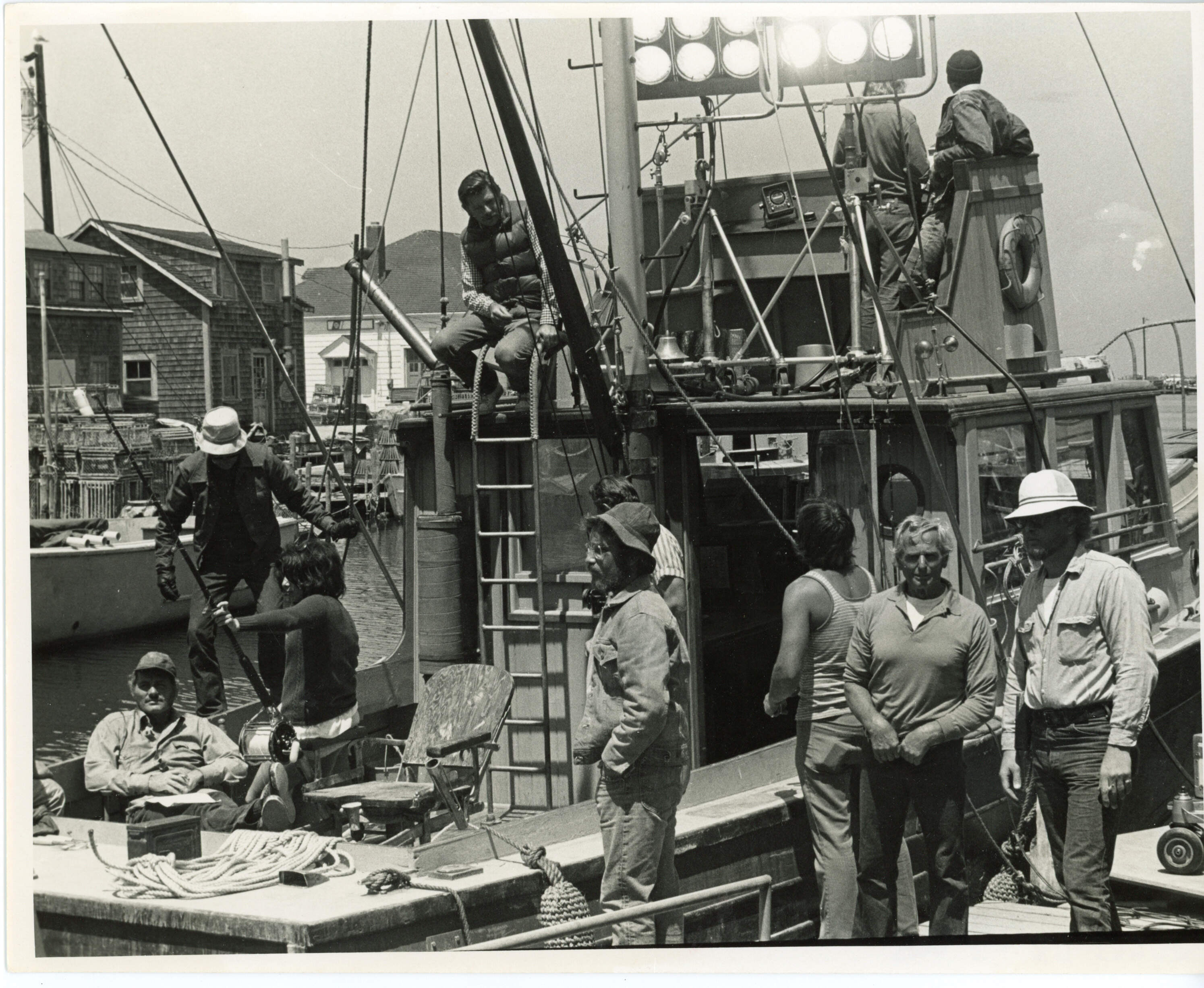
For another production built around a distinctive imagined world, read how Pan’s Labyrinth was made. Our account of the making of Jaws follows a different crew adapting ambitious scenes to practical limits.
Ready to bring your own film to viewers? Explore Vidreno On Demand with a free Vidreno account.