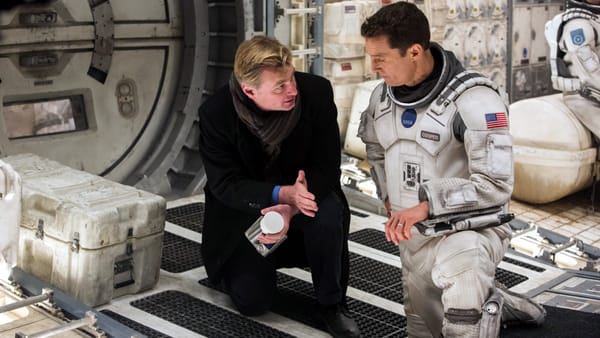
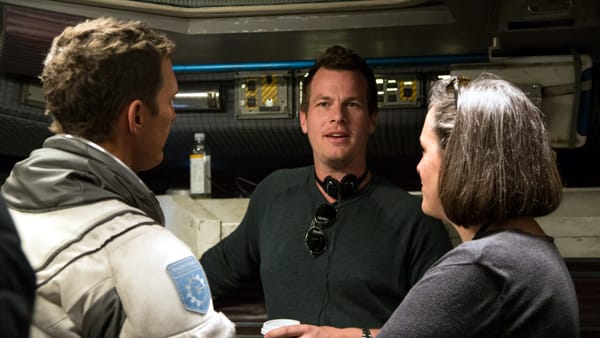
Christopher Nolan talking to Matthew McConaughey inside a spacecraft tells you something about how Interstellar was made. The actor has walls, equipment and a floor around him. The conversation about performance is happening inside a physical version of the world.
That approach grew out of a project with a long history. Before the 2014 film had its familiar cast or its journey through Gargantua, a producer and a physicist were trying to imagine a story that could take modern science seriously.
The idea before the Nolan brothers
Lynda Obst and Kip Thorne developed the original story treatment together. Their connection went back to Carl Sagan, who had introduced them. Obst brought the experience of a producer; Thorne brought questions about what physics might permit.
A Caltech account of the project’s early workshop describes scientists meeting Steven Spielberg on 2 June 2006. Spielberg was interested in directing. The discussion ranged across space travel, other worlds and the problems a crew might face.
The story could speculate, but Thorne wanted it to respect established physical laws. That gave the writers an unusual starting point: scientific constraints could generate dramatic possibilities, rather than merely checking a script after it was written.
Jonathan Nolan writes the journey
Jonathan Nolan developed the screenplay while Spielberg was attached. In his Creative Screenwriting interview, he recalls wanting a space adventure grounded in physics but driven by an optimistic view of human possibility.
Moving the story into an unspecified future gave him room to imagine a damaged Earth and a NASA working out of sight. Conversations with scientists helped him consider both the fragility of life and the difficulty of leaving the planet.
The Spielberg version did not reach production. When Christopher took over, he made his own pass through his brother’s screenplay, concentrating its ideas around the human story. Jonathan describes a collaboration in which he handed over possibilities and allowed the director to reshape them.
For the finished film, time is more than a scientific concept. It is the years Cooper loses with his children. The scale of the journey becomes understandable because the family gives those lost years a cost.
That is also why the early scenes at home matter. The audience needs to know what departure means before the spacecraft leaves Earth.
Making a huge camera feel close
Interstellar began Christopher Nolan’s collaboration with cinematographer Hoyte van Hoytema. They used 35mm and IMAX film, but the intention was not simply to photograph enormous landscapes.
Van Hoytema told Den of Geek that he wanted the large IMAX camera to become intimate and flexible. The team adjusted it so he could work with it on his shoulder, bringing the format closer to people.
He also describes entering the partnership as himself, rather than trying to reproduce the work of Nolan’s previous cinematographer, Wally Pfister. The film’s visual approach came from a new conversation between collaborators.
A spacecraft the actors could inhabit
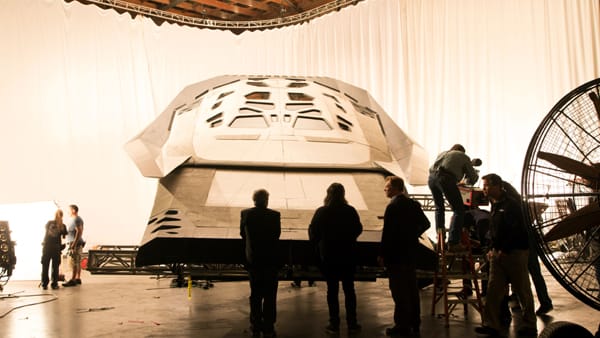
Production designer Nathan Crowley’s spacecraft interiors gave the performers a practical environment. Moving sets and projected imagery helped connect what happened inside the cockpit with the imagined world outside.
At a Science Museum discussion reported by Screen International, Nolan described the spacecraft as closer to a simulator than a conventional set. Crew moved it on gimbals, while the actors experienced its motion.
The robot with a performer inside the process
TARS followed the same interest in physical presence. Bill Irwin puppeteered and voiced the robot, giving the cast a performer to react to. Its simple rectangular form could still produce humour and character.
Editor Lee Smith recalled another revealing decision at the Science Museum event. Elaborately processed mechanical sounds did not quite suit TARS, so Nolan suggested a filing cabinet. An ordinary, recognisable noise helped make an extraordinary machine feel solid.
Iceland supplies the ground beneath alien worlds
The production filmed in Canada and Iceland, with stage work in Los Angeles. For the water planet, a shallow Icelandic lagoon supplied a real horizon and real water around the actors and spacecraft.
Visual effects supervisor Paul Franklin explains in his Post interview how practical water effects were combined with the immense digital wave. The physical shoot provided the starting point; visual effects extended it into something impossible.
The ice planet also began with an actual glacier. Digital environment work then altered recognisably terrestrial features. The method was a combination of location photography and carefully constructed images.
- On Earth: practical dust effects and digital storm imagery worked together.
- On the water planet: the cast performed in a real lagoon, while visual effects created the giant wave.
- In space: physical sets and spacecraft miniatures sat alongside digital environments.
Gargantua becomes a scientific collaboration
The black hole demanded another kind of invention. Thorne worked with Double Negative, now DNEG, to translate the behaviour of light into images that the audience could understand.
DNEG’s technical account describes the renderer developed through a year of collaboration with chief scientist Oliver James and his team. It traced how light bends near a rotating black hole.
The work produced more than a striking film image. It also contributed to published research on gravitational lensing. That does not make every element of the story a scientific prediction, but it shows how deeply the collaboration entered the production.
Bringing the pieces back to the family
Writing, photography, performance, practical effects, visual effects and editing all had to serve the same journey. A spectacular image alone could not explain what Cooper stood to lose.
Hans Zimmer’s music supplied another part of that connection. Our separate story on how the Interstellar organ score was made follows the work with Roger Sayer and the Temple Church instrument.
For the wider path that led Nolan to this production, read Christopher Nolan’s filmmaking story. Here, the important point is how many different kinds of expertise were needed to turn a speculative idea into a film people could inhabit.
If you are developing your own film, make room for those conversations early. A writer, performer, designer or composer may find the detail that makes an ambitious idea emotionally clear. When it is ready for an audience, Vidreno offers a place to publish your work.