The house looks like a child’s kingdom. The staircase becomes a battlefield. Yet the making of Home Alone was also a story about adults solving practical problems before a camera could capture Kevin McCallister’s freedom.
Written and produced by John Hughes, the 1990 film gave Chris Columbus a major directing breakthrough. Its route to the screen included a studio withdrawal, a replacement deal and a Chicago production that made a suburban home feel enormous.
A family holiday becomes a screenplay
In James Hughes’s oral history for Chicago magazine, the idea begins with his father preparing for a European family holiday in August 1989. What if a child was accidentally left behind? Hughes returned to the premise and completed a first draft in nine days.
The setup gives the film two engines. Kevin can enjoy the independence he thinks he wants, while his mother struggles to return. The burglars make that freedom dangerous; the separation gives the comedy something to resolve emotionally.
The director who needed another chance
Columbus told Vanity Fair that the failure of Heartbreak Hotel had left him thinking he might return to writing. After leaving Christmas Vacation, he received Hughes’s Home Alone script. The opportunity rebuilt his directing career.
Hughes already knew Culkin from Uncle Buck. Columbus nevertheless looked at other young actors before deciding that Culkin was the right Kevin. The finished film needs both his confidence and his vulnerability: winning against the burglars cannot replace wanting his family back.
The studio changed before filming began
Warner Bros originally backed the project, then withdrew over its rising budget. The production found a new home at 20th Century Fox. This was a crisis before principal photography, rather than a shutdown halfway through filming.
Netflix’s The Movies That Made Us lets the participants describe that abrupt change. The memorable part is the distance between the office being told to close and the project becoming a Fox picture. A film that now seems inevitable was still dependent on a financing decision.
A real house outside, a school full of sets inside
The AFI Catalog dates the start of principal photography to 14 February 1990 in Illinois. Production continued into late May, using Chicago and its northern suburbs.
The Winnetka house supplied the recognisable exterior. But the production also built house interiors and an aircraft interior in the gym at New Trier West High School. The school swimming pool held the flooded basement set.
- The house gave Kevin’s world a believable neighbourhood and a memorable face.
- The constructed interiors gave the camera and effects departments space to work.
- The pool made a water filled basement possible within the production’s improvised studio.
- O’Hare Airport played both Chicago and Paris Orly.
That division is easy to miss while watching. The audience experiences one continuous home, although the crew assembled it from different places. Editing makes geography feel effortless when production has done the planning.
Winter became a continuity problem
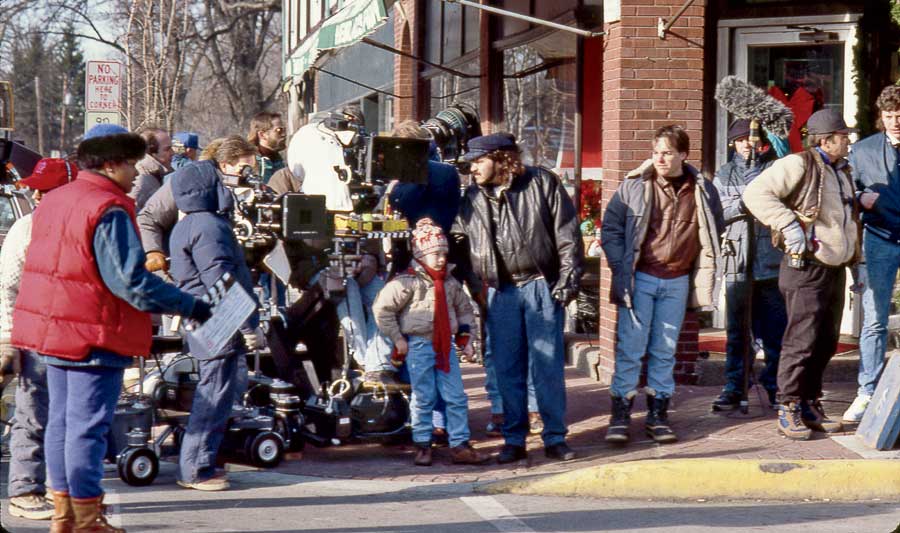
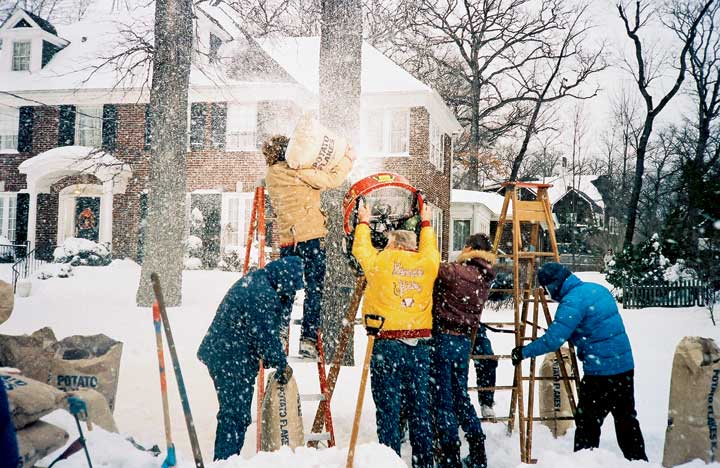
Real snowfall established the wintry look, then the team had to maintain it. The Netflix account describes artificial snow made with potato flakes. The crew photograph below shows the physical labour behind the effect: bags, a fan and people directing the snowfall.
Make the danger feel real, then make it funny
In the American Film Institute’s scene commentary, Columbus explains the practical tricks behind the climax. The paint cans were rubber, the nail retracted, and Daniel Stern wore protective rubber feet for the broken ornaments.
The inspiration included Chuck Jones’s cartoons. But a live performer falling onto a surface creates a different feeling from a drawing. The filmmaking has to suggest an outrageous impact without making the viewer stop enjoying the scene.
Editor Raja Gosnell describes that structure in the Chicago oral history. Stunt doubles Troy Brown and Leon Delaney supplied the demanding falls. Sound and music then shaped what the audience felt at the moment of impact.
That labour deserves to remain visible in a production story. A remembered gag is often the combined work of an actor, a double, a designer, an effects team and an editor. Our Jeannie Epper story follows another career built around that often unseen contribution.
John Williams gives the house its emotional memory
John Williams composed the score. His music lets the film move between mischievous movement and the longing to be home. AFI records Academy Award nominations for both the score and Somewhere in My Memory, with lyrics by Leslie Bricusse.
The musical warmth makes room for a different kind of ending from the burglar battle. Kevin’s reunion with his mother answers the wish at the beginning: being alone looked like freedom until he understood what was missing.
The finished film, and the people behind it
Home Alone opened on 16 November 1990. The credits join Columbus and Hughes with cinematographer Julio Macat, production designer John Muto, editor Raja Gosnell and the many performers and technicians who made the illusion coherent.
The useful lesson is how closely story and production fit together. The home has to feel desirable before it becomes a trap. Kevin has to feel capable before he feels lonely. The comedy works because those physical and emotional spaces were built together.
For another production that turned practical difficulties into memorable filmmaking, read how Jaws was made.