Not needing an app does not automatically settle this choice. You might want a small public page for one documentary. You might want a branded catalogue where viewers browse several collections. Both can happen in a browser, but they are different things to pay for.
This comparison looks specifically at individual film purchases and rentals. It uses published offers checked on 8 October 2026 and hypothetical sales examples. We have not run paid buyer tests on both platforms. If you are still choosing between individual films and a membership, start with our guide to choosing a film sales model.
Can you use Uscreen without buying its apps?
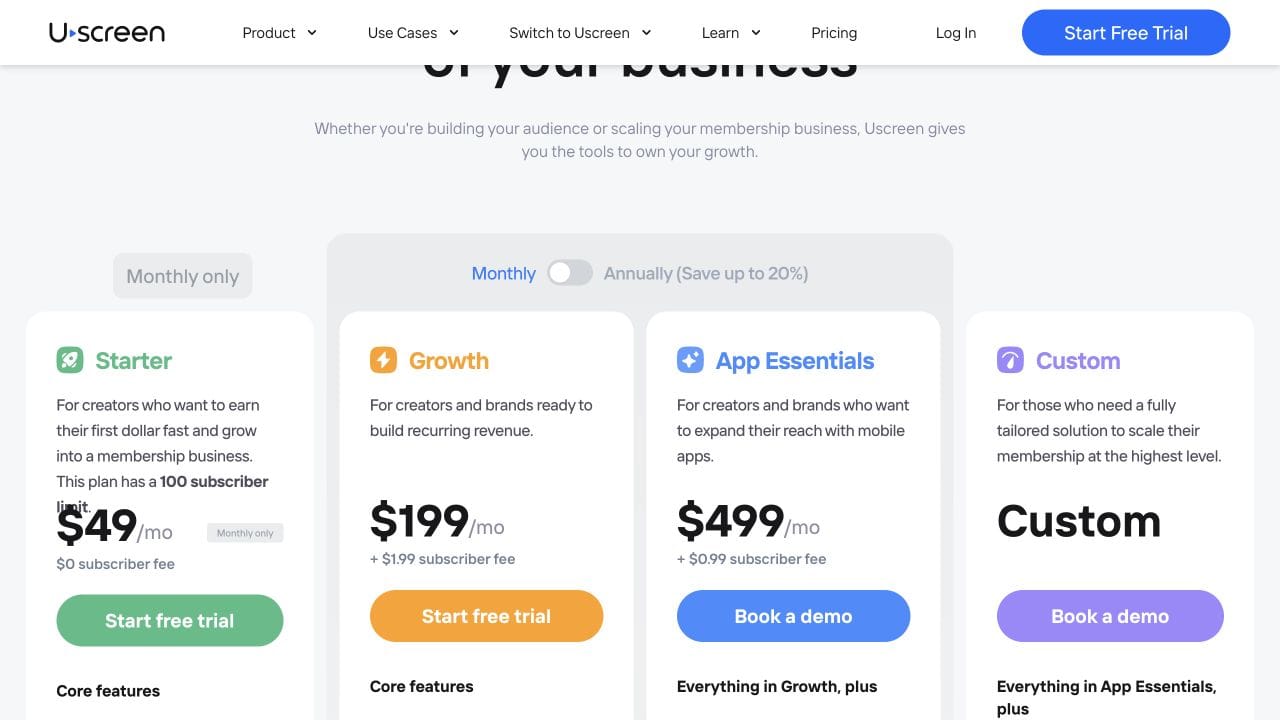
Yes. Uscreen's Starter and Growth plans provide a web offering, while branded mobile apps appear in its separate App Essentials plan. Comparing only the app price would overstate the cost of a browser release.
The practical distinction between the two web plans includes the domain and catalogue allowance. Starter lists a Uscreen branded domain and 20 hours of storage; Growth lists a custom branded domain and 100 hours. Check the current Uscreen plan details against the size and presentation your collection needs.
What are you paying for beyond a film page?
Uscreen is worth examining when organising and presenting a collection is part of the offer. Its catalogue overview describes categories, filters and a library of purchased content. Those capabilities can matter when someone arrives to browse a body of work rather than follow a link to one film.
Uscreen's video access documentation also describes individual purchases, rentals, bundles and subscriptions. Do not mistake a membership focused sales pitch for a requirement to sell everything by subscription.
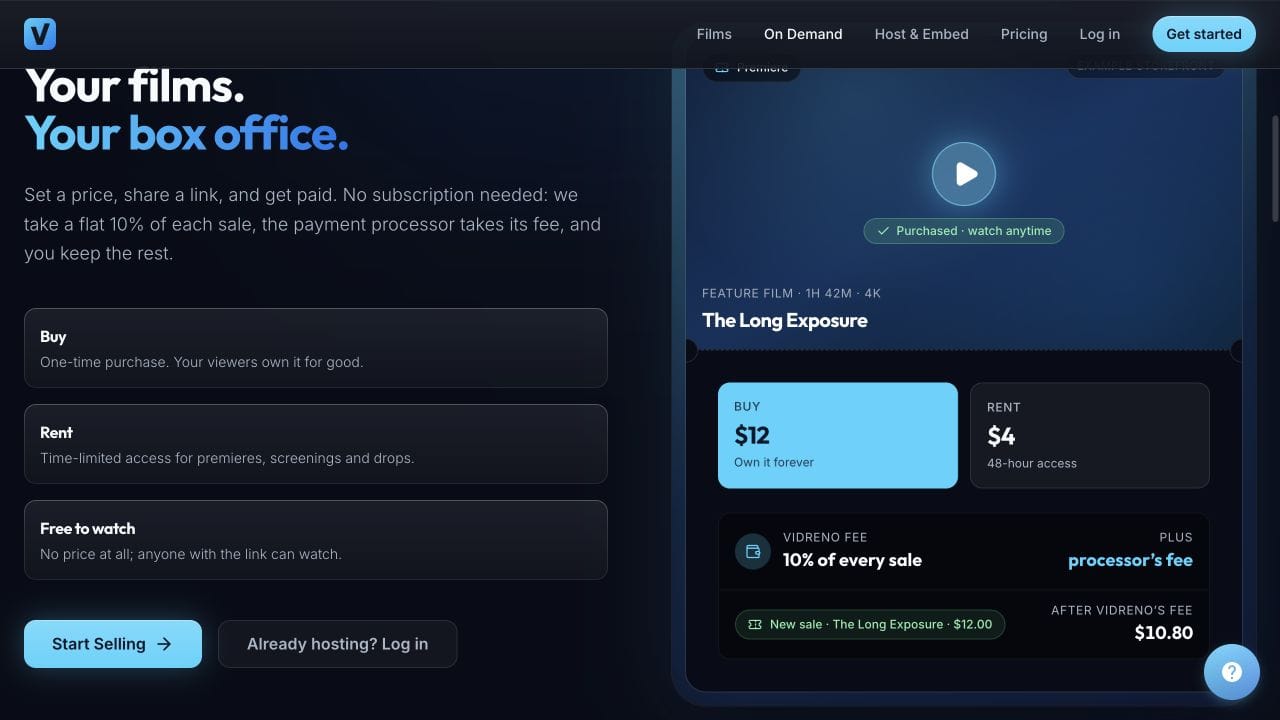
For a smaller release, Vidreno On Demand provides public film pages for purchases and rentals without a required platform subscription. That is separate from Vidreno Hosting, which delivers embedded video on your own website or app. A Hosting plan is not the item being compared here.
Before comparing features, write down three things your buyer must do. For a single documentary, that might be understand the offer, pay for the rental and find the film again. For a collection, it might include searching by subject or buying a bundle. Ask each provider to demonstrate those exact jobs. A longer feature list only helps if it solves one of them.
What are the current platform costs?
Vidreno has a percentage fee without a required subscription; Uscreen adds a plan charge and uses different transaction percentages by plan. Payment processing is an additional consideration on both sides.
| Option | Recurring platform charge | Individual sales or rental fee |
|---|---|---|
| Vidreno On Demand | No required subscription | 10% |
| Uscreen Starter | $49 per month | 10% |
| Uscreen Growth, monthly billing | $199 per month | 5% |
| Uscreen Growth, annual billing | $149 per month equivalent | 5% |
Sources: Vidreno's current selling offer, Uscreen's plan comparison and Uscreen's fee schedule. Growth also lists $1.99 per subscriber. Our calculations below assume individual transactions only, with no recurring subscribers. Do not add a subscriber fee to every film buyer without checking which charge applies.
Uscreen's general fee guide describes a 5% transaction charge, but its current plan comparison explicitly lists 10% for Starter. Use the plan specific figure and confirm your agreement before committing. The annual Growth figure represents $1,788 over a full year; it is not a $149 month to month plan.
At what sales level does Growth's lower percentage matter?
On platform fees alone, Uscreen Growth with monthly billing and Vidreno On Demand meet at $3,980 of individual sales in one month. That is a comparison of two cost formulas, not a claim that the services are interchangeable.
Let R be that month's sales value before tax. Vidreno's platform fee is 0.10 × R. Growth's monthly platform cost in this example is $199 + 0.05 × R. The five percentage point difference covers $199 when R is $3,980.
| Monthly sales | Vidreno | Uscreen Starter | Uscreen Growth monthly |
|---|---|---|---|
| $0 | $0 | $49 | $199 |
| $1,000 | $100 | $149 | $249 |
| $3,980 | $398 | $447 | $398 |
| $6,000 | $600 | $649 | $499 |
At $1,000 of sales, Vidreno's platform charge is $149 below Growth's in this narrow example. At $6,000, Growth is $101 lower. Starter retains the same sales percentage as Vidreno plus its $49 recurring charge, so sales volume alone does not remove that difference.
What if most of your sales happen around one premiere?
Compare the whole period you need the service, including quiet months. A good launch month can make a subscription look attractive while hiding the cost of keeping the catalogue available afterwards.
Imagine one release produces $6,000 of sales in month one, then $500 in each of the next two months. Total sales are $7,000. Vidreno's platform fee is $700. Keeping Growth on monthly billing for all three months costs $597 in plan charges plus $350 in transaction fees, or $947. The difference is $247 before the excluded charges.
This is a planning example, not typical filmmaker sales data. It assumes the same sales on both platforms and that Growth stays active for all three months. If Uscreen's tools produce additional sales or replace another service you already pay for, include that value rather than pretending the results would be identical.
For an annual Growth commitment, the comparable platform fee equation is $1,788 + 5% of annual individual sales. It meets 10% at $35,760 a year under the same limited assumptions. Do not divide one strong premiere by twelve and call that evidence of steady demand. Use a cautious full year estimate and check cancellation and access terms before relying on an early exit.
How should you decide before moving a catalogue?
Use a short requirements list and a realistic release calendar, then compare the full cost of meeting them. If you already pay for a suitable Uscreen account for other work, compare the additional cost of the films as well as the total account cost. Allocating the entire existing subscription to one new film could distort the decision.
- Presentation: is a public film page enough, or is your own branded catalogue essential?
- Access: do viewers need a single rental, a purchase, a bundle or a subscription?
- Continuity: what happens to existing buyer access if you change plans or leave?
- Capacity: does the selected plan cover the actual catalogue and required features?
- Cost: what would you pay in a quiet month as well as at launch?
For the viewing journey itself, use our browser based film release checklist. A provider comparison does not replace checking playback and return access on the devices your audience uses.
Film Courage's interview with filmmaker Josh Folan is useful context on the work around self distribution. Listen for the release preparation and audience work that remain yours whichever service you choose. It is an older interview, not a source for today's platform fees or a test of either product.
Frequently asked questions
Is Uscreen only useful if I want branded apps?
No. Evaluate its browser plans and catalogue features on their own merits. An app package is not the right baseline when your release only needs the web.
Does a lower transaction percentage always save money?
No. A recurring charge can outweigh a lower percentage at modest sales volumes. Compare the full period you need the service, not just the busiest week.
Are the example figures profit after all fees?
No. They compare platform charges only. Processing, taxes, refunds, production, marketing and other applicable costs are outside the calculations.
Can I treat annual pricing as a monthly trial?
No. A monthly equivalent attached to annual billing describes a longer commitment. Check the actual billing and cancellation terms before using it in a short release budget.
Will a public film page bring its own audience?
Do not budget on that assumption. Plan how interested viewers will find the offer. Our direct film sales guide covers that separate work.
Which should I consider for one film with uncertain sales?
Start by considering Vidreno On Demand if a public purchase or rental page meets the release requirements. Avoiding a required subscription keeps the recurring platform cost out of a quiet month. Choose a more involved catalogue service when you have a specific need and a budget for it.
For a straightforward individual release, explore Vidreno On Demand, prepare one film and check the offer before sharing it. You can make that first decision without buying a monthly platform plan.