You have finished the film. Now comes a different decision: should people watch it freely, pay for it, or see it first at a festival?
Start with the result you want. A useful introduction to your next project, a screening with the right people and receipts from viewers are different outcomes. A release can serve more than one, but it helps to choose the first priority.
This guide is about that choice. It is not a promise that a particular platform will find your audience or recover your budget.
When does selling your short film directly make sense?
Selling directly makes sense when watching the complete film is the offer, and you have a credible way to bring interested viewers to it. With Vidreno On Demand, you can offer a purchase, a rental, or both on the film's own page, without a subscription.
That is the useful advantage over waiting for YouTube advertising eligibility: the commercial offer is access to your film. You do not have to make a channel's advertising thresholds the centre of your release strategy. You still need people who want to watch, and a price does not guarantee a sale.
Imagine a short documentary about a community whose members already follow the project. An invitation to watch the trailer and rent the finished film gives that audience a clear action. That is an illustrative release situation, not a Vidreno customer result.
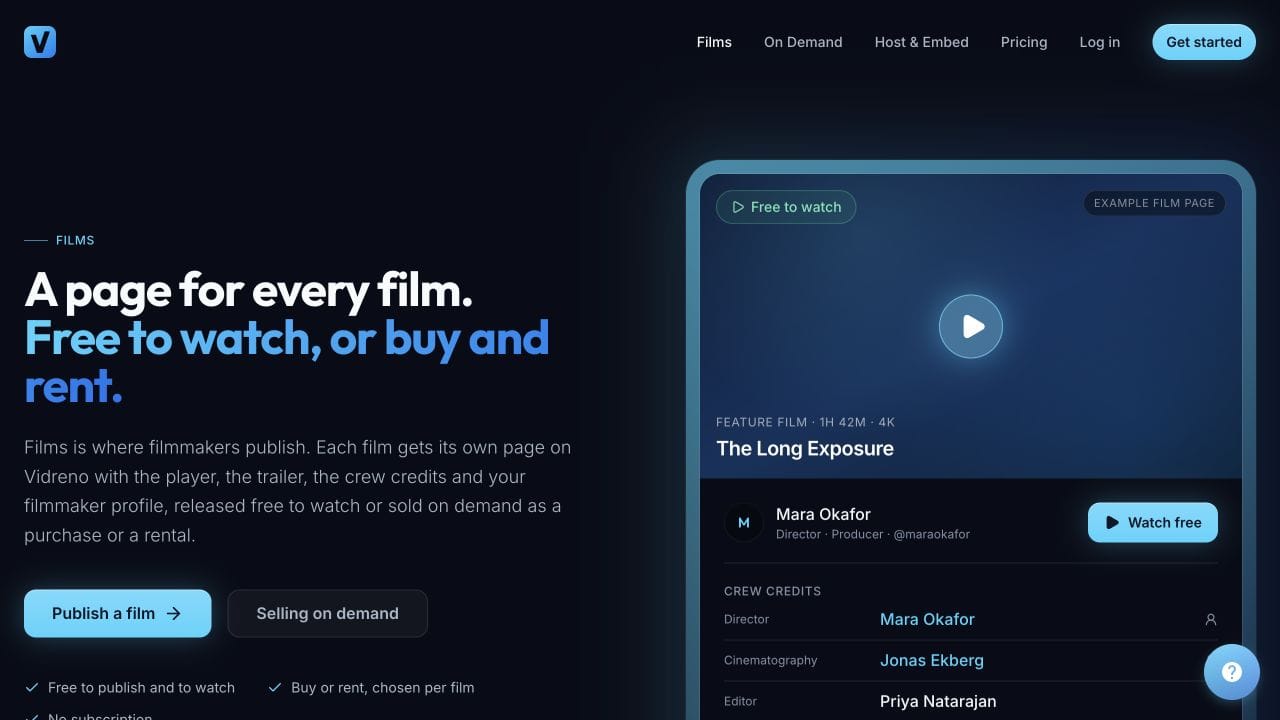
Vidreno also lets you publish a film free to watch. You can choose the approach per film and change it later. That is helpful if your first priority is simply to let people see the work while keeping a dedicated film page, trailer and credits together.
These are public film releases. Vidreno Hosting is the separate service for embedding hosted videos inside websites and apps.
Will YouTube pay you for uploading one short film?
Uploading one film does not automatically earn advertising revenue. As checked on 12 October 2026, YouTube's eligibility rules require 1,000 subscribers and either 4,000 qualified public watch hours in 12 months or 10 million qualified Shorts views in 90 days for the higher revenue sharing threshold. Channels also undergo review and must meet the other programme requirements.
A short film and a YouTube Short are not interchangeable terms. Watch time from the Shorts Feed does not count towards the 4,000 hour route.
| Level | Audience requirements | What this means |
|---|---|---|
| Expanded programme, in eligible countries | 500 subscribers, three public uploads in 90 days, plus 3,000 qualified watch hours in 12 months or three million qualified Shorts views in 90 days | Earlier access to eligible fan funding and Shopping features, not the higher advertising revenue tier |
| Advertising revenue sharing | 1,000 subscribers, plus 4,000 qualified watch hours in 12 months or 10 million qualified Shorts views in 90 days | Eligibility to apply, not automatic acceptance or guaranteed earnings |
The lower level is described in YouTube's expanded programme guidance. For a filmmaker trying to sell access to one finished work, Vidreno's purchase and rental model addresses a different need from building towards advertising eligibility.
There is no honest fixed answer to how much your film would earn from views. Do not build a release budget around an assumed payment for every play.
Does putting a short film online rule out festivals?
Not universally. Festival rules differ by category and edition, so check the events you actually intend to enter before publishing the complete film, whether free or paid.
The Sundance 2027 submission FAQ is a useful example. Its US and international short film categories allow projects completed after 31 December 2025 regardless of premiere status. It separately excludes completed projects publicly exhibited or made available before 1 January 2026. Other eligibility conditions still apply.
That does not establish the rule for another festival, another year or a feature film. Sundance's feature categories have different requirements. The listed final short film submission deadline for the 2027 edition was 31 August 2026, so this is an example of the eligibility distinction, not an invitation to submit now.
What can Ryan Koo's Amateur release teach us?
A release plan needs a purpose beyond the upload. In Film Courage's interview published on 28 August 2013, Ryan Koo explains why he released the short Amateur online and how it related to his feature ambitions.
At about 1:00, Koo describes strong film press attention around the launch, but also explains how the wider news cycle disrupted the sports coverage he hoped to reach. A promising plan still depended on circumstances outside his control.
At 2:30, he discusses festival screenings despite the film being online. Later, around 3:39, he describes the short's value as a proof of concept and an opportunity to work with crew. The lesson is to decide what the short needs to do for your next step, rather than treating view counts as the whole result.
The cover shows Amateur, the short discussed here. Image source: Ryan Koo's No Film School article about turning a short into a feature.
How should you choose a release route?
Choose the route around a specific outcome and the audience you can realistically reach. Vidreno gives you a dedicated destination for either a paid or free release; your launch plan supplies the reason to visit.
| Your first priority | A practical starting point | What to check |
|---|---|---|
| Sell access to the completed film | A Vidreno purchase or rental page | Who is likely to pay, what access they receive and how you will reach them |
| Let prospective collaborators see your work | A free Vidreno film page with clear credits | Whether public release fits your remaining commitments |
| Preserve specific festival opportunities | Confirm those rules before a public release | The current edition and category, not general advice from an old video |
| Develop a feature from a short | Decide who needs to see the proof of concept | Whether a private presentation, festival screening or public film page serves that next conversation |
If you already use YouTube to introduce your work, a trailer can point viewers towards the complete film on Vidreno. The advantage of the Vidreno destination is a clear purchase or rental offer for that film. Keep the invitation accurate, and do not describe the full film as exclusive if it is freely available elsewhere.
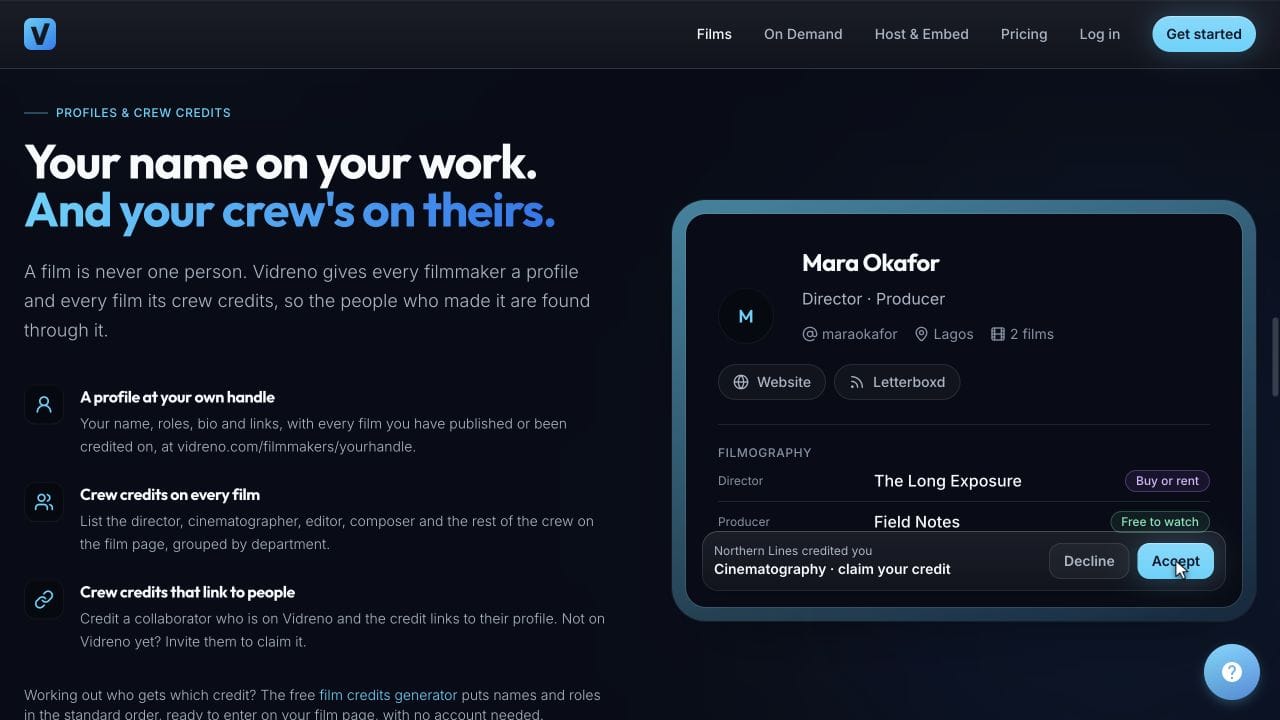
A release is also an introduction to the people who made the film. Vidreno's film pages connect crew credits with filmmaker profiles, so viewers can follow the work back to its makers. Our film landing page checklist covers how to make the film's offer and next step understandable.
What should you decide before launch?
Write a short release plan before choosing the public date. Keep it specific enough that you can tell whether the release did what you hoped.
- Choose one primary result. Paid viewings, relevant industry conversations and broad access need different invitations.
- Check remaining commitments. Confirm festival conditions and any existing distribution agreement before publishing.
- Choose the offer. Decide whether the film is free, a rental or a purchase. Describe the access accurately.
- Choose the destination. Use the Vidreno film page as the clear viewing link in your release materials.
- Set a review date. After the first release period, compare the response with your actual goal before changing access or price.
You do not need to decide the film's entire future on launch day. You do need to avoid promising paying viewers something that a later change would undermine.
Frequently asked questions
Can a short film be free without going on YouTube?
Yes. Vidreno supports free public film pages as well as purchases and rentals. Free access is a release choice, not something tied to one viewing platform.
Should every short film be sold?
No. If the priority is letting collaborators or a relevant community see the work, a free release may serve that goal better. Vidreno lets you choose per film, rather than forcing the same offer across your catalogue.
Does a paid film page bring its own audience?
No audience is guaranteed. A Vidreno page provides the film's destination and offer; you still need a reason for relevant people to visit it.
Can I make a paid film free later?
Vidreno lets you change a film's mode. Plan that change carefully around what earlier buyers were promised, and communicate the offer honestly.
Will taking a film offline restore festival eligibility?
Do not assume it will. A festival may consider the film's previous availability, not just whether a link works today. Check the specific rules before the first public release.
Give your short film a clear next step
If the aim is to sell viewings, start with Vidreno On Demand and a straightforward purchase or rental offer. If the aim is access, publish the film free on Vidreno. Either way, build the release around what the film needs to achieve, not an advertising threshold that may have little to do with your next project.