Before it became a shorthand for determination, Gonna Fly Now was a practical answer to an editing problem. John G. Avildsen needed music to organise footage of Sylvester Stallone training. Bill Conti gave him a piano sketch. The director wanted more, then more again.
The famous Rocky theme grew through that exchange. Its story brings together a composer working within a small budget, a director finding the shape of a sequence and singers whose layered voices made a handful of people sound much larger.
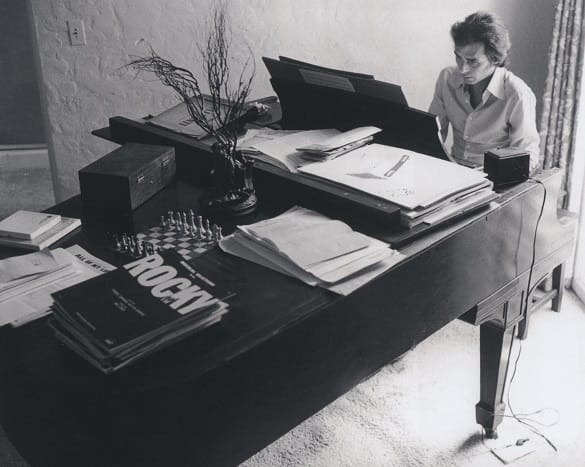
Cover: Bill Conti at the piano, with Rocky material among the papers. Photograph published with Thomas Alexander’s HeyUGuys interview. The source does not identify the photographer or date.
A character theme before a hit song
Stallone wrote and starred in Rocky, released in 1976, with Avildsen directing. The film gives its boxer an extraordinary opportunity without turning him into a naturally invincible hero. That distinction matters to the music: the training sequence has to make possibility feel real.
In his ABC 10 News interview, Conti explains the dramatic assignment in unusually direct terms. The audience needed to believe Rocky could win. A succession of exercises would convey information, but music could make those exercises feel like a change in the man doing them.
Conti describes taking material associated with Rocky’s sadness and making it faster and more spirited. The melody’s identity remained useful precisely because its emotional meaning could change. We recognise the person even as we begin to imagine a different result.
Watch Conti explain the idea: in this ABC 10 News interview, he describes the dramatic purpose of the montage and Avildsen’s requests for more music.
The edit and the music grew together
The starting request was around ninety seconds. In Tim Greiving’s NPR interview report, Conti recalls supplying a piano recording for Avildsen and the editors to work against. The music helped them decide which physical actions belonged together and where the sequence should change.
Requests for additional thirty second stretches eventually brought the passage to roughly three minutes. The climb towards the Philadelphia Museum of Art steps became the destination of a small story within the larger film.
This is a useful reversal of the familiar idea that a score simply follows a finished cut. Here, a musical sketch gave the edit a structure; the developing edit then asked the composer for more. Neither had to be complete before the other became useful.
For filmmakers, the lesson is practical. An early musical idea can test the emotional direction of a sequence without pretending to be the finished recording. What matters is agreeing what changes for the character, then letting rhythm and picture help express that change.
A package budget and a fast recording session
Conti’s Television Academy oral history puts a figure on the constraints. He remembers a $25,000 package covering musicians, recording materials and engineering, with his own payment coming from what remained. He says he retained $15,000.
In the same recollection, there was no money for a projectionist at the recording session. Rather than watching the film run while the orchestra played, they worked through the prepared music and moved on. He remembers recording the score in one three hour session.
Those are Conti’s later memories, not a surviving session ledger. They nevertheless explain the production pressure clearly: the package had to deliver recorded music, not just pay for composition. Preparation and decisions made before the players arrived had financial consequences.
The voices behind the apparent choir
Carol Connors and Ayn Robbins supplied the lyrics. The familiar vocal performances are by DeEtta Little and Nelson Pigford. In Total Rocky’s original interview with DeEtta Little West, the singer recalls meeting Conti through his wife Shelby, with whom she worked.
West identifies United Artists Studio in Los Angeles as the recording location. Her account places Conti at the centre of the session: conducting, playing piano and directing the singers. She also recalls Shelby singing on the recording, although uncredited.
The scale of the vocal sound was partly a studio construction. West describes overdubbing the small group to produce the impression of a choir. That detail gives the theme a different kind of grandeur: much of its force came from performances being combined, rather than from assembling a huge vocal ensemble.
Conti’s brisk story about recruiting people from his wife’s office should not obscure the performers’ skill. West had already recorded professionally. Her recollection restores names and craft to an anecdote that can otherwise make the singing sound accidental.
Thinking beyond the film mix
Conti also remembers paying extra to record on 16 tracks. In his Academy interview, he distinguishes that recording from the magnetic film recording used for synchronisation. He had an album in mind even when others were not discussing one.
The useful point is not that every independent score will become a hit. It is that a recording decision can preserve possibilities beyond the immediate delivery. Agreeing what needs to be recorded, retained and available for later use belongs in the production conversation early.
The score had more to do than inspire a run
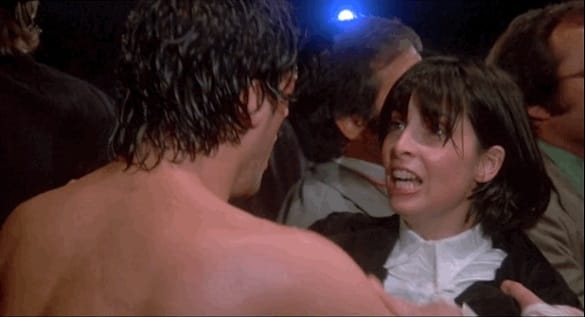
The training anthem can overshadow the rest of Conti’s work. In his 2016 interview with Thomas Alexander, he describes the final fight as a difficult musical problem because rounds had to be compressed. He also recalls playing Avildsen music that supported ending the film with Rocky and Adrian in the ring, rather than the departure originally filmed.
That account places the composer inside decisions about the film’s emotional ending. The important arrival is a connection between two people. The music’s job is broader than making a boxer look powerful.
Listen to the score with that in mind and the training theme becomes part of a larger dramatic design. Its lift matters because Rocky has sounded vulnerable. The achievement is the change between those states.
What to carry into your own film
- Give the composer a dramatic question. What should the audience believe about the character by the end of this sequence?
- Try music while the edit can still respond. A piano sketch may reveal a structure before the recording budget is spent.
- Budget for delivery. Composition, players, studio time and usable recordings are separate needs even when the fee arrives as one package.
For another approach to musical character, read our story of Interstellar’s organ score. Conti’s piano sketch and Zimmer’s organ writing offer very different sounds, but both show how a musical choice can give a film its emotional scale.
Making a film of your own? Explore Vidreno and create a free account to start planning how you will share it.