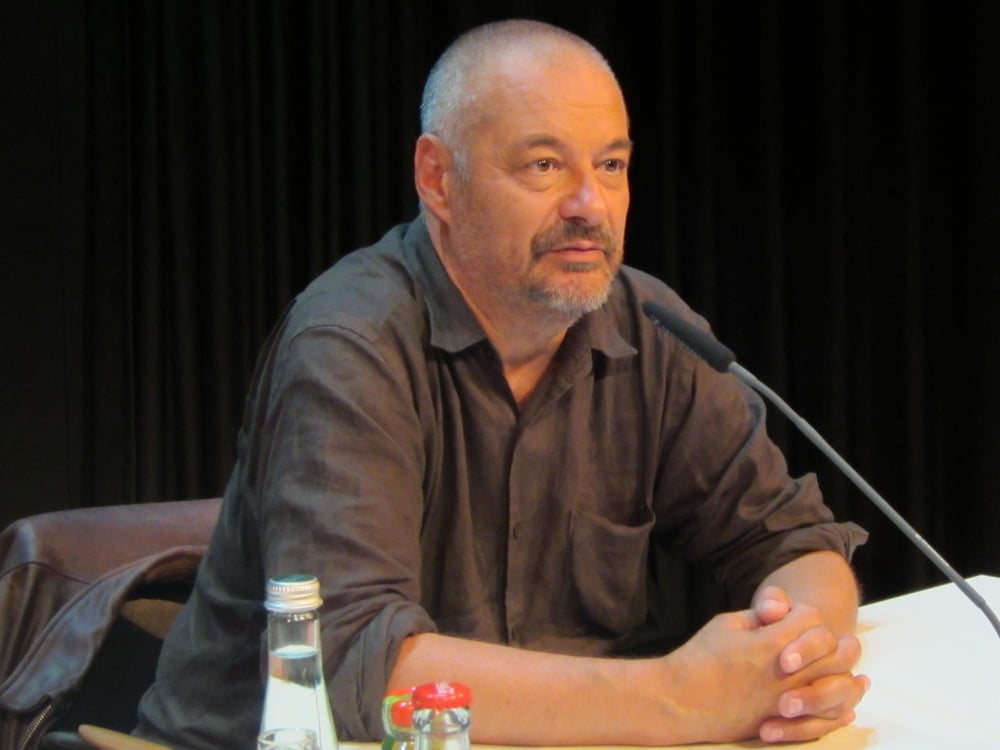
Jean Pierre Jeunet at the Munich Film Festival in 2014. Photograph: Kalligraf, CC BY SA 4.0. Original image, uncropped.
Before Jean Pierre Jeunet had a film set, he had a small theatre he built himself. At eight, he was already assembling a story, lighting, costumes and scenery. The scale would change enormously. The appetite for making every part of an imaginary world would not.
His career runs from puppet animation and Delicatessen to Alien Resurrection, the worldwide embrace of Amélie and the mechanical household of Bigbug. Now Violette, his adaptation of Valérie Perrin’s Fresh Water for Flowers, brings him back to a story rooted in human lives. His official site gives its French cinema release as 9 December 2026.
A telephone job, a camera and a partner
Born in 1953, Jeunet learned filmmaking by doing it. In his BAFTA conversation with Francine Stock, he remembers seeing Once Upon a Time in the West at 17 and feeling overwhelmed. Two years later, a visitor brought a Super 8 camera to the family home. Jeunet still remembered the sensation of holding it.
Working for a telephone company gave him a practical route to buying his own camera. Animation offered a way to start making films without waiting for a large production. At an animation festival in Annecy, he met Marc Caro, whose drawings and visual imagination would become central to their work together.
They made L’évasion and Le Manège, then moved into live action with The Bunker of the Last Gunshots. Commercials and music videos helped sustain the years before a feature. These were working years, not a blank space before the career began: small productions let them practise how images, sound and performance could fit together.
In his interviews, he separates wanting the status of a director from wanting to make films. His own route began with something he could build and finish, then grew through the people who saw it.
Delicatessen made the strange idea travel
The first feature breakthrough was Delicatessen in 1991. Its grotesque apartment building and butcher were an unlikely proposition for financiers. In Vanity Fair France’s career interview, Jeunet credits producer Claudie Ossard with the long search for money.
He also describes a wonderfully ordinary source for the premise: living above a butcher’s workshop and hearing the cleaver in the morning. A joke about the butcher working through the residents became an idea for a film. Keeping the action in one building offered a way to contain the cost without containing the imagination.
Jeunet remembers the film selling to 45 countries during a week at Cannes. That international response mattered beyond the first success. It showed that an extremely particular visual world could reach audiences who did not share its language.
Dominique Pinon became one of the faces of that world. Caro shaped its design while Jeunet concentrated on actors and storytelling. Writer Gilles Adrien and cinematographer Darius Khondji were important parts of the early features too. The credits on Jeunet’s IMDb page trace a career built through returning collaborators.
A bigger world, then Hollywood
The City of Lost Children followed in 1995, expanding the partnership into a dream stealing fantasy. Ron Perlman joined a production whose collaborators included composer Angelo Badalamenti and costume designer Jean Paul Gaultier. Its scale made the division between visual invention and narrative discipline more demanding.
At BAFTA, Jeunet describes that tension as one reason he and Caro stopped directing features together. In the Vanity Fair interview, he connects the film’s American following to the invitation to direct Alien Resurrection in 1997.
He was already developing Amélie and was initially uncertain about the Hollywood offer. Sigourney Weaver’s welcome helped. So did permission to bring familiar collaborators. Pinon, Perlman and Khondji were among those who joined him. Jeunet remembers considerable freedom, alongside a difficult shoot. The experience enlarged his working world without making him abandon the film he wanted to make back home.
Amélie turned a collection of observations into a life
Amélie arrived in 2001, but its material had accumulated over years. Jeunet describes a store of memories, jokes and personal observations. Guillaume Laurant brought his own ideas into the writing. The result gave small private pleasures and quiet acts of kindness the attention usually reserved for grand adventures.
The casting was not inevitable. Jeunet tells BAFTA that he first developed the role for Emily Watson. After she withdrew, he saw Audrey Tautou on a poster and met her. Her screen test quickly convinced him. The film’s identity emerged through that meeting of performer and material, rather than simply executing the first version of the plan.
The success opened a door to A Very Long Engagement in 2004. Jeunet had wanted to adapt Sébastien Japrisot’s novel, and Tautou gave him his Mathilde. Gaspard Ulliel played opposite her, with a cast also including Marion Cotillard and Jodie Foster. Jeunet recalls Warner supporting a French language production with the casting freedom and final cut he wanted.
Micmacs, Spivet and the pleasure of making things
Micmacs in 2009 brought Dany Boon into Jeunet’s cinema. The Young and Prodigious T.S. Spivet followed in 2013. For the latter, Jeunet took on filming in 3D rather than converting the finished images. In the Vanity Fair interview, he describes studying what worked in the format, then the frustration of limited opportunities for audiences to see the result that way.
Between features, the smaller forms continued: advertising, a Casanova television film and the 2016 animated short Deux escargots s’en vont, made with Romain Segaud. A filmmaker who began with objects and puppets had not outgrown them.
That continuity makes Bigbug, released in 2022, more revealing than a simple change of platform. Jeunet says Netflix agreed to make the unusual robot comedy after years of difficulty getting it financed. Yet the futuristic setting still depended on physical construction and familiar collaborators.
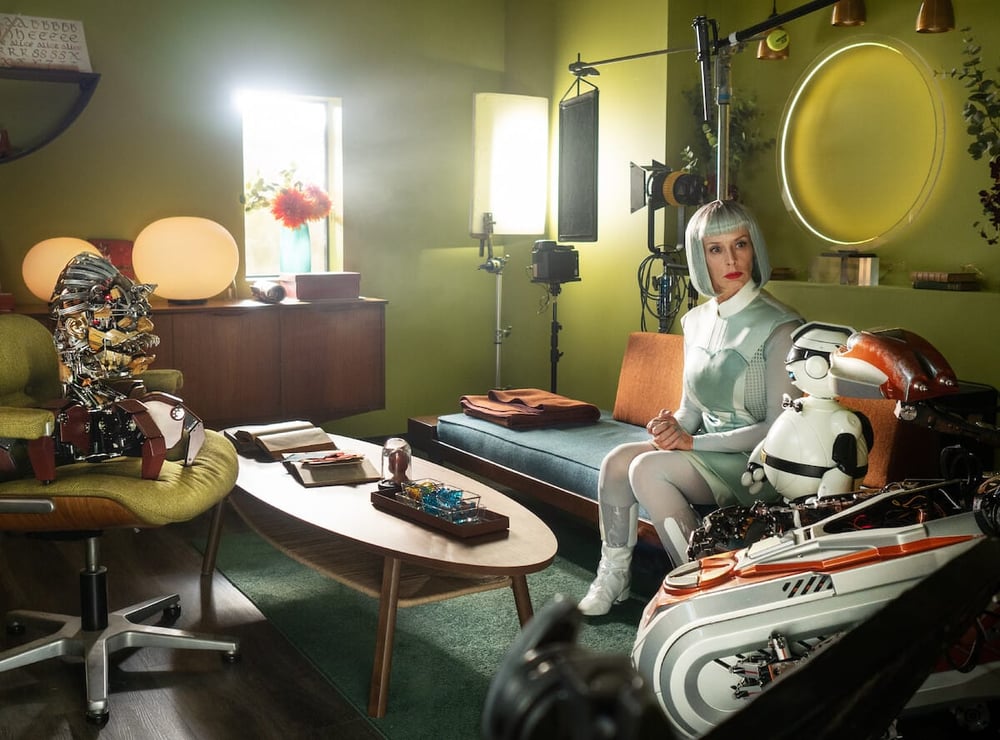
In Netflix’s production interviews, effects supervisor Pascal Molina explains how the robot Einstein grew into a wood and metal construction with 82 servomotors. Molina had previously worked on The City of Lost Children and A Very Long Engagement. Costume designer Madeline Fontaine shaped Monique’s appearance around a 1960s idea of the future, while visual effects supervisor Alain Carsoux helped give the humanoid robots subtle electronic details.
It is a useful reminder of what an individual style actually requires: people who can turn an idea into a costume that behaves properly, a prop that moves or a performance that feels just unfamiliar enough. Our story on the creature craft of Pan’s Labyrinth explores another production where those disciplines meet.
Violette and the work still ahead
Jeunet’s latest feature is known internationally as Violette and in France as Changer l’eau des fleurs. His official updates describe four years of work on Perrin’s novel and name Leïla Bekhti, Matthias Schoenaerts and Melvil Poupaud among the cast. Palomar and 24 25 Films produced the adaptation. Sony Pictures Classics lists Violette among its forthcoming films.
His site also reports a completed screenplay with Laurant adapting Jean Baptiste Andrea’s Des diables et des saints. A finished script is not a finished film, but it shows the writing partnership continuing beyond the current release.
Looking across the career, the breakthrough was not one lucky leap from obscurity to Amélie. It was a sequence of completed work, difficult financing, recurring collaborators and new chances to build. The boy making a theatre became a director who kept finding different sizes of stage.
Follow the work
- Jeunet’s official website carries his own film updates.
- IMDb lists his directing, writing and producing credits.
- The original BAFTA Guru and Vanity Fair France YouTube interviews let you hear the stories in his own words.
Making a film of your own? Create a free Vidreno account to start sharing your work.