Cover photograph: Pedro Pascal holding a cello on the set of Behemoth! Photograph: Justin Lubin/Searchlight Pictures. Courtesy of Searchlight Pictures. © 2026 Searchlight Pictures. All rights reserved.
A cellist sits down to record someone else’s film. The music begins, and his own past comes back. That is the structural idea behind Tony Gilroy’s Behemoth!, and it created an unusual composing problem: the music needed to sound as though it belonged to several different films, families and working lives.
Gilroy recruited nine composers, credited as the Behemoth! Collective. Their assignments ranged from an action franchise and a television detective theme to a period romance, a cartoon and a young musician’s own compositions. Understanding those separate briefs explains how the score became part of the writing, rehearsal and filming.
Nine composers created distinct musical identities within one drama. Some pieces had to be ready before filming so that Pedro Pascal and the musicians could perform convincing movements. Other music followed the edit. The shared structure came from Gilroy’s script and the life of cellist Alex Serian.
A story discovered inside a scoring stage
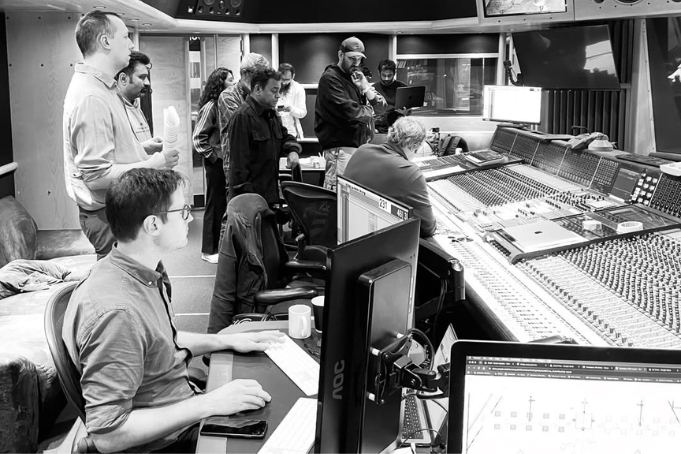
In his Film at Lincoln Center conversation, Gilroy traces the idea to the recording environment he had encountered on his earlier films, particularly the intense scoring period for Rogue One. The room contained an entire working culture: specialist musicians, inherited habits, professional pressures and people whose lives extended beyond the session.
The screenplay follows Alex Serian, played by Pascal, back to Los Angeles after twenty years away. Music opens passages into his past. Gilroy explains that the familiar experience of a song retrieving a memory offered a natural structure for a character whose whole working life is musical.
That gives a scoring session two jobs. It is an event in the present, with players doing paid work, and a doorway into an earlier experience. A cue therefore needs an identity of its own before it can carry the larger drama.
Nine composers, nine different briefs
Gilroy describes the selection process as “cast it like actors”. The point was to find the right musical personality for each assignment. Searchlight’s official production notes set out the division of work:
| Composer | Music within the film |
|---|---|
| Henry Jackman | Spies Don’t Run, a fictional action comedy franchise. |
| Michael Giacchino | Happy & Slappy, cartoon music attributed to Alex’s father. |
| Alan Silvestri | Open World, a fictional blockbuster. |
| Brandon Roberts | Look Away Jones, a fictional detective series theme. |
| Emily Bear | Seasons of Glass, a period romance, and the song Make Mine Salty with Gilroy. |
| Michael Abels | Solo cello practice pieces. |
| James Newton Howard | Music associated with Viviana, the young musician played by Alexa Swinton. |
| Lukas Frank | The club song Your God Is Sleeping and the opening Serian family theme. |
| Nami Melumad | Tolerance Hill, a fictional period drama with music for harp. |
These are useful distinctions for a listener. Jackman’s cues belong to a commercial action world. Bear’s waltz suggests an older romantic cinema. Roberts supplies the remembered identity of a television programme. Abels brings the scale down to the private work of practising an instrument.
The variety has a dramatic purpose. Alex moves through music as a professional and as a son, father and former partner. Keeping those musical worlds distinct allows a change in sound to carry information about where he is, and which part of his life has returned.
Writing music before the camera could roll
The production notes describe phone recordings and rough visualisations assembled with music before filming. These helped establish timing and physical action. Editor John Gilroy consequently faced an unusual relationship between image and sound: some musical structures were already waiting for the scenes.
In the original interview, Tony Gilroy explains why that preparation mattered. There was little value in asking Pascal to spend time learning a passage that would never appear in the film. For the relevant sequences, the filmmakers needed to know what the camera would require from the performance.
It was not a single rule for every composer. Gilroy specifically says that Giacchino worked after the cut. That distinction is useful for smaller productions too: decide which music must shape an action during filming, and which music can respond to the finished scene.
Making a musician believable, one movement at a time
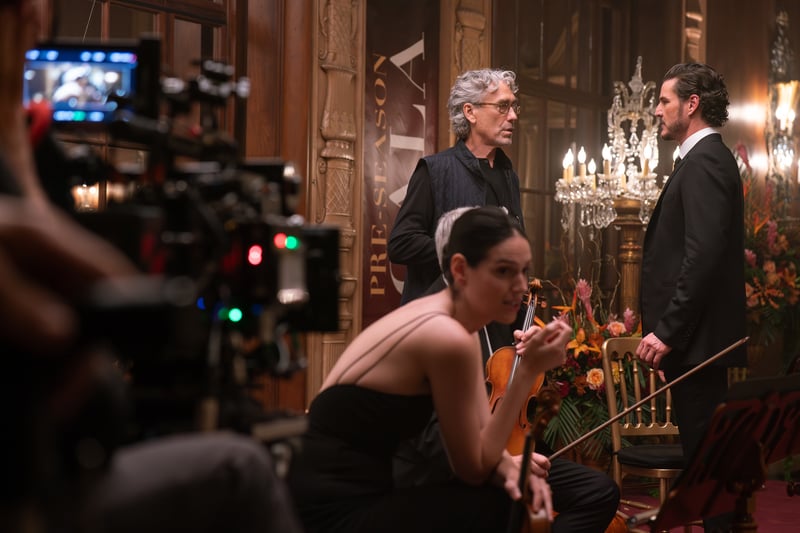
Pascal’s account begins with something much smaller than a finished performance: learning to hold the bow. He describes weekday lessons and the satisfaction of placing it correctly without his teacher having to adjust him. The work made a seemingly simple gesture into a rehearsed action.
Music production supervisor Timothy Loo led the preparation. According to Searchlight’s notes, the production also cast real musicians and used Los Angeles recording spaces including the Sony Pictures Scoring Stage, the Newman Scoring Stage and EastWest Studios.
Those decisions give the actors a credible working environment. A scoring room has a way of sitting, watching and responding as well as a sound. The surrounding players help establish the professional world the central performance must inhabit.
The difficult brief was a child’s musical voice
One particularly revealing passage in the interview concerns Viviana. Gilroy wanted music that could communicate an exceptional imagination while remaining physically plausible for a young player. Hand size, reach and freedom of tempo were part of the discussion, alongside the emotional meaning of the composition.
He recalls working through that problem with James Newton Howard, then giving Howard the other music associated with the character to preserve continuity. A recognisable voice emerged from a specific dramatic and physical brief.
The lesson travels well beyond this film. Describing a character as talented does not tell a composer enough. Explaining how that person moves, what they can physically play and what the scene needs the audience to understand provides something concrete to write towards.
For each cue, establish who it belongs to, what the audience must learn, whether a performer appears to play it, and when it must be finished. Those answers can determine the composing schedule as much as the final edit does.
Giving the collective a workable shape
In an Associated Press interview, Gilroy says the composers received equal pay. Establishing common terms was part of bringing together people with different careers and working arrangements.
Artistically, the structure remained specific: each contributor had an assignment, while Gilroy held the wider narrative. For a filmmaker, the useful idea is the clarity of that division. A shared credit alone cannot explain how several pieces of music should relate to a story; the brief has to do that work.
Where to follow Behemoth!
Behemoth! premiered as the New York Film Festival’s 2026 Centrepiece selection. Searchlight lists its US cinema release for 4 December 2026. Its official film page carries the production notes and photographs used here; Film at Lincoln Center’s Instagram accompanies its original filmmaker conversations.
For the broader path to this film, read our Tony Gilroy career story. For another example of music shaping a film’s identity, explore the organ at the heart of Interstellar.
Making a film of your own? A free Vidreno account lets you explore publishing it through Vidreno On Demand.