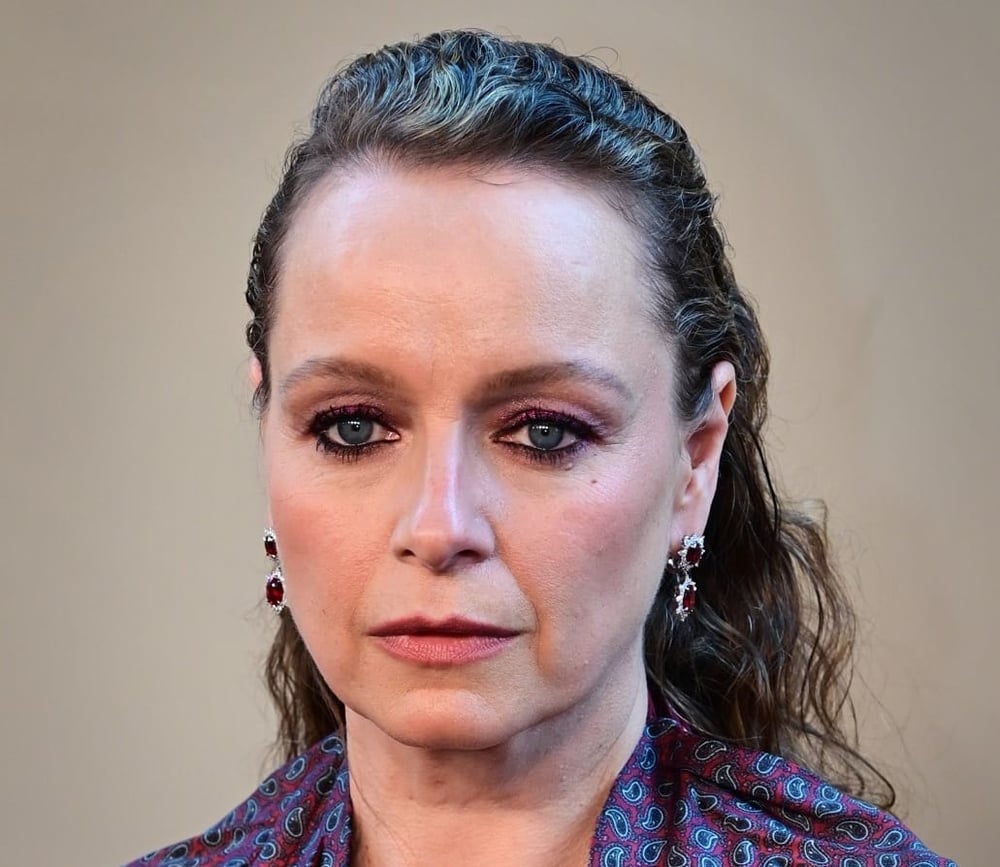
On the day a Wall Street Journal crew visited the set of Vicious, the actors filmed five scenes covering more than thirteen script pages. One performer described the gap between takes in increments of five minutes. Change clothes. Touch up make up. Rehearse. By then the camera was ready again.
Vicious is a romance made for people holding their phones upright. Its episodes last a minute or two. For a filmmaker considering a job on one, the revealing number is how many pages a crew shoots in a day. It explains why a producer looking at a showreel might want to hear as much about continuity as camera movement.
Media Partners Asia estimates worldwide microdrama revenue at $20 billion in 2026. In a Los Angeles Film School panel, a ReelShort producer put a typical production budget at $130,000 to $200,000 for an entire series. A crew member’s fee comes out of a production budget. The global revenue figure measures what audiences, advertisers and brands spend.
Who gets the first 74 cents?
The new study from Media Partners Asia estimates that China accounts for $15.2 billion of this year’s total. Outside China, the researchers counted dedicated apps and their web stores. A drama watched in a general social feed falls outside that part of the calculation.
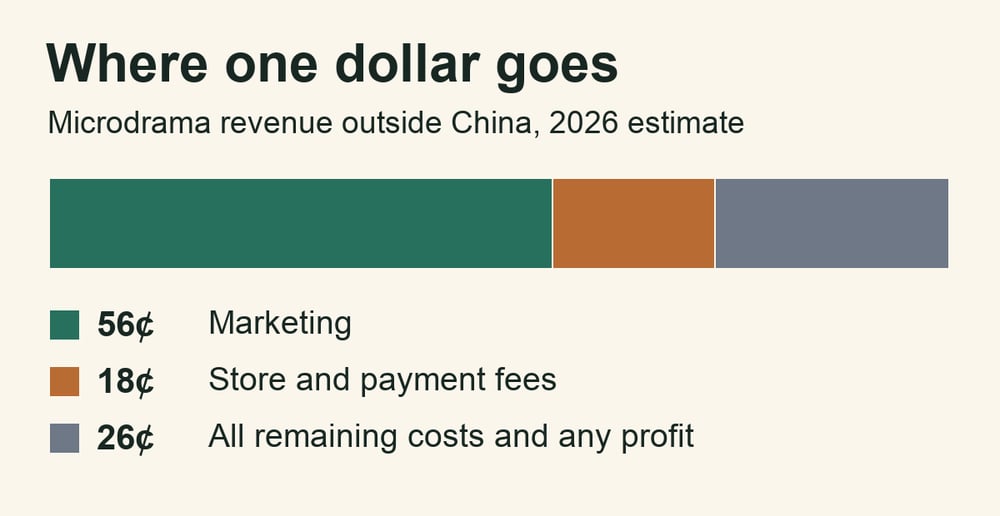
Getting a viewer from an advert into an app is expensive. Outside China, MPA estimates that marketing absorbs 56 cents of each dollar of revenue. App stores and payment providers take another 18 cents. That leaves 26 cents to cover making or buying shows, paying staff, running the service and any eventual profit. A producer budgeting a shoot cannot count on that whole quarter.
Only about one user in twelve pays in a typical month, according to MPA. Watch the set report below and the connection between that figure and the script comes into focus. The app lets viewers watch opening episodes for free. A later episode can stop just before a kiss, with the next instalment available for coins. For the writer and editor, the cut before that kiss is also a commercial decision.
What fits into seven to ten shooting days?
Speaking to the Los Angeles Film School, ReelShort’s producers described filming something close to feature length and delivering it in 70 to 90 instalments. A shoot typically took seven to ten days. They aimed for about ten pages a day, dropping to eight or nine when the work involved stunts or intimacy.
One producer remembered getting through 29 pages in a day. The actors were talking in one space, so the crew could block the action and keep shooting. That detail matters more than the record. Move company, change the light or ask two performers to rehearse a complicated physical scene and those same pages make quite a different day.
The Journal’s visit offers a check against the exceptional anecdote. Its reporters saw just how quickly the crew moved between scenes on Vicious, an adaptation of L. J. Shen’s novel. Watch the director ask for a change to the reading of one line. Even in a schedule measured in minutes, there is time for another version when the note is specific.
Which crew skills do the producers ask for?
At the film school panel, producers singled out three jobs that can be hard to fill well. Each solves a problem that becomes more expensive the faster a unit moves. These are examples of what to show a production manager when making an approach.
| Role | A useful work sample |
|---|---|
| Script supervisor | A lined script and continuity notes from a finished scene. Show how the editor could find a matching take. |
| Assistant director | A day’s schedule you helped deliver. Explain what you moved when a location or performer became unavailable. |
| Digital imaging technician | A camera report and an example of how you checked and handed over the day’s media to post. |
In a public crew call, producer Annine Zhang listed contract roles for Los Angeles locals, including assistant directors and script supervisors. She described a rolling list for future projects. It gives applicants a sense of what to send and whom a producer needs to hear from. A call for names is a step before a booking.
Before you accept a booking
The panel’s budget range covered the whole production. Neither the panel nor MPA’s revenue estimate establishes a rate for a particular crew role. If you are comparing two offers, get the terms that determine what the job will actually pay.
- Count the paid days. Ask which prep, shoot and wrap days are confirmed and which are still being held.
- Get the working day in writing. Check the hours covered by the rate, overtime terms and whether the production expects you to supply equipment.
- Ask how your work will be credited. Agree what material you can show in a reel and when it can be shared.
For someone making the move from student films, it is worth keeping the paperwork from a good shoot alongside the footage. On a phone, a viewer sees a close up and a cut. A producer deciding whom to hire may be more interested in the notes that made those two shots fit. For another route into screen work, see how BAFTA Breakthrough supports emerging filmmakers.
Cover image. Still from the Japanese Topshorts drama Shachō to Watashi no Kekkon Gokko. Image by Whitemusk no1, Creative Commons Attribution 4.0.