
Quick answer: Unlimited video hosting rarely means that every part of the service has no limit. A plan might allow unlimited uploads while restricting storage, monthly delivery, individual file size or permitted use. The useful question is what happens when your audience grows: an extra bill, a conversation with support or interrupted playback?
I would rather know the allowance than discover the exception during a launch. A generous plan with clear numbers can be easier to work with than an unlimited headline that leaves the important questions unanswered.
This guide is about hosting videos on your website or app. It explains how to read the restrictions, using current provider policies as examples. These examples illustrate different approaches to limits; they are not a claim that each provider currently advertises unlimited hosting.
What does unlimited actually refer to?
Start by finding the noun after the promise. Unlimited videos, unlimited viewers and unlimited bandwidth describe different things. None automatically includes the others.
| The promise | What still needs checking |
|---|---|
| Unlimited videos | Total storage, maximum file size and upload restrictions |
| Unlimited viewers | Monthly delivery allowance and any limits on simultaneous viewing |
| Unlimited bandwidth | Fair use policy, permitted content and the response to unusually heavy usage |
| Unlimited embeds | Whether delivery from every website counts towards the same account allowance |
Also check the measurement period. An account allowance, a monthly allowance and a limit on each file need different planning. If the sales page and the usage policy seem inconsistent, ask the provider to explain which condition applies to your plan.
If you are still choosing a service, our affordable video hosting comparison covers the wider buying decision. Here, we are concentrating on the rules behind the allowance.
Is a fair use threshold the same as a hard cap?
No. A threshold can trigger a review without immediately stopping playback. A hard cap can block further use. A metered plan may let delivery continue and charge for the extra usage. Those are very different outcomes for a business that has just sent customers to a video.
Do not infer the consequence from the number alone. Look for wording about notifications, response deadlines, automatic charges, reduced service and suspension. If the policy gives the provider discretion, treat that discretion as something to clarify, not a guaranteed free extension.
What do current provider policies show?
Vimeo illustrates a review threshold. Its bandwidth policy sets a monthly threshold of 2TB, meaning 2,000GB. Crossing it does not generally stop streaming immediately. Human outreach can follow when usage exceeds 2TB in at least two months within twelve months, or exceeds 10TB once within that period. Vimeo describes options including reducing usage, arranging a custom plan or moving videos elsewhere. It expects a response and resolution within seven days of its initial outreach; unresolved cases can lead to temporary playback suspension. That is more specific than either “unlimited” or “your video stops at 2TB”.
Wistia illustrates why the usage definition matters. Its account usage guidance explains that bandwidth can include player and thumbnail loading, internal views and downloads. Eligible paid plans can buy additional monthly bandwidth, while arrangements differ across plan generations. A play count alone is therefore not a complete bill forecast. Check the terms for the actual plan you are buying, especially if an older review describes a previous plan.
Cloudflare illustrates permitted use. Its video delivery policy explains that ordinary Free, Pro and Business website CDN plans are not blanket permission to deliver video files through the CDN. Cloudflare may take action when video or disproportionate large file delivery falls outside the appropriate service. Embedding another provider's player is a different situation from sending the video files through that CDN. A website plan and a dedicated video delivery product should not be treated as interchangeable.
These policies were checked on 28 September 2026. Read the linked current terms before committing, because plan details and enforcement rules can change.
How do you check a normal month and a busy month?
Give the provider a concrete example. “Will this be enough?” is difficult to answer. “We expect 500GB of delivery in an ordinary month and 3TB during a launch” gives support something useful to assess.
For example, imagine a business with a 5GB video library, 500GB of normal monthly delivery and a possible 3TB launch month. These are hypothetical planning figures, not measurements from a customer or a test of any provider.
- Confirm that the library fits the storage allowance independently of delivery.
- Ask whether the launch month is allowed on the same plan.
- Ask what notification arrives before a limit, and who receives it.
- Get the extra cost or required upgrade explained before the launch.
- Find out whether playback can continue while an account review is in progress.
Do the same for how you use the video. A short homepage loop, a long training session and a downloadable film can create different usage patterns. Tell the provider about autoplay, repeat viewing and downloads instead of describing every visitor as one identical view.
Why can a clear allowance be more useful?
A published allowance gives you a number to compare with your expected audience. It also makes it easier to spot which resource is the constraint. Plenty of delivery is little help if your library cannot fit in storage.
Vidreno Hosting's current plans separate those figures. Free includes 20MB of storage and 50GB of monthly bandwidth. Standard is $12 per month with 10GB of storage and 5TB of monthly bandwidth. Premium is $59 per month with 1TB of storage and 50TB of monthly bandwidth.
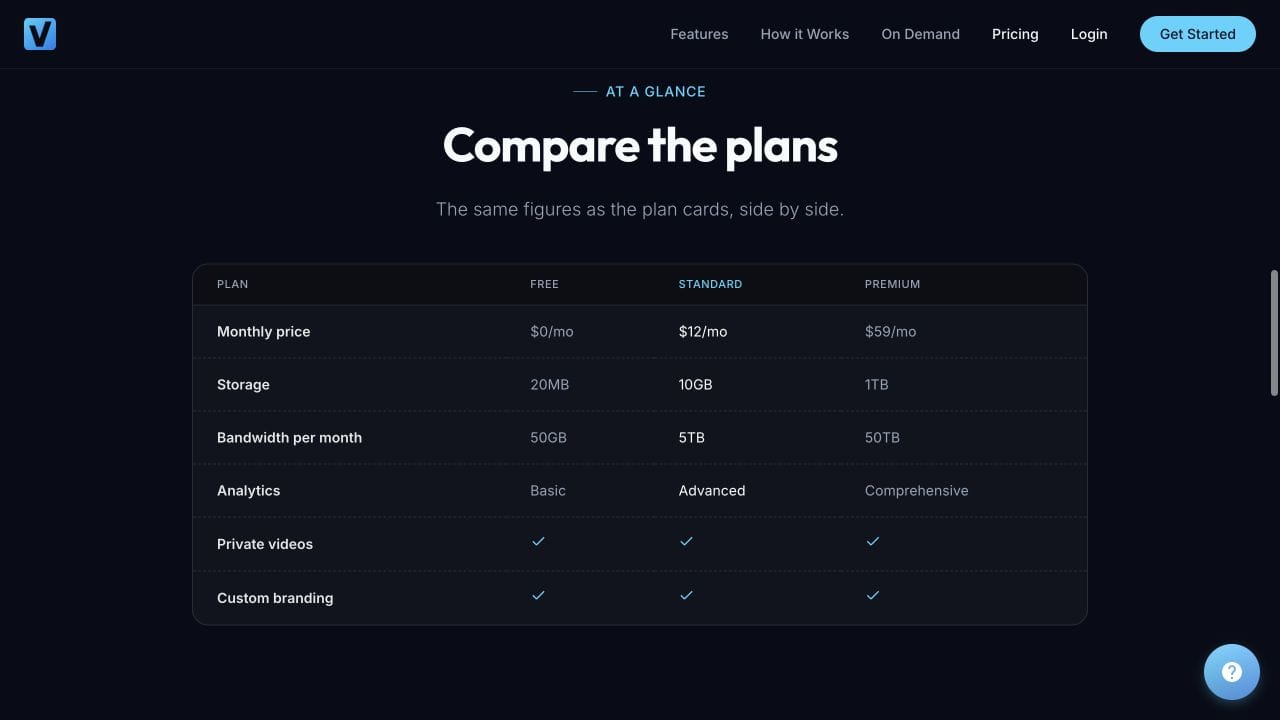
Those are finite allowances. Even a large delivery allowance should not be described as unlimited. Check the current pricing page and clarify what happens if you approach your allowance before planning a large campaign.
For a small video that fits the Free storage allowance, you can start without a monthly hosting charge. For a larger library, compare the paid plan against both your stored files and expected delivery. That gives you a practical starting point without relying on an unlimited promise.
What should you check beyond the allowance?
You still need a player that feels at home on your website. Vidreno's player has a clean layout and supports custom branding, including colour changes. Try it with your own video and page design before deciding whether it suits your site.

The official Cloudflare Developers video below demonstrates a dedicated video hosting workflow. It is useful for seeing the distinction between uploading a video to a video service and simply putting a file behind a website CDN. Use the current written policies above for limits and account terms, rather than treating a tutorial as a pricing promise.
Watch Getting Started with Cloudflare Stream on YouTube if the embedded video does not load.
Questions worth asking before you commit
Here is a message you can adapt:
We need to host this size of video library and expect this much monthly delivery, with a larger launch month. Which allowance applies to each? What counts towards usage, when does it reset, and what happens if we exceed it? Please confirm any extra charges, notification process and conditions that could interrupt playback.
Keep the answer with the plan details. A clear response is more useful than an impressive adjective. If the purchase also involves a long commitment, our guide to evaluating lifetime video hosting deals looks at that separate decision.
Frequently asked questions
Do unlimited video uploads mean unlimited storage?
No. Upload count and stored file size are different measures. A plan can allow many uploads while limiting the total library size or the size of each file.
Do unlimited viewers mean unlimited bandwidth?
Not automatically. The number of people allowed to watch and the amount of data delivered can be governed separately. Read the delivery allowance even when the viewer count has no stated ceiling.
Can a fair use policy affect a legitimate business?
Yes. Legitimate content can still generate usage outside a plan's intended allowance. Explain your workload before committing instead of assuming that acceptable content guarantees unrestricted delivery.
Will a video always stop when I cross the threshold?
No. The response depends on the provider and plan. A review, an extra charge and an immediate restriction are different possibilities. Check the stated process rather than assuming either uninterrupted service or an instant cutoff.
Is unmetered video hosting the same as unrestricted hosting?
Do not assume so. Ask the provider to define unmetered in its own terms. A service can still have acceptable use conditions, technical limits or restrictions on the workloads it supports.
Can free video hosting be enough for a website?
Yes, when the video library and audience fit the included allowances. Compare both storage and delivery, then test whether the player suits your page. Free is a useful place to start, but it is not a promise of unlimited capacity.
You do not need an unlimited headline to get your first video online. Start with an allowance you understand, a player you like and room for the audience you realistically expect.