
Quick answer
Price a film rental around a single viewing occasion, and price a digital purchase around the extra value of returning to the film. Then calculate what you keep after fees and how many sales you need. A $4 rental and a $12 purchase are useful numbers for a worksheet, but they are not a universal recommendation. Your audience, release window and access terms should decide the final prices.
You've finished the film. Now you need to put a number beside it. Copying a major studio's rental price is tempting, but your audience may have a completely different reason to watch. A local documentary, a specialist climbing film and a short drama do not have the same buying context.
This guide helps you build a price you can explain and a sales target you can check. If you're still choosing where to sell after Vimeo On Demand, start with our Vimeo On Demand alternatives comparison. Here, we'll concentrate on the price of your film.
What is the viewer actually buying?
Write down the offer before choosing the number. A rental provides access for a limited period. A purchase provides the continuing access described by the seller and platform. Neither label alone tells a viewer whether they can download a file, watch offline or show the film to a group.
Make these details clear beside the price: when access starts, when it ends, the available language and captions, and what happens after payment. Don't advertise a download or a particular rental duration until you've checked that your chosen service supports it.
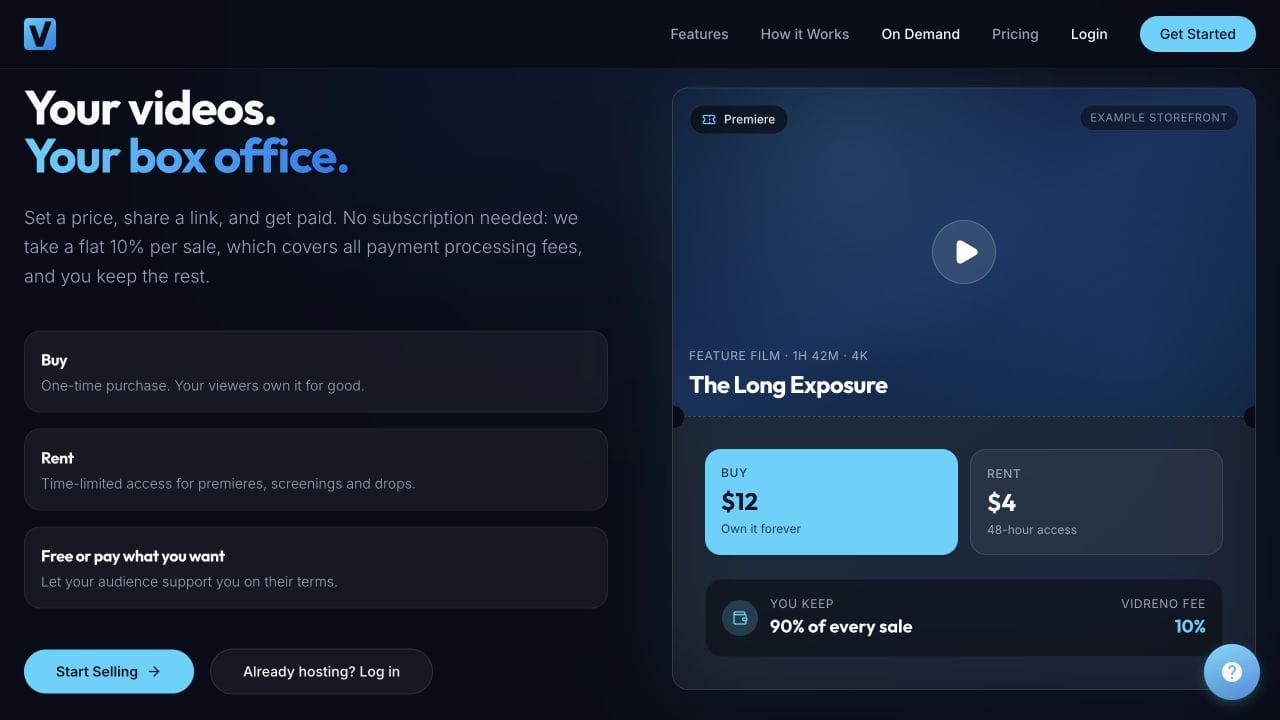
If someone only wants to watch tonight, a rental can make the decision easier. If the film has lasting reference value or an audience who wants to support its creator, a purchase may be attractive. Offering both lets viewers choose, provided the difference is easy to understand.
How do you choose a sensible starting price?
Start with a small comparison sheet of films your audience could realistically choose instead. Compare similar subjects, release stages and viewing terms. A festival premiere with an accompanying event is a different offer from a catalogue film available for an ordinary evening at home.
- Audience: are you reaching existing supporters or people who have never heard of the film?
- Occasion: is this a special release, a community screening or a film people can watch whenever they like?
- Repeat value: is there a reason to return to the film after the first viewing?
- Offer: does the price include anything beyond the film that you can actually deliver?
Use that sheet to choose one starting rental price and one purchase price. You don't need a complicated price ladder. You need a clear offer, a reasonable hypothesis and a way to review the results.
A useful question is: “If I had just discovered this film, would I understand why the purchase costs more?” If the answer depends on a paragraph of vague promises, improve the offer before increasing the price.
What will you keep after the platform fee?
Use the amount left after selling fees when planning your release. The example below uses the fees published on 27 September 2026. All amounts are USD. These are calculations from published rates, not results from a sales experiment.
| Offer | Viewer price | Vidreno On Demand | Vimeo OTT buy and rent |
|---|---|---|---|
| Rental | $4 | $3.60 | $3.10 |
| Rental | $6 | $5.40 | $4.90 |
| Purchase | $12 | $10.80 | $10.30 |
| Purchase | $15 | $13.50 | $13.00 |
Vidreno On Demand publishes a flat 10% per sale including payment processing, with no subscription required. Vimeo OTT's published buy and rent fee is 10% plus $0.50 per transaction, including merchant fees. Its subscription model uses different charges. Enterprise contracts and other currencies can differ.
The calculation for Vidreno is price × 0.90. For the stated Vimeo OTT transaction rate it is price × 0.90 minus $0.50. At the same selling price, that is a $0.50 difference per transaction, or $50 across 100 transactions. This is a comparison of those transaction fees only. It excludes taxes, refunds, production, marketing and any other applicable service costs, so the amounts are not your profit.
Vidreno's simple fee is useful when you're putting a first film on sale without taking on a monthly subscription. Its On Demand service gives films a public purchase or rental page. That is separate from Vidreno Hosting, which delivers embedded videos on your own website or app.
How many rentals equal one purchase?
At the illustrative $4 rental and $12 purchase prices, Vidreno receipts after the 10% fee are $3.60 and $10.80. Three rentals therefore produce the same receipts as one purchase. That does not mean you should push every viewer towards buying. Some people will rent who would never have bought.
Think about the mix. If 100 transactions comprise 80 rentals and 20 purchases, the calculation is 80 × $3.60 plus 20 × $10.80, giving $504 after the platform fee. That is an average of $5.04 per transaction. These are hypothetical transactions, not 100 guaranteed customers or a prediction for your release.
| Sales mix | Average receipt after the 10% fee | Transactions to cover $900 |
|---|---|---|
| All $4 rentals | $3.60 | 250 |
| 80% $4 rentals, 20% $12 purchases | $5.04 | About 179 |
| All $12 purchases | $10.80 | 84 |
For the mixed example, 143 rentals and 36 purchases produce $903.60 after the platform fee. The 80% and 20% split is approximate once you count whole transactions. The purchase example rounds up because 83 purchases would leave you short.
Replace $900 with the costs you're trying to recover. A release budget might include artwork, captions and promotion. If your aim is to recover the entire production budget, include that too. Keep taxes and other deductions in a separate line rather than treating these receipts as money you can spend immediately.
Should you lower the rental price to get more viewers?
Only if the extra transactions make the trade worthwhile for your goal. Reducing a rental from $6 to $4 reduces receipts after a 10% fee from $5.40 to $3.60. You need 50% more rentals to keep the same receipts: 100 rentals at $6 and 150 rentals at $4 each produce $540 after that fee.
That arithmetic gives you a useful test. It does not tell you whether demand will rise by 50%. If you want to try a lower price, record the dates, traffic sources, page visits, transactions and receipts. Changing the trailer, promotion and price at once makes it harder to understand what helped.
A small release may never produce enough data for a firm conclusion. Treat a handful of sales as a clue, not proof of the perfect price. If reaching viewers matters more than receipts for this release, say that in your plan so you're judging the result against the right goal.
When does pay what you want make sense?
It can suit a film whose main purpose is to reach people while giving supporters a way to contribute. It is a less predictable starting point when you need a particular amount from every viewing to recover a fixed cost.
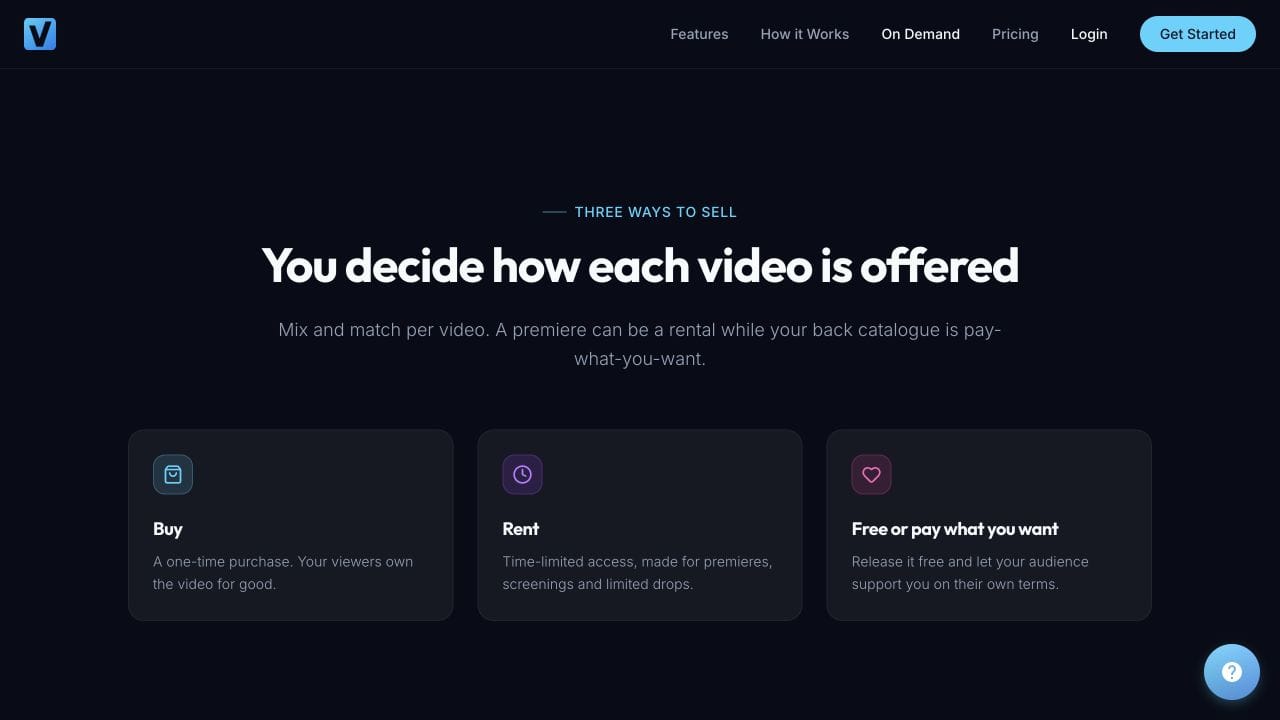
If you choose free access with optional support, keep the invitation straightforward. Explain what support helps you do, without implying that a contribution is compulsory or promising a result you cannot deliver.
What should you check before announcing the price?
Read the page as someone who knows nothing about your film. The trailer, synopsis, artwork and viewing terms all help a person decide whether the offer is worth it. Price cannot do that work on its own.
Film Courage's interview with Josh Folan offers useful background on preparing and marketing a film for direct distribution. It is a wider release planning conversation, not a current pricing benchmark or a Vidreno tutorial.
Watch the Josh Folan interview on YouTube if the embedded player is unavailable.
Before launch, write one sentence explaining the rental and one explaining the purchase. Check the price on a phone, confirm the access terms, and choose a date to review the first results. If you're moving an existing catalogue, use our Vimeo On Demand migration checklist for the separate task of preparing files and links.
Frequently asked questions
Should a short film always cost less than a feature?
Runtime is one consideration, but it is not a pricing formula. Consider the audience, subject and offer. Compare relevant films before assuming that a shorter running time requires a particular discount.
Should the purchase price be three times the rental price?
No fixed ratio works for every film. The three to one ratio here makes the worksheet easy to follow. Choose a gap that reflects the access and value the viewer receives, then review what people actually choose.
Can I charge more for a premiere?
You can consider a different offer for a premiere if you can clearly explain the extra value. Only include an event, discussion or limited availability if it is genuinely part of the release. Do not manufacture urgency with a deadline you will not honour.
Does a digital purchase include public screening rights?
Do not assume it does. Keep an ordinary personal viewing offer separate from any permission to show a film to an audience. State the intended use and direct screening enquiries to the rights holder.
Should I use discounts straight away?
A discount is useful only when you know what you want it to achieve. Work out the receipts at the discounted price first. Avoid launching with a supposedly normal price that viewers have never actually been asked to pay.
What if nobody buys at my first price?
Check whether enough relevant people saw the page and whether the trailer and offer were clear. No sales from a few visits tell you very little about price. Review the route to the page before assuming that a lower number will solve the problem.
Give your film a clear offer
Start with a rental price, a purchase price and a realistic plan for reaching viewers. Work through the receipts, explain the access terms and set a date to review what happened. Vidreno On Demand lets you begin without a subscription, with payment processing included in its flat 10% selling fee.