
For a film people can watch online and support voluntarily, start with Vidreno On Demand. Choose Gumroad when a minimum contribution and a suggested amount matter most, and consider itch.io for a downloadable film or creative bundle. The best pay what you want film platform depends on whether someone can watch for nothing, what they receive, and how much of a small payment reaches you.
That first detail changes the whole release. “Watch free and support the next film” is a different invitation from “Pay at least £3 to watch”. Both can work. Pick the promise before picking the platform.
Does pay what you want mean the film is free?
Sometimes. There are three useful arrangements:
- Free with optional support: viewers can access the film without paying. Contributions help fund your work.
- A minimum price with room to give more: every paying viewer covers a floor you choose, with the option to increase it.
- A suggested contribution: a guide to what you would appreciate. Check whether the platform treats it as a suggestion or a compulsory minimum.
Write the invitation in plain language. For a genuinely free release, try: “Watch the film free. If you enjoyed it, a contribution helps us make the next one.” Only mention the next production if that is actually where you intend the money to go.
Which platform suits your film?
Each route suits a different release. The product facts and fees below were checked on 1 October 2026.
| Platform | Where it fits | Payment model and fees |
|---|---|---|
| Vidreno On Demand | A public film page with online viewing and optional audience support | Free or pay what you want option. Advertised flat 10% per sale, including payment processing, with no On Demand subscription. |
| Gumroad | A film product with a minimum price and suggested contribution | Standard direct sale fee of 10% plus $0.50, with processing extra. Discover sales cost 30% including processing. No monthly platform charge. |
| itch.io | A downloadable film, animation or collection of creative files | Minimum price can be zero. You choose the platform revenue share; payment processing is additional. |
Sources: Vidreno On Demand, Gumroad fees and itch.io payment terms. Gumroad reduces its standard direct percentage to 5% on new direct sales after paid monthly sales reach $20,000; its fixed charge and processing still apply. Account specific rates can differ.
When is Vidreno On Demand the best fit?
If your invitation is “come and watch our film”, Vidreno On Demand is the natural place to begin. Its public film service supports purchases, rentals and free releases with voluntary support. You can choose the release model per video, so a free short and a paid feature do not need the same offer.
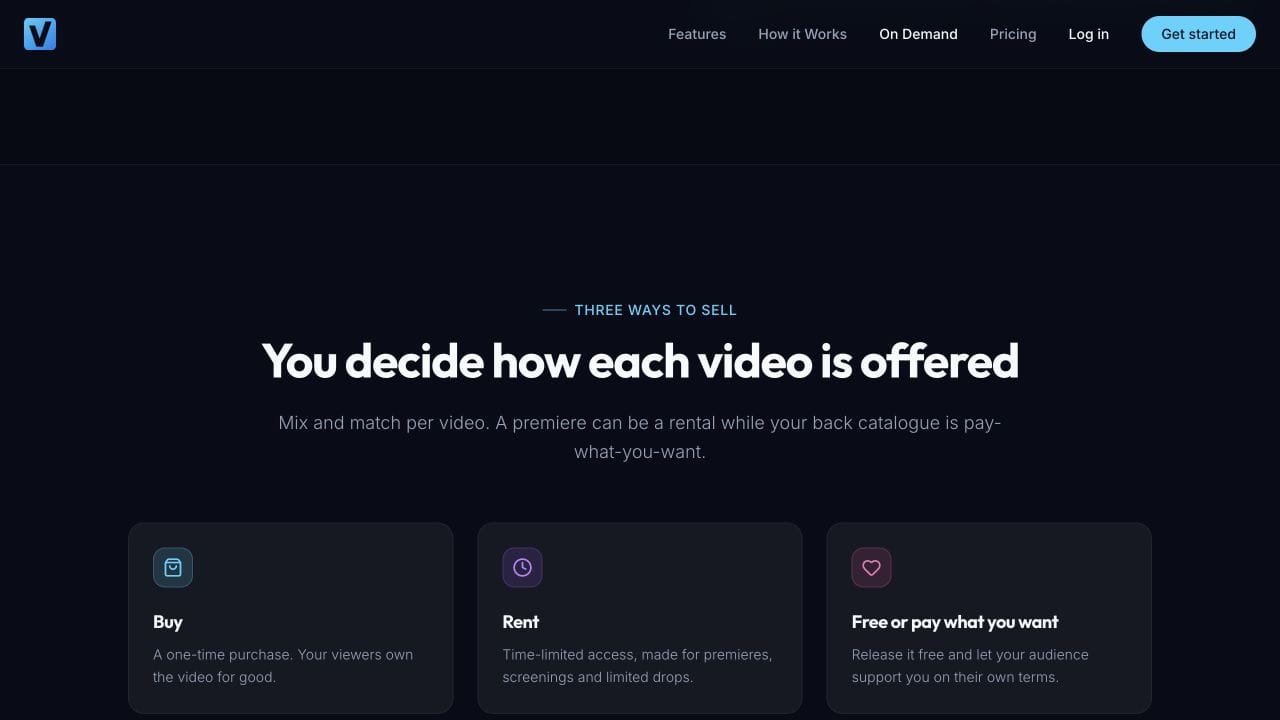
For this guide, the useful part is the free release with optional support. We have not verified a creator controlled minimum contribution or suggested amount field for that mode, so do not choose it on the assumption that those controls are available. If a compulsory minimum is central to your plan, compare that requirement explicitly.
This is Vidreno On Demand, the service for public film purchases and rentals. Vidreno Hosting is the separate service for embedding videos on your own website or app. Also check the storage and delivery treatment for your particular free release before promoting it widely; a transaction fee is not a promise of unlimited free delivery.
When should you consider Gumroad or itch.io?
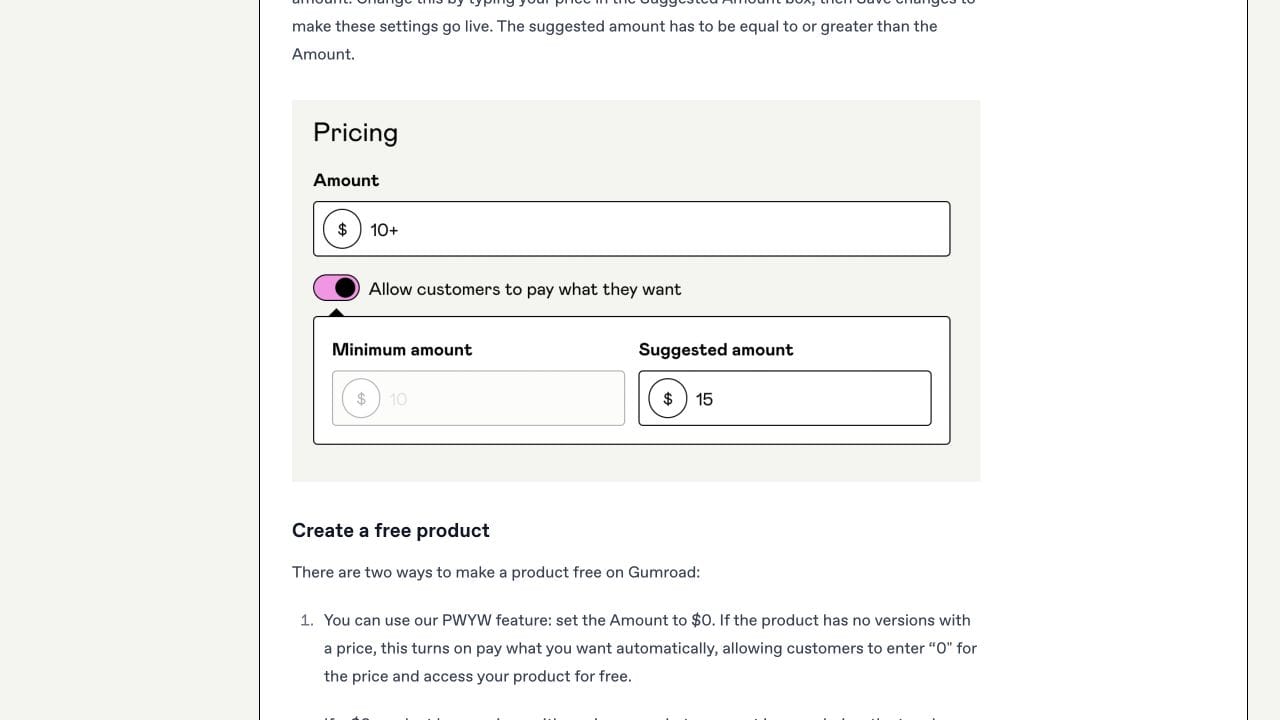
Gumroad is worth considering when you want a defined floor and a suggested contribution above it. Its pricing documentation distinguishes those amounts. A zero minimum permits free access, although someone choosing to pay must contribute at least $0.99 USD.
There is an important film constraint: Gumroad’s file size rules cap a product with a zero minimum at 250 MB across its files. Check your finished export before choosing that route. An attractive contribution form is little help if your intended film package does not fit.
For a downloadable release, itch.io offers a useful alternative. Its pricing options include free downloads with optional payment and paid downloads with a minimum. Its creator FAQ describes hosting project files and notes that individual file limits apply. Check those limits against your export. We would consider it for a film plus a booklet or other files, rather than assume it provides the same viewing experience as a dedicated film service.
Already deciding between the first two? Our Vidreno On Demand and Gumroad comparison covers the wider film selling decision.
What does a minimum contribution look like?
This short walkthrough by Be Wiser Clips shows Gumroad’s pay what you want control and explains the difference between a zero minimum and a paid floor, starting around 0:28. Use it to understand the choice. The current documentation linked above supplies the precise payment and file limits.
Watch the contribution pricing walkthrough on YouTube.
Can voluntary contributions earn enough to matter?
Start with the number of people who contribute, rather than the total who watch. Here is a planning example, not a forecast or a result from a Vidreno customer.
Suppose 1,000 people watch, 50 contribute, and their average payment is $6. That produces $300 in gross contributions. Applying Vidreno’s advertised 10% transaction fee leaves $270 after that fee, before any other relevant adjustments or production costs. The assumed contribution rate is 5%; it is not a benchmark.
Now keep the same 1,000 viewers but assume only 20 people contribute an average of $4. Gross contributions fall to $80, leaving $72 after the same fee. The change in audience response matters far more than a small difference between platform percentages.
Fixed transaction charges matter too. A $0.50 charge alone consumes 25% of a $2 contribution, before any percentage fee. Compare the total deductions at the amounts your audience might actually give. Do not calculate your budget using a generous average payment you have never observed.
If the release needs predictable revenue per paying viewer, a minimum price may be more appropriate. Our film rental and purchase pricing guide can help you compare the alternatives.
How should you choose before announcing the release?
- Choose the access promise. Decide whether someone paying zero gets the full film, a trailer, or nothing.
- Check the delivery format. Confirm online viewing or downloads, subtitles and the file size you need.
- Read the payment screen as a viewer. The minimum, suggestion and free option should mean what your announcement says.
- Budget for modest support. Use a cautious contribution count and calculate fees on small payments.
- Give the film a clear home. Share one destination where people understand what they can watch and how support works.
For an accessible public film release, explore Vidreno On Demand. If you are moving an existing catalogue, our Vimeo On Demand migration guide covers that separate job. For a subscription catalogue instead of voluntary payments, use the Vimeo OTT comparison.
Frequently asked questions
What is the best pay what you want platform for a short film?
Start with Vidreno On Demand for a public film release with optional support. Compare Gumroad if a specific minimum and suggested contribution matter, or itch.io if you want to distribute downloadable files. Check the actual viewer journey before announcing it.
Can I let people watch without paying?
Yes, when the offer permits zero payment. Make that clear in the invitation. A paid minimum with the option to contribute more is a different arrangement, even when a platform describes both as pay what you want.
Should I suggest a contribution?
A suggestion can help someone who wants to support you but has no idea what to give. Keep it clearly optional where access is free, and do not present an arbitrary figure as the usual contribution unless you have evidence.
Is pay what you want better than a fixed film price?
It suits a release where access matters and voluntary support is welcome. A fixed price gives a clearer amount per paid transaction. Neither guarantees an audience or enough revenue to recover your costs.
Do I keep every voluntary contribution?
Check platform and payment fees. Vidreno advertises 10% including processing; other services may combine a percentage with a fixed charge. Very small contributions can lose a larger proportion to fixed fees.
What should I measure after the release?
Track viewers, contributing viewers, average contribution and receipts after fees where your tools provide those figures. Use the same date range for each. Keep free views separate from payments so your next release budget rests on real numbers.