Before the red letters, before Hawkins had an audience, there was a trailer for a programme that did not yet exist.
The Duffer brothers assembled it from other films to communicate the mood of Stranger Things. Under those borrowed images they put Dirge, a track by the Austin band S U R V I V E.
When the series received its green light, they went back to the musicians whose work had helped sell the idea. Kyle Dixon and Michael Stein now had to turn an atmospheric connection into music for characters, scenes and an entire television world.
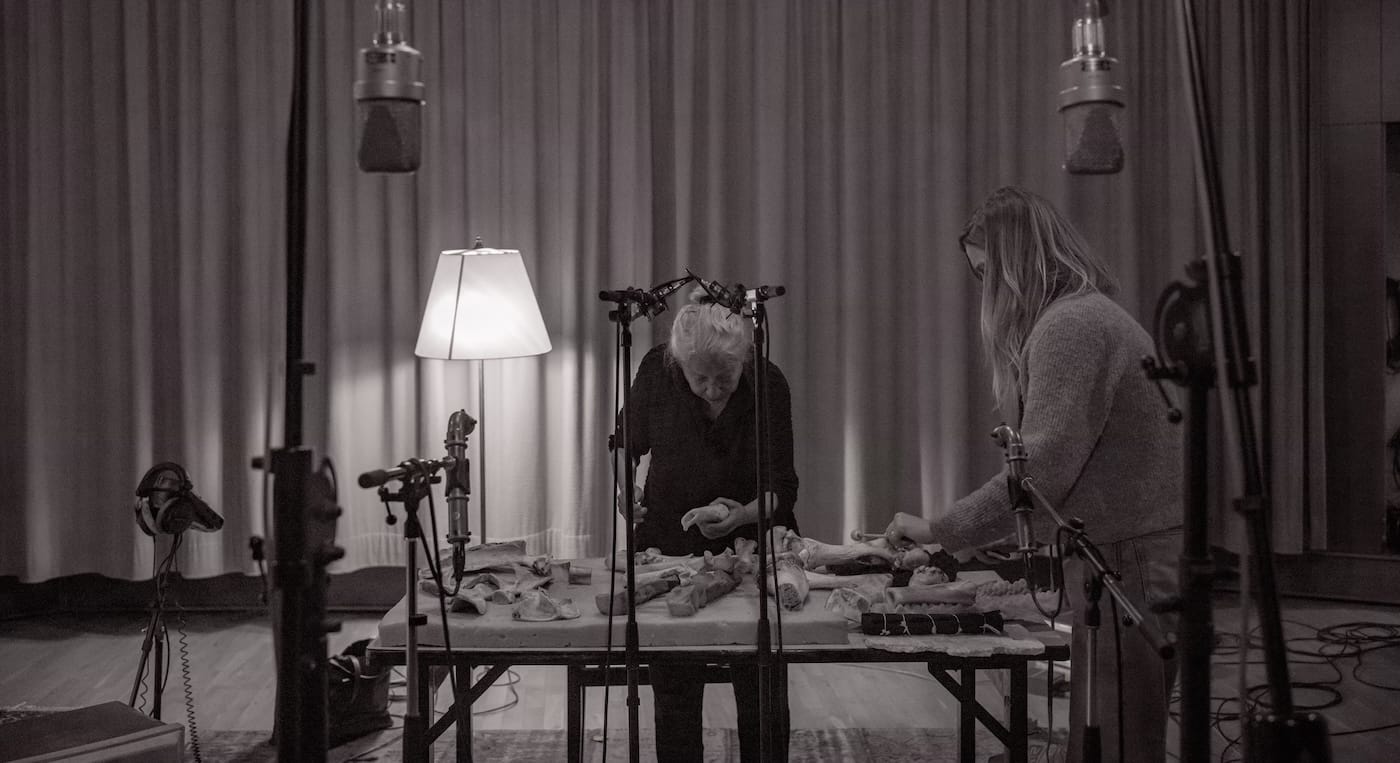
Cover: Kyle Dixon, in the foreground, and Michael Stein in Dixon’s studio. Photograph by Alex Kacha for Sound On Sound.
A band’s sound opened the door
In their Spitfire Audio interview, Dixon and Stein describe how Dirge accompanied the pitch alongside scripts and look books. The connection made sense, but it did not make the job theirs.
They sent a collection of material they had already marked out as cinematic: drones, textures and moods that might never become band songs. Then the requests became more specific.
Could they write for these characters? Could they make the sentimental moments work as well as the darker ones? They remember spending about six weeks pitching before their involvement was secure.
That distinction matters. The sound that attracts a director is a beginning. A score still has to follow people through experiences that the original song was never written to carry.
The title theme was waiting in an old demo
Dirge helped bring the composers into the project. The familiar opening theme came from a different piece.
In Will Betts’s Sound On Sound interview, Stein explains that the Duffers selected a demo he had made for S U R V I V E. He returned to its parts, using an Akai MPC to rearrange them and add material. About three versions brought it close to the finished theme.
That makes the opening a particularly good example of keeping unfinished ideas. The useful thing was not a polished song waiting for release. It was a mood that found the right story.
Listen for what sits underneath
In their Song Exploder breakdown, the composers explain that they rebuilt the demo rather than sampling it. That conversation and their Sound On Sound interview reveal some of the layers underneath the finished theme:
- The recurring arpeggio: an Oberheim SEM Two Voice supplies the main pattern of repeated notes.
- The bass: a Roland SH2 gives the theme its darker weight.
- The heartbeat: a Pro One contributes the underlying thumps.
- A nearly hidden piano sound: a Prophet 5 part adds atmosphere even when it is difficult to pick out.
His point is about the whole sound. Removing a barely noticeable layer can still change how the music feels.

The red letters needed a sound of their own
The music belongs to the title sequence as much as the lettering does. In Art of the Title’s interview, creative director Michelle Dougherty explains how the Duffers brought references including Stephen King book covers and Richard Greenberg’s film titles to the conversation.
At Imaginary Forces, those references became a sequence built around moving fragments of Benguiat lettering. You see glowing edges before the words fully reveal themselves.
Dougherty recalls receiving a rough version of the music early in the process. The composers later reshaped it to the picture. It was a collaboration between rhythm, movement and the gradual arrival of a recognisable title.
The score also began with listening to ordinary things
Long before Stranger Things, Dixon and Stein were recording objects and spaces to find sounds they could use. Their Spitfire conversation includes memories of hitting metal, recording an air conditioner and popping balloons in a corrugated metal tunnel.
The interest was in what happened to the sound. A space could stretch a short impact into something strange. A recording could become the starting point for a musical part.
That habit followed them onto the Stranger Things set.
The broken piano in the Wheelers’ house
During a visit while the first season was being filmed, they found a piano in the Wheeler house set. It was broken and badly out of tune. They played it, noticed its peculiar low notes and made a recording.
As they explain in Score: The Podcast, some of that sound ended up in jump scares. A piece of the fictional family’s house had become part of the programme’s frightening world.
This was a discovery, rather than a sound they had arrived intending to capture. They heard something useful and kept it.
Making electronic music feel performed
The instruments are electronic, but the composers’ account is full of physical actions: playing, listening, adjusting a control and trying another take.
In the Spitfire interview, they describe preferring to walk over and move a filter by hand rather than draw a perfectly smooth automated change. Several passes might produce the one that feels right.
They also discuss keeping a performance with imperfections when a technically tidier version loses something. That is a useful way to hear this music: as decisions made by players, rather than a machine reproducing a preset.

A monster that could be recognised by sound
For the Upside Down, the Duffers wanted a simple musical signature, with Jaws as the reference for recognisability. Stein described deliberately detuning its small sequence of notes to make it unsettling.
That is a different use of repetition from the opening title: an idea can become a warning. Our story of how Jaws was made explores the production behind the film that supplied that reference.
Writing for a scene changed the way they worked
Getting involved early gave Dixon and Stein room to develop themes. It also meant learning what happens when music meets an unfinished edit.
They admit to writing too many cues. In the Spitfire interview, they recall cuts changing as often as three times in a day, with detailed scoring then needing to be done again.
The lesson they draw is practical: use the early stage to explore melodies, moods and a palette of sounds. Precise timing becomes a different task when the picture settles.
- Develop ideas early. A theme can help a team understand a character before the final scene exists.
- Expect the edit to change. Music shaped tightly to one cut may need substantial revision.
- Let the scene determine the structure. A moment on screen may need a short musical thought rather than a complete song.
For Dixon and Stein, these restrictions could also provoke ideas they would never have written for a band record. The story gave their experiments a purpose.
There is a related pleasure in how Interstellar’s organ score was made: hearing composers and musicians discover what an instrument can contribute to a particular film. Here, that discovery could begin with an old demo, a hand on a synthesiser or an unexpectedly useful piano.
A few things listeners often wonder
Was Dirge used as the opening theme?
No. The band’s track helped the Duffers pitch the programme. The title theme developed from a separate demo by Michael Stein.
Is every sound in the score a synthesiser?
No. The composers also discuss acoustic material and manipulated recordings. The prop piano is one clear example of a physical sound source entering the score.
Did the broken piano make the opening theme?
Their podcast account places the prop piano in jump scares. Stein separately describes a synthesised piano part within the title theme. Those are different elements.
Was the score made like a S U R V I V E album?
The work shared musicians and an interest in sound, but the demands differed. Television asked them to support characters, respond to edits and write for moments that did not follow a song’s structure.
If you are bringing a film of your own to an audience, our film landing page checklist covers how to present the finished work clearly and help viewers decide to watch.