A film about the creation of Facebook could have spent its time explaining a website. The Social Network is more interested in the people sitting across a table from one another, and the distance opening up between them.
David Fincher and screenwriter Aaron Sorkin made that tension through choices you can hear and see: the speed of a line, the darkness of a room, a face assembled in postproduction and music pressing against a conversation.
With Sony listing Sorkin’s The Social Reckoning for an October 9 cinema release, it is a good moment to return to how the 2010 film was actually built.
A screenplay written alongside the book
In his Vanity Fair career interview, Sorkin recalls hearing about a book proposal and the lawsuits around Facebook. Producer Scott Rudin held the proposal’s rights. Instead of waiting for Ben Mezrich to finish The Accidental Billionaires, Sorkin wrote his screenplay while the book was being written.
Sorkin might also have directed. The script went to Fincher first, and Sorkin remembers an email accepting it arriving just three hours later.
The opening scene teaches you how to watch
Fincher told Time Out that Sorkin’s screenplay ran to 166 pages. He timed the writer reading the opening nine pages with a stopwatch. Page count alone could not tell him how long this language would take on screen.
Dialogue begins over the studio logo. Before the audience has settled, the film is already asking them to follow an argument. Fincher wanted that first scene to establish the attention the rest of the film would demand.
What 99 takes gave the actors
Jesse Eisenberg told Campus Circle that the opening scene took 99 takes. He asked for a hundredth; Fincher declined.
The number sounds punishing in isolation. The actors’ account is more interesting. Justin Timberlake described early takes on a digital production as almost a rehearsal period, with room to keep searching. Eisenberg valued having time to work.
That changes the question from “Why so many?” to “What is still changing?” A pause, an interruption or the weight on one word can alter who appears to be winning the exchange.
Making Harvard feel enclosed and California feel different
Cinematographer Jeff Cronenweth described the preparation in British Cinematographer: discussions about character went alongside visits to locations in Massachusetts, California, Maryland and England.
Harvard did not provide access for the production, so much of the college world was created around Cambridge. The intended feeling mattered as much as a recognisable building.
- The college rooms: muted colours and shallow focus help make the characters’ world feel enclosed.
- The California parties: a different visual atmosphere marks the change in surroundings.
- The deposition rooms: brighter, more clinical spaces interrupt the remembered events.
Cronenweth and Fincher worked through blocking before the director watched from the monitors. The photography had to accommodate performances while making these different social spaces legible.
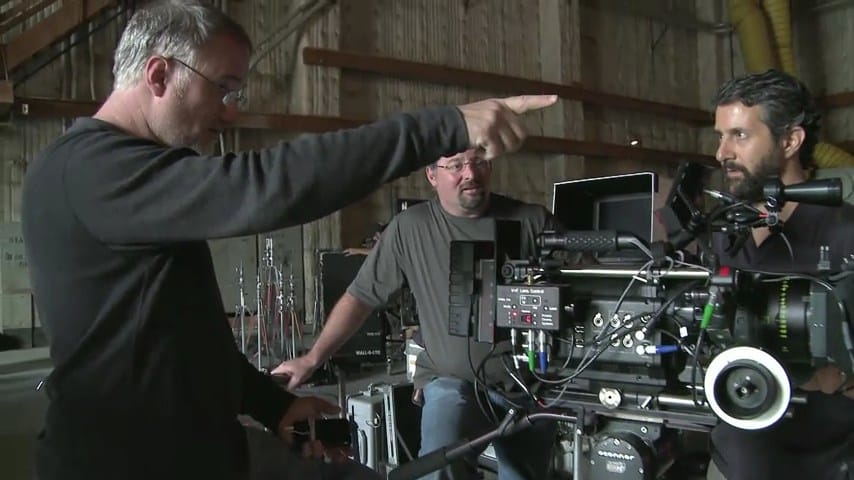
Opening photograph: Fincher and the crew on set, via ShotOnWhat.
The twins needed two performances and invisible effects
The Winklevoss scenes were not simply one actor appearing twice. Josh Pence performed alongside Armie Hammer, giving the scenes another physical presence for Hammer to react to.
In AWN’s interviews with the effects team, Lola describes filming Pence with facial tracking markers. After Fincher selected the material, Hammer supplied matching facial performances. Those images were projected onto a scanned head model and composited into the shot.
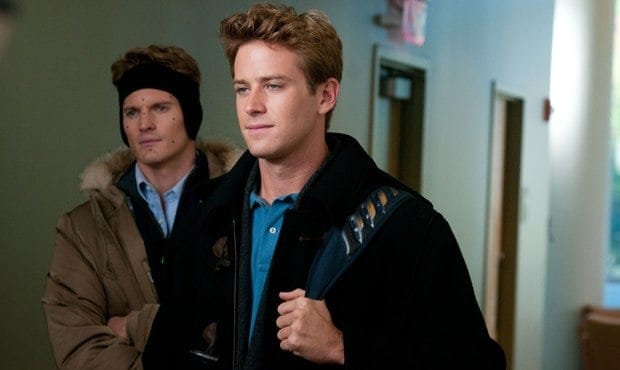
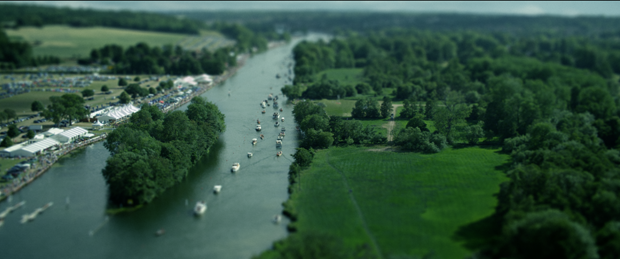
The rowing sequence needed a different intervention. Effects studio a52 separated elements of the Henley images and manipulated focus to create the distinctive miniature appearance.
The sound makes a business meeting feel overwhelming
The SoundWorks Collection featurette explains how location recordings helped distinguish Boston, Stanford and the technology offices of Silicon Valley. Sound gives the film places to move between, even when the picture is dominated by people talking.
The club meeting posed a particularly revealing problem. The audience needed to understand the conversation while feeling the force of the music around Mark. Fincher kept pushing for a louder environment.
The featurette also describes receiving separate elements of Trent Reznor and Atticus Ross’s score. That gave the mixers room to position and balance the music against dialogue and effects.
For another example of music shaping a screen world, our Stranger Things score story follows the development of its theme and unsettling electronic sound.
Editing the argument, then sending it into cinemas
Editors Angus Wall and Kirk Baxter described the work in MovieMaker. Fincher’s detailed involvement began early, rather than arriving only when an assembly was ready for approval.
Their challenge was to extract meaning from gestures and syllables. With dialogue this dense, cutting quickly is only part of the job. The more important decision is which reaction the audience gets to see, and precisely when.
The film reached US cinemas on 1 October 2010. At the 2011 Academy Awards, it won for Sorkin’s adapted screenplay, Wall and Baxter’s editing, and Reznor and Ross’s original score.
Those awards recognise three different departments. Watching the film, their work is difficult to separate: a sentence accelerates, a cut redirects attention, and the music leaves an emotion hanging after the exchange ends.
Our Jaws production story follows another film whose writing, shooting and finishing became inseparable. The practical problems differ, but both stories reward looking beyond the director’s name.
Questions about the production
Was The Social Network filmed at Harvard?
The production did not have access to film at Harvard. It built much of the college setting using locations around Cambridge, Massachusetts.
How were the Winklevoss twins filmed?
Hammer and Pence performed together, with facial replacement and other compositing techniques helping create the finished twins. The physical performance on set remained part of the work.
Who wrote the music?
Trent Reznor and Atticus Ross composed the Oscar winning original score.
Is the film a documentary about Facebook?
No. Fincher described working with the character in Sorkin’s screenplay. The film is a dramatisation, and its scenes should not be treated as an independently verified record of every real conversation.
If you are making a film of your own, you can create a free Vidreno account to explore the platform.