Before Jeannie Epper could become Wonder Woman, she had to learn how Lynda Carter ran.
That was the problem she set herself when another chance at the job came along. A matching costume would only take her so far. The audience needed to believe that the woman leaving a car was still Diana Prince.
It is a revealing detail in a career remembered for falls, fights and frightening heights. Epper’s work depended on watching another performer closely enough to continue her character through the action.
A childhood among horses and stunt performers
Born in Glendale, California, on 27 January 1941, Epper grew up in a family where film work and horsemanship were intertwined. Her father, John, had come from Switzerland and become a Hollywood stunt performer.
In her Television Academy Foundation interview, she describes how he taught the children to ride: bareback first, then a flat saddle. A Western saddle came later, once they had proved themselves.
She remembers him knowing each child’s strengths. Helping him work with horses gave them practical experience that could become useful on a set, especially when an animal was difficult to handle.
The Taurus World Stunt Awards biography places her first camera stunt at nine. A spell at boarding school in Switzerland interrupted that childhood before she returned to the United States and the profession around her.
The work was not simply inherited. She had to become someone a production could rely on, across movements and situations far removed from the horse yard.
The Big Valley gave her a place to grow
Doubling Linda Evans on The Big Valley was an important early chapter. Epper also worked as Barbara Stanwyck’s double, building experience on a Western series where riding and physical action were part of the job.
Her 2014 interview with Amy Harrington follows that work into a larger discussion of women’s place in the stunt business. Performers were proving themselves in an industry that still used men to double actresses.
Evans and Carter mattered in that change. Epper remembered female stars supporting women who could do the work. Being accepted by the person whose character she shared was part of finding a lasting place on set.
The breakthrough: becoming Carter’s Wonder Woman
Wonder Woman became Epper’s defining job, but she did not get it at the first attempt. In the interview below, she recalls being passed over because another performer looked more like Carter.
When a further opportunity appeared, she studied Carter’s running style. Her test involved getting out of a car and moving behind a tree, where Diana would make her transformation.
The running mattered because it joined the stunt performer to the actor. Epper had found a way to make the change between them less visible.
She became the main double for jumping and fighting, while specialists handled other work. Epper specifically credits Debbie Evans with the motorcycles. One character could depend on several people’s skills.
The partnership also had a warmer side. Epper remembers Carter arranging a class visit when her son’s schoolmates refused to believe his mother doubled Wonder Woman. The children watched her put on the costume and perform.
Film work made the career much bigger than one costume
Television kept bringing her into different characters’ lives:
- She doubled Lindsay Wagner on The Bionic Woman.
- On Charlie’s Angels, she doubled Kate Jackson.
- Dynasty brought her back to Linda Evans, this time for the confrontations around Krystle Carrington.
Film work stretched from Blade Runner to doubling Nancy Allen in RoboCop. The recognisable star changed; Epper’s contribution remained part of the performance.
Mike Barnes’s account for The Hollywood Reporter also traces her long association with productions directed or produced by Steven Spielberg, including Close Encounters of the Third Kind, 1941, Poltergeist and Minority Report.
These credits place her across television drama, comedy, science fiction and action. A stunt performer could help create an image that audiences remembered without becoming the name they remembered with it.
Romancing the Stone: what the mudslide felt like
In Romancing the Stone (1984), Epper doubled Kathleen Turner. The famous mudslide looks like a wild rush through the landscape. Her own recollection is about the repeated effort behind it.
Speaking with Stunt Tales, she remembers working on the sequence for two and a half weeks. It was filmed in sections, with a cargo net used to stop her. She says the strain almost dislocated her shoulder.
The detail changes the scene. What plays as one tumbling escape was work that had to be broken apart, repeated and brought to a stop before the next section could begin.
Asked about a favourite, she turns instead to Terms of Endearment (1983): driving the Corvette into a spin and sending the passenger’s double out into the water. In her telling, that one was fun.
Helping the next woman find her way
Epper helped found the Stuntwomen’s Association of Motion Pictures in 1968 and later served as its president. Collective support sat alongside the individual skill needed to win a job.
Amanda Micheli’s documentary Double Dare brings that part of her life into view. It follows Epper and Zoë Bell at different points in their careers, with uncertainty about work running through both stories.
The trailer contains a striking contrast. Epper talks about giving something back, then is heard leaving a message asking for work herself. Experience and generosity had not removed the need to keep looking for the next call.
For Bell, newly looking towards Hollywood after Xena, Epper became a mentor. The relationship joins two generations through practical help rather than a ceremonial passing of the torch.
Our Zoë Bell career story follows the next chapter, from that transition to Kill Bill, Death Proof and stunt coordination.
Recognition, later roles and a lasting partnership
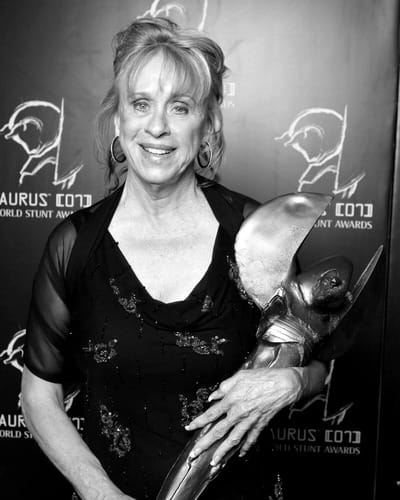
In 2007, Epper became the first woman to receive the Taurus lifetime achievement honour. It recognised a career that had already crossed generations, but did not mark the end of her screen work.
Her IMDb filmography records later stunt credits on Flight (2012) and Hot Pursuit (2015), as well as acting. She played Ms Espinoza in Quarantine (2008) and Aunt Sallie in The Rookie in 2019.
Those roles make another part of her career visible: sometimes she continued somebody else’s performance, and sometimes the person on screen was a character of her own.
Epper died on 5 May 2024, aged 83. In Carter’s tribute the following day, the actress remembered a relationship built on respect and collaboration, and the path Epper had opened for other stuntwomen.
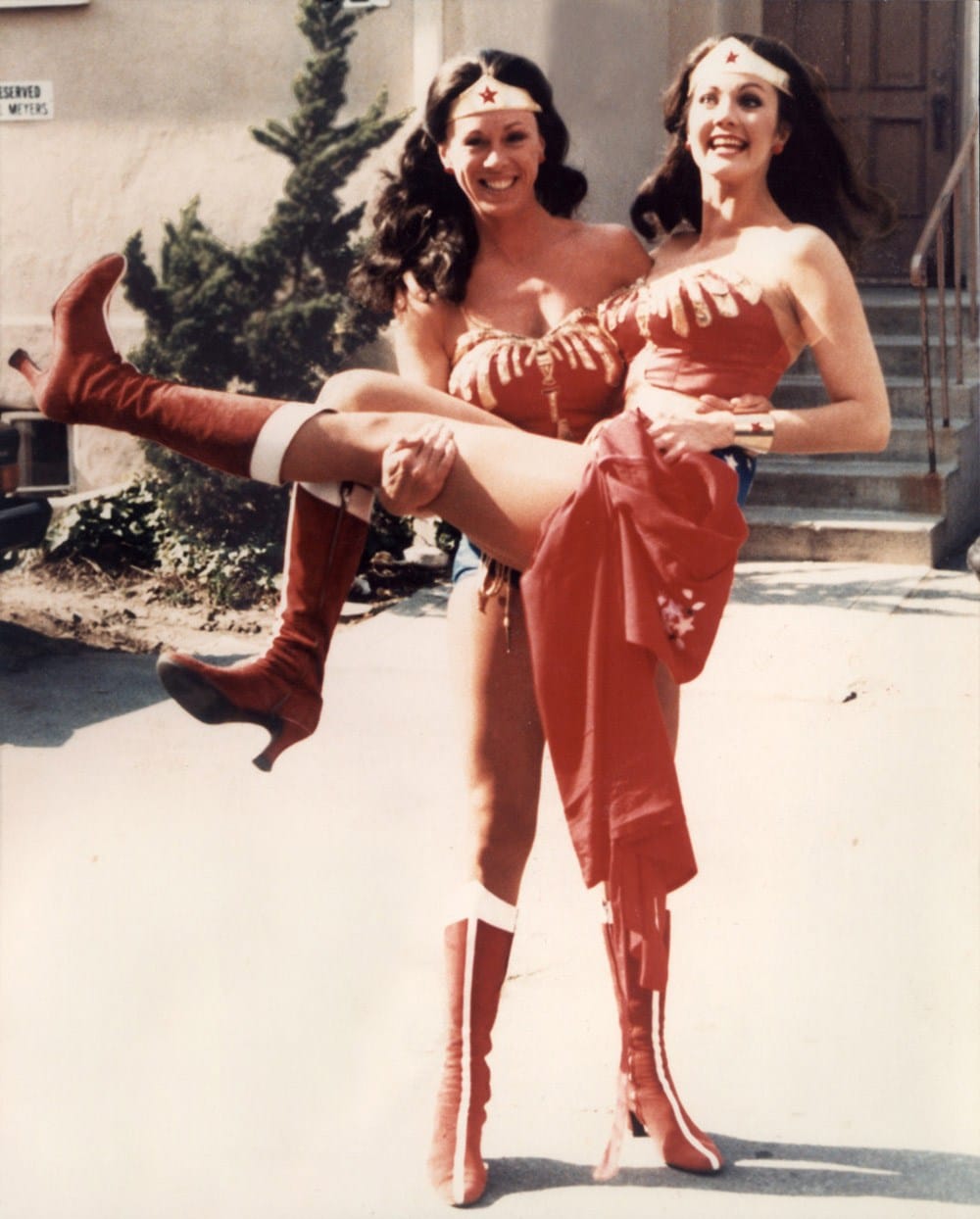
The photograph of them together makes that partnership tangible. Two women in the same costume, each bringing something essential to the character audiences saw.
A few useful details
Was Jeannie Epper the only Wonder Woman double?
No. She was Carter’s main double, particularly for jumping and fighting. Debbie Evans handled motorcycle work, and other performers also contributed.
What was her big break?
Wonder Woman became her signature role after years of stunt work, including The Big Valley. Her career had already begun before she put on the superhero costume.
Did she perform the Romancing the Stone mudslide?
Yes. She doubled Kathleen Turner. Her Stunt Tales interview describes filming the sequence in sections and the physical strain of stopping herself.
Where can you explore her story further?
Start with the Television Academy Foundation’s full interview, her IMDb credits and Micheli’s Double Dare. Together they show the work, the working life and the relationships behind it.
Making a home for your own screen work? Explore Vidreno with a free account.